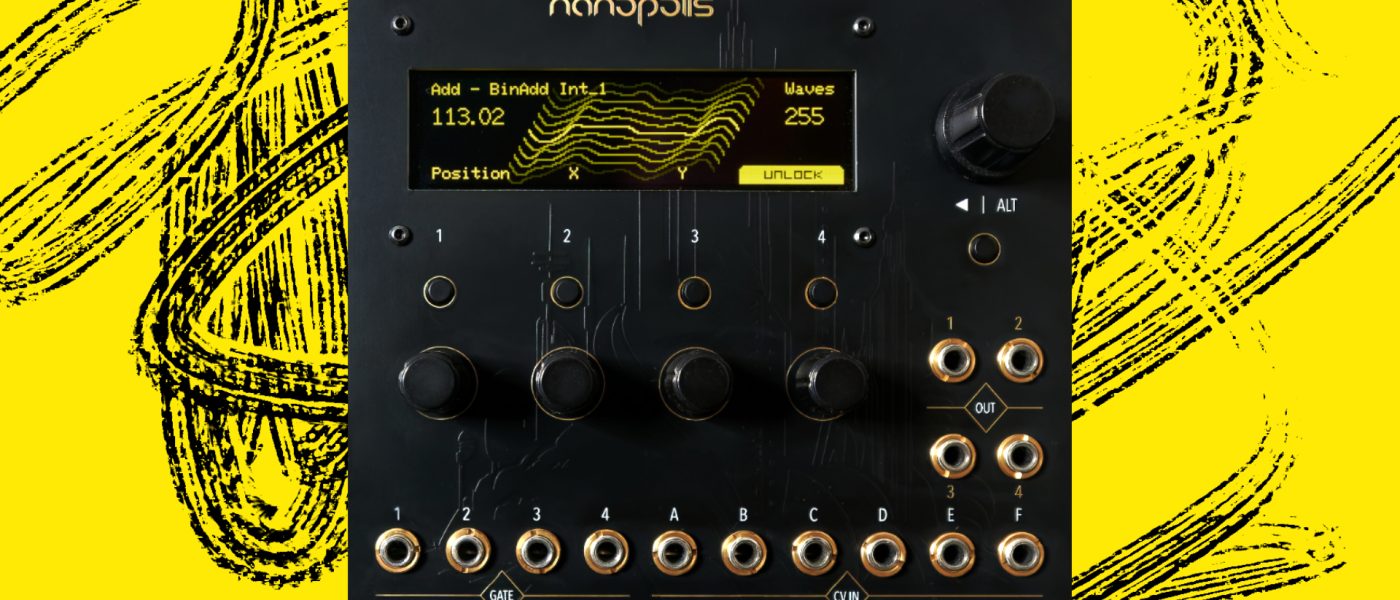
TL;DR: Nanopolis is preparing a monumental firmware 2.0 for its Antigone Eurorack synth voice, set to debut at SynthFest France 2026. The update promises to transform the 4-voice multi-timbral module with new granular and resonator engines, a revamped FM and wavetable system, and dedicated drum synthesis. In the meantime, a substantial firmware 1.1.5 is available now, delivering enhanced wavetable modifiers and smarter voice management.
- Firmware 2.0 (2026) is a complete overhaul, adding granular synthesis, physical modeling resonators, and dedicated drum synth machines.
- Firmware 1.1.5 (Available Now) brings new wavetable transform modes, a pitchable sub-oscillator, and intelligent MIDI voice allocation.
- The core Antigone module remains a 4-voice, multi-timbral digital powerhouse with wavetable, FM, and sampler engines.
- The module is sold directly by the French developer upon request, priced at 649€, with a 99€ expander.
- This evolution signals a shift from a capable synth voice to a potential all-in-one digital sound design hub for Eurorack.
Reading time: 5 min
Want more synth news before your next coffee break? Join the Noxal newsletter — no spam, just gear worth knowing about.

The Antigone: A Refresher

Before we dive into the future, let’s ground ourselves in the present. The Nanopolis Antigone is, at its core, a rather ambitious first act from a young French developer. It’s a 4-voice, multi-timbral digital synth voice crammed into a Eurorack module. That means you can have four completely different sounds—each with its own synthesis engine, modulation, and effects—playing simultaneously from a single 26HP skiff resident. The original feature set was already comprehensive: a wavetable engine, a virtual-analog oscillator, FM synthesis, and a sample player. It was positioned as a one-stop shop for complex, polyphonic textures in a modular environment, eliminating the need to patch together four separate VCOs, filters, and envelopes.
The module has been available on a direct-request basis from Nanopolis for a while now, priced at 649€ (with a 99€ expander for additional I/O). It’s not a mass-market, store-shelf item; it feels more like a boutique instrument for those who seek out specific capabilities. For the past three years, since its debut at SynthFest France 2023, its development has been a slow, steady burn rather than a flash-in-the-pan release. This approach—releasing a solid foundation and then building a skyscraper on top of it via firmware—is becoming a hallmark of thoughtful digital design, and Nanopolis appears to be committing to it wholeheartedly.
Firmware 2.0: The Beast Awakens
Now, let’s talk about the main event: Antigone 2.0. Slated for a first look at SynthFest France 2026 (yes, you read that year correctly—this is a forward-looking announcement), this isn’t a simple patch. The developer’s own words say it all: “the same instrument but a different beast.” This is a ground-up reimagining that expands the module’s identity from “versatile synth voice” to “modular sound design laboratory.” The headline features are the new granular synthesis and resonator engines. Granular synthesis within a dedicated Eurorack voice is a game-changer for ambient and textural composers, while polyphonic physical modeling via resonators opens doors to mallet, string, and bell-like tones that are notoriously difficult to achieve in analog.
But the upgrades don’t stop in the textural realm. The existing wavetable engine gets a “smoother, cleaner” overhaul with real-time spectral transformations, and the FM engine is being “reimagined” and pushed “way further” than its chip-inspired origins. Perhaps most practically, dedicated drum synth machines are being added—kicks, snares, hi-hats, FM percussion, noises, and glitches. This directly addresses a previous limitation where drums relied solely on the sample engine, effectively turning the Antigone into a potential central brain for a full, percussive Eurorack track. Coupled with a new arpeggiator, chord mode, and rhythm generators, Firmware 2.0 aims to make the Antigone a complete idea-generation hub.
Firmware 1.1.5: The Bridge Update
While we wait with bated breath for 2026, Nanopolis hasn’t left current users in the lurch. Firmware 1.1.5 is available now, and it’s a substantial update in its own right. This is the “bridge” that shows the developer’s ongoing commitment and teases the direction of 2.0. The most tangible addition is a suite of new waveform modifiers for the wavetable engine—modes with evocative names like Fractal, Gravity, Tidal, Magnetic, Crystal, and Quantum. These aren’t just new wavetables; they’re transformation algorithms that can mutate a waveform in complex, animated ways, making the existing engine “significantly more complex and interesting.”
On the functional side, a new sub-oscillator mode provides a fully pitchable second oscillator that can use the main oscillator’s wavetable, enabling rich, layered tones. Under the hood, smarter MIDI voice allocation now prioritizes stealing voices with the lowest output volume, leading to smoother, less jarring polyphony management—a small but crucial detail for playing chords. CPU optimizations across the board ensure all these new features run efficiently. This update proves Nanopolis is actively refining the core experience, making the wait for 2.0 a period of valuable improvement rather than a stagnant hold.
Context and Conclusions
So, what does this all mean in the broader Eurorack landscape? The Antigone’s journey reflects a maturation in digital modules. It’s no longer enough to ship a product with a fixed featureset. The expectation, especially for a complex digital voice, is a long-term roadmap. Nanopolis is betting that users will invest in a platform. The promise of a free update that adds granular synthesis and drum machines two years down the line is a powerful value proposition. It transforms the module from a purchase into a partnership with the developer.
Who is this for? The Antigone, especially with its coming 2.0 update, is for the modular musician who wants maximum sonic versatility and compositional power in a minimal footprint. It’s for the artist who loves the immediacy of hardware but craves the evolving depth of a software instrument. It’s not for the purist seeking purely analog signal paths, but for the synthesist who views the Eurorack case as a computer worth programming. If the 2.0 update delivers on its promises, the Antigone could become a modern classic: a single module capable of being an entire digital studio rack, waiting for your filters and modulation to give it character. We at Noxal will be watching SynthFest 2026 very, very closely.
Frequently Asked Questions
When will Antigone Firmware 2.0 be released?
It is currently scheduled to be showcased for the first time at SynthFest France 2026. A public release date for existing users has not yet been announced, but it will likely follow the show demonstration.
Is the Nanopolis Antigone module easy to buy?
It is not sold through typical retail channels. You must contact the French developer, Nanopolis, directly to request purchase. The base module is 649€, and an expander module is available for 99€.
What’s the difference between Firmware 1.1.5 and the future 2.0?
Firmware 1.1.5 is a significant feature update to the original Antigone system, adding new wavetable transforms and utility features. Firmware 2.0 is described as a complete overhaul that will introduce entirely new synthesis engines like granular and physical modeling, as well as dedicated drum synthesis, fundamentally expanding the module’s capabilities.
I’m going to need a stronger espresso to ponder all the granular possibilities waiting until 2026. In the meantime, I suppose I’ll just have to content myself with the fractal transformations in 1.1.5.