
TL;DR: PPG is resurrecting the legendary Modular 300, a rare 1975 high-end analog system, as a faithful modern recreation. It will be hand-built, feature discrete circuitry based on the original schematics, and be configurable as a full set or custom build. Expect a price tag north of $10,000, making it an exclusive collector’s piece and sound designer’s dream.
- The PPG Modular 300 is a new, hand-built recreation of Wolfgang Palm’s ultra-rare 1975 analog modular system.
- It promises the original’s sonic character: transparent analog sound, ultra-fast envelopes, and exceptional oscillator tracking.
- The system will be offered in full sets or custom configurations, with black faceplates and discrete circuitry.
- Pricing is not finalized but will be “a bit more expensive” than the $9,790 PPG 1002 Mk2 synthesizer.
- This follows a trend of high-end PPG reissues, including the 1002 and W2.2×4 Eurorack module.
Reading time: 4 min
Want more synth news before your next coffee break? Join the Noxal newsletter — no spam, just gear worth knowing about.

The Ghost of Hamburg Past
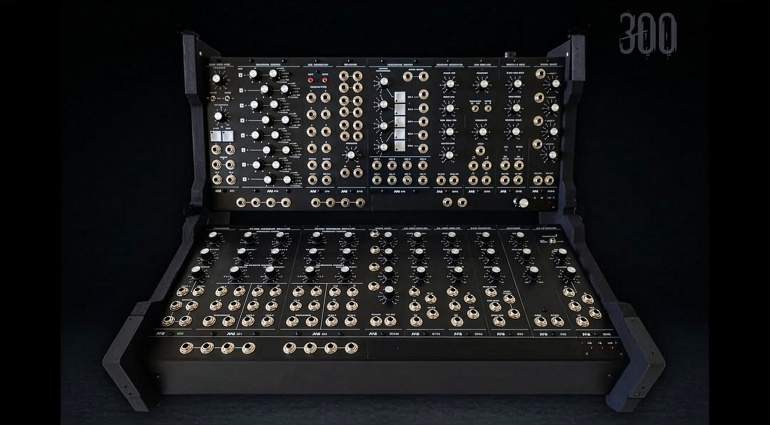
It seems you can’t swing a patch cable these days without hitting a new piece of gear bearing the hallowed PPG logo. Hot on the heels of news about an unofficial PPG Wave rackmount unit, the official custodians of the brand have announced something far more foundational, and far more analog: the resurrection of the PPG Modular 300. This isn’t just another synth; it’s a direct lineage back to Wolfgang Palm’s very first commercial product, conceived in Hamburg in 1975. In an era dominated by the looming shadow of the Minimoog, Palm took a different path, creating a high-end, Moog-format modular system that embodied what the announcement calls “German engineering precision meeting uncompromising analog power.”
The original Modular 300 was, by all accounts, a commercial flop. It was expensive, complex, and arrived as the market was shifting towards pre-patched, portable instruments. But its failure to sell in volume is precisely what makes this announcement so intriguing. It became one of the rarest and most exclusive systems ever made, a secret weapon for the German electronic music elite. Its notable users read like a who’s who of kosmische pioneers: Tangerine Dream and the prolific Klaus Schulze, who famously paired it with two PPG sequencers and his gargantuan Moog Modular. This isn’t a reissue of a common workhorse; it’s the exhumation of a mythical, almost forgotten titan.
Modern Recreation, Analog Philosophy
The team behind the recent, breathtakingly expensive PPG 1002 and the clever W2.2×4 Eurorack module is undertaking this new project. Their approach appears to be one of reverence, not mere replication. They are promising a “faithful recreation” of the system’s sonic character and physical format, but with a modernized approach to module layout. The original 300 often combined functions—like dual envelopes or amplifiers—into single modules to maximize utility within a case. The new version will break these out into individual modules, offering greater patching flexibility and a clearer, more immediate interface for the modern modularist.
Physically, it will retain the classic, imposing Moog format—a deliberate choice that connects it to the modular tradition of the 1970s. The faceplates will be black, a sleek update, but the magic is promised to be underneath. PPG states the new modules will be built using discrete circuitry that meticulously follows the 1975 schematics, with high-end components selected specifically for thermal stability and long-term reliability. This isn’t a chip-based homage; it’s a hand-built, discrete reincarnation meant to last another 50 years.
Specs, Sound, and Schultze-Approved Sonics
So, what are you supposedly buying, beyond history and heft? PPG’s announcement makes some specific sonic promises that are catnip for analog purists. The original system was renowned for its “high-end and transparent” analog sound, a description that suggests clarity and detail over sheer brute force. They are touting “ultra-fast envelopes,” a critical spec for percussive and precise articulation, and oscillators with “exceptional tracking across multiple octaves,” which speaks to tuning stability and musicality.
Perhaps most enticing is the mention of “discrete VCA and filter stages that react vibrantly to control voltages.” This is the heart of the analog modular experience: the nonlinear, lively interaction between modules that never behaves *quite* the same way twice. This is what turned a collection of circuits into an instrument for Schulze and Tangerine Dream. If the recreation captures even 90% of this “vibrant” reactivity, it will be a profoundly compelling instrument for sound design, regardless of its vintage pedigree.
The Price of Admission and The Pattern
Let’s address the elephant in the studio. There is no official price yet. The system is currently at 90% prototype stage, with show appearances planned at SynthFest France and other events. However, Dr. Walker of PPG has offered a crucial benchmark: it will be “a bit more expensive” than the PPG 1002 Mk2. For those who haven’t memorized that particular price tag, it sits at a cool $9,790. So, we are firmly in five-figure territory for a full system. It will be sold as a complete set or in custom configurations, but make no mistake, this is a luxury item, an investment piece, and a statement.
This launch continues a very clear pattern from the modern PPG entity. They are not chasing the voluminous, budget-conscious market of Behringer or even some Korg reissues. They are strategically resurrecting the most exclusive, historically significant, and technically ambitious instruments from Palm’s catalog—the 1002, the W2 digital waves in Eurorack, and now the foundational Modular 300. They are building a new niche: the ultra-high-end, historically-authentic reissue. For collectors and studios with deep pockets, it’s a dream. For the rest of us, it’s a fascinating spectacle of analog archaeology, best observed with a strong cup of coffee in hand to soothe the sticker shock.
Frequently Asked Questions
How much will the PPG Modular 300 cost?
An official price has not been announced. However, Dr. Walker of PPG has stated it will be “a bit more expensive” than the PPG 1002 Mk2 synthesizer, which retails for $9,790. Expect the full Modular 300 system to comfortably exceed $10,000. Custom configurations may vary in price.
Is this a true analog replica or a digital emulation?
PPG is marketing this as a true analog recreation. They specifically mention using discrete circuitry based on the original 1975 schematics and selecting high-end components for stability. This suggests it is a fully analog, hand-built system, not a digital model or emulation.
When will the PPG Modular 300 be available?
The system is currently in the prototype phase (reportedly 90% complete). It will be shown at trade shows like SynthFest France first. A firm release date for public sales has not been provided, suggesting it is still several months away, at minimum.
I’ll be admiring the Modular 300 from a respectful, financially responsible distance, likely while patching a far more affordable oscillator and wondering if my coffee tastes sufficiently “high-end and transparent.”