
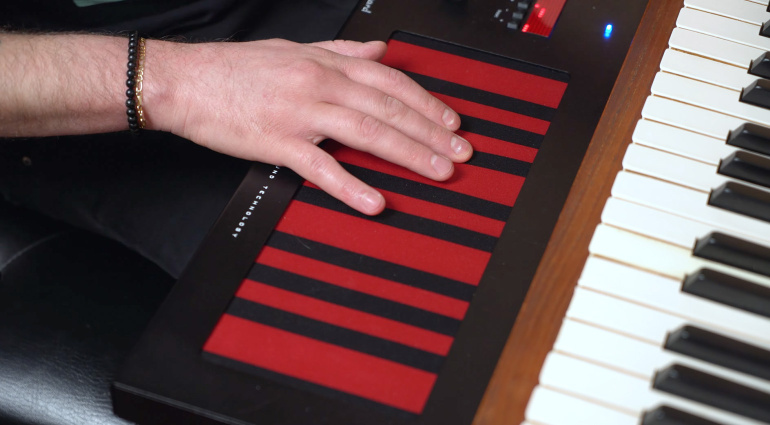
TL;DR: Haken Audio has introduced the Slim21 Continuum, a compact, two-octave version of its revered MPE+ controller. Priced at $1799, it’s the most affordable entry point yet into the Continuum ecosystem, packing the full EaganMatrix synth engine and highly expressive touch surface into a portable 1.6 kg frame.
- The Slim21 is a 21-half-step (nearly two-octave) MPE+ controller with pitch, pressure, and front-to-back position sensing for each finger.
- It includes the complete EaganMatrix digital synthesizer engine, the same sound module found in the Expressive E Osmose.
- With dimensions of 45 x 19 x 3 cm and a weight of just 1.6 kg, it’s designed for portability and desktop use.
- Priced at $1799, it significantly undercuts its larger siblings, the Slim46 and Slim70 models.
- Purchase includes the Haken Editor software for deep sound design and supports custom Overlays for different control layouts.
Reading time: 4 min
Want more synth news before your next coffee break? Join the Noxal newsletter — no spam, just gear worth knowing about.
The Gateway Continuum

Let’s be frank: for most of us, a Haken Audio Continuum Fingerboard has lived squarely in the realm of fantasy gear. We’ve watched videos of masters like Jordan Rudess or Richard Devine conjure sounds from the ether with fluid, otherworldly gestures, all while quietly weeping into our coffee mugs at the price of admission. Haken’s instruments have always been the pinnacle of expressive control, but their cost placed them firmly in the “if I win the lottery” category. That calculus shifts today with the announcement of the Slim21 Continuum.
Slotting in as the little sibling to the Slim46 and flagship Slim70, the Slim21 represents a strategic and welcome democratization. By offering a focused, nearly two-octave version of their unique playing surface and—critically—including the full EaganMatrix synth engine, Haken isn’t just making a smaller controller. They’re building a gateway drug. At $1799, it’s still a significant investment, but it’s no longer a purely theoretical one. It’s a price point that moves the Continuum from “impossible dream” to “serious savings goal” for a vast swath of synthesists and composers hungry for next-level expression.
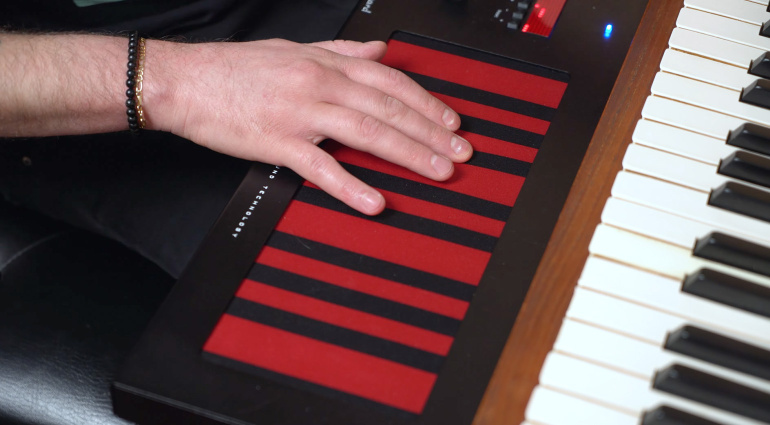
The physical form factor is a huge part of the appeal. At 45 cm wide and weighing a mere 1.6 kg, the Slim21 is arguably the most portable professional MPE controller on the market. This isn’t a centerpiece that demands its own stand; this is a device you can toss in a backpack, place on a desk next to your laptop, or integrate seamlessly into a crowded studio setup. Haken’s demo video, showing it perched neatly on a piano, perfectly illustrates its new role as an expressive companion instrument rather than a monolithic replacement for your entire rig.
MPE+, and Then Some
If you’re new to the Continuum, the term “MPE+” requires unpacking. Standard MPE (MIDI Polyphonic Expression) gave us per-note pitch bend, pressure, and timbral control—a revolution that controllers like the ROLI Seaboard and LinnStrument brought to the masses. Haken’s “MPE+” is that, but dialed to eleven and then given a custom firmware update. The silicone playing surface isn’t divided into discrete keys; it’s a continuous, seamless plane. Each finger contact is tracked independently for vertical position (pitch), pressure (downward force), and horizontal position (front-to-back movement, often assigned to timbre or filter).
This three-dimensional vector for every single finger is what creates the Continuum’s legendary, vocal-like phrasing. Glissandos are perfectly smooth, vibrato is controlled by a subtle rocking motion, and aftertouch is an intrinsic, polyphonic dimension of playing rather than a separate channel message. The Slim21 brings this entire paradigm to a 21-half-step range. While that may sound limited for two-handed piano repertoire, it’s more than enough for melodic leads, bass lines, and atmospheric textures—the parts where expressiveness matters most.
The build follows the established Slim series design: a sleek, low-profile aluminum chassis with that distinctive grey playing surface. The reduction in size hasn’t come at the cost of sensor resolution or responsiveness. Haken’s forty years of experience in this hyper-niche is evident; they’re not cutting corners on the core technology, just offering it in a more digestible, affordable portion.
The Engine Within
Here’s where the Slim21’s value proposition gets seriously compelling: it’s not just a controller. Nestled inside is the complete EaganMatrix sound engine. For the uninitiated, the EaganMatrix is a wildly powerful digital synthesizer created by Dr. Lippold Haken (the company’s founder). It’s a modular environment that combines subtractive synthesis, frequency modulation, physical modeling via modal filter banks, and more into a deeply programmable and uniquely responsive system.
You likely know this engine from its other high-profile host: the Expressive E Osmose. The fact that the Slim21 includes this $1000+ synth module as a built-in feature fundamentally changes its identity. You’re buying a complete, standalone expressive instrument. Plug it into speakers via its 1/4″ outputs, and you’re ready to play. This inclusion bridges the gap for those who want the Continuum experience but don’t yet have a robust MPE-compatible synth setup. The EaganMatrix is famously designed to exploit every nuance the Continuum surface provides, meaning you get a perfectly optimized, turnkey system.
Of course, it’s also a superb controller for your external gear. The included Haken Editor software unlocks deep programming of the EaganMatrix from your computer, and the ecosystem of custom Overlays—pre-mapped control templates for popular DAWs and soft synths—continues to grow. Whether you use it as a sound source, a controller, or both, the integration is seamless and professional-grade.
Who Is This For, Anyway?
The Slim21 Continuum is a targeted strike. It’s for the composer or producer who has felt constrained by traditional keyboards and yearns for more fluid, organic control over virtual instruments and soft synths. It’s for the touring musician who needs profound expressiveness in a portable, reliable package. It’s for the sound designer for whom a knob-per-function interface is a bottleneck, not a solution.
Perhaps most importantly, it’s for the curious musician who has been captivated by the promise of the Continuum but was locked out by the price and scale of the larger models. The Slim21 is an invitation. It asks for a significant but not unreasonable commitment in return for access to a fundamentally different way of interacting with sound. You will have to learn a new technique; this is not a plug-and-play keyboard. But the reward is a level of connection with your synth that feels more like guiding a living sound than triggering a sample.
In a market filling with competent MPE controllers, the Slim21 stands apart by being a holistic instrument. It combines a best-in-class control surface with a best-in-class, purpose-built synthesizer engine. Haken Audio isn’t just selling a smaller slab of silicone; they’re offering a curated path into high-end expressivity. For $1799, that path has never been clearer, or more tempting.
Frequently Asked Questions
Can the Slim21 Continuum control other synths?
Absolutely. While it includes the fantastic EaganMatrix synth internally, it functions as a full-featured MPE+ controller over USB MIDI. You can use it to play any MPE-compatible software synth (like Pigments, Serum, or Falcon) or hardware synth that supports MPE, sending per-note pitch, pressure, and timbral data.
How does the EaganMatrix in the Slim21 compare to the one in the Osmose?
It’s the same core sound engine. You get the same synthesis power, the same programming depth via the Haken Editor software, and the same incredible responsiveness to expressive input. The primary difference is the physical interface—the Continuum’s continuous surface versus the Osmose’s semi-weighted keys—which will inherently lead to different playing techniques and sonic results.
Is the playing surface difficult to learn?
It requires practice, like any new instrument. If you’re coming from a piano keyboard, there’s a learning curve to navigating a continuous pitch surface without fixed reference points. However, Haken instruments often have optional overlay guides that can be placed on the surface, and the muscle memory for expressive gestures develops surprisingly quickly. Think of it less as a keyboard and more as a new instrument category altogether.
Now, if you’ll excuse me, I need to audit my studio’s “dream gear” savings fund. This might require switching to a cheaper bean roast for a few months, but for a taste of the Continuum, it could be worth the sacrifice.