
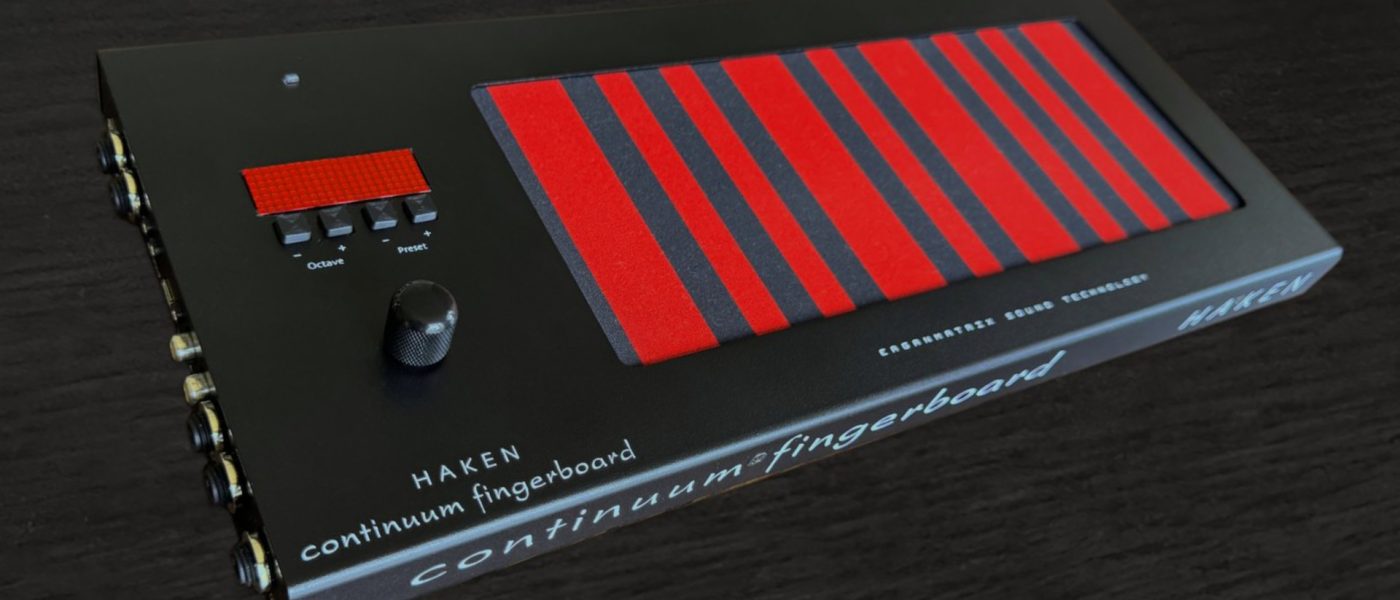
TL;DR: Haken Audio has unveiled the Slim 21, a more affordable and compact version of its flagship Continuum expressive controller. It packs the same neoprene playing surface and powerful EaganMatrix synth engine into a 21-half-step (under two-octave) body. This is the most portable and accessible entry point yet into the high-end Continuum ecosystem.
- The Slim 21 is a full-featured, portable Continuum with a 21-half-step (under 2-octave) playing surface.
- It retains the core technology: the unique neoprene surface with per-finger tracking and the onboard EaganMatrix sound engine.
- Dimensions are 45 x 19 x 3 cm (17.7″ x 7.5″ x 1.2″) and it weighs just 1.6 kg (3.5 lbs).
- It is positioned as the most affordable model in the Continuum lineup, priced at $1799.
- The announcement was made ahead of its showcase at SynthFest France 2026 in Nantes.
Reading time: 4 min
Want more synth news before your next coffee break? Join the Noxal newsletter — no spam, just gear worth knowing about.

The Slim Proposition

In a market increasingly saturated with MPE controllers—from the ROLI Seaboard to the Expressive E Osmose—standing out requires either a gimmick or genuine, groundbreaking technology. Haken Audio has always fallen squarely into the latter camp. The original Continuum Fingerboard wasn’t just another controller; it was a paradigm shift, a neoprene-covered slab of sorcery that felt alien and profoundly musical in equal measure. Its barriers? Size, weight, and a price tag that demanded serious commitment. Enter the Slim 21.
Haken’s new offering is a strategic distillation. They’ve taken the Continuum’s soul—its patented playing surface and formidable EaganMatrix synth engine—and housed it in a body measuring a svelte 45 x 19 x 3 cm and weighing a mere 1.6 kg. With 21 half-steps (just shy of two octaves), it’s a focused instrument. This isn’t a cut-down version in terms of capability; it’s a concentrated one. The goal is clear: portability and accessibility. At $1799, it remains a significant investment, but it’s a notably lower threshold for entry into a world that was previously the domain of well-funded studios and the most dedicated virtuosos.
The timing, ahead of SynthFest France 2026, is apt. Trade shows are for hands-on demos, and the Slim 21’s portability is its killer feature for the traveling musician or the composer who wants this unique expressivity on a desk without it dominating the entire workspace. It answers a question many have asked: “What if the Continuum, but for the rest of us?”
The Engine Within
Let’s be clear: a Haken product without the EaganMatrix would be like a espresso machine without pressure. The Slim 21 is not just a controller; it’s a complete synthesizer. The EaganMatrix engine onboard is the same powerhouse found in its larger siblings and even in the Expressive E Osmose. This isn’t a simple virtual analog oscillator core. We’re talking about a modular-style environment capable of additive synthesis, physical modeling, phase distortion, and more, all manipulable in real-time by the playing surface.
This integration is the secret sauce. The Slim 21 isn’t sending generic MIDI CC data to an external plugin and hoping for the best. The EaganMatrix is designed from the ground up to respond to the hyper-detailed, multi-dimensional data the Continuum surface generates. Parameters like Spectral Tilt, Formant Motion, and complex modulation indices become direct extensions of your finger pressure and glide. The dedicated Haken Editor for Mac and Windows unlocks this fully, allowing you to build sounds that are as intricate and responsive as your playing technique.
For the skeptic who views this as “just a fancy MIDI controller,” the onboard synth engine is the retort. It guarantees that out of the box, you have an instrument of staggering depth. You can, of course, use it to control your favorite MPE-compatible soft synths, but to ignore the built-in brain is to miss half the point. It’s a synth that demands to be played, not programmed and forgotten.
The Magic Is in the Surface
We can talk specs all day, but the Continuum experience is tactile. That signature neoprene surface isn’t a marketing choice; it’s an engineering one. It provides just enough resistance and give to feel organic, unlike the hard, slippery silicone of some competitors. Underneath this layer lies the technical marvel: an array of up to 12 independent hall-effect sensors per finger track.
The process is worth dwelling on. As you press and move a finger, these sensors generate analog data, which is then digitized by ultra-high-speed A/D converters. Haken claims a typical note uses data from “hundreds of thousands of Hall-Effect samples.” This granularity is what enables the Continuum’s legendary sensitivity. It’s not just measuring pressure (Z-axis) and left/right pitch glide (X-axis); it’s capturing the minute shifts in the angle and footprint of your fingertip, allowing for independent articulation of every single note you’re holding down.
The result is a fluidity that even excellent MPE controllers can struggle to match. Glissandos aren’t stepped; they are liquid. Vibrato isn’t a LFO toggle; it’s the natural wobble of your finger. The Slim 21 brings this entire, uncompromised playing experience to the table. They haven’t reduced sensor density or tracking resolution to hit the price and size point. The magic touch remains fully intact, just on a more manageable canvas.
Who Is This For?
The Slim 21 is a compelling proposition for a few key archetypes. First, the traveling performer or composer. Throwing a 1.6 kg slab into a backpack alongside a laptop is a feasible reality now, unlocking the Continuum’s expressivity for live shows or writing sessions away from the studio altar. Second, it’s for the sonic explorer who has been intrigued by the Continuum legend but was physically or financially barred from the full-size models. This is your on-ramp.
Third, and perhaps most interestingly, it’s for the synthesist who already has a room full of gear but craves a new, deeply physical relationship with sound. In a world of menus, encoders, and presets, the Slim 21 demands engagement. It rewards practice and nuance. It won’t replace your polysynth or your modular, but it will sit beside them as a profoundly different instrument for melody, lead, and textural work.
Of course, the two-octave range is a limitation for certain types of playing. This isn’t the instrument for performing dense, wide-voiced classical pieces. It’s a lead instrument, a soloist’s vehicle, and a sublime sound design tool. For that purpose, its focused range is almost a benefit, forcing a compositional clarity. Haken hasn’t made a compromise; they’ve made a choice. The Slim 21 is the essence of Continuum, distilled and bottled for a broader audience. Whether that audience is ready for its particular brand of intensity remains to be seen, but the invitation is now officially open.
Frequently Asked Questions
Can the Slim 21 be used as a standard MIDI controller for other synths?
Absolutely. While its integrated EaganMatrix engine is a major feature, the Slim 21 outputs full MPE (MIDI Polyphonic Expression) data over USB. This means it can control any MPE-compatible software synth (like Pigments, Serum with MPE enabled, or various offerings from U-He and others) or hardware that supports the standard, allowing you to apply its unique playing technique to a vast palette of sounds.
How does the Slim 21 differ from the Expressive E Osmose?
They share the same EaganMatrix synth engine, but the playing interface is fundamentally different. The Osmose uses a patented keybed with polyphonic aftertouch and vertical key movement (bounce). The Slim 21 uses the Continuum’s signature continuous, neoprene surface with no discrete keys. The playing technique—gliding fingers versus pressing keys—leads to a different tactile experience and musical result, even with the same sound engine. The Osmose is more familiar to keyboardists; the Slim 21 is its own unique discipline.
Is the build quality compromised for portability?
Based on Haken’s track record and the stated specs, there’s no indication of a build quality compromise. The reduction in size and weight comes from the smaller playing surface and a presumably more compact internal layout, not from cheaper materials. It’s built to be transported, suggesting a robust construction. The hall-effect sensor technology and core electronics are identical to the larger Continuums, which are known for their durability.
I’ll need a particularly strong espresso to steady my hands before even thinking about touching that neoprene surface. Some instruments demand respect, and a caffeine tremor is not the kind of expression Haken had in mind.