TL;DR: Fred’s Lab has unveiled the Angler, a compact desktop monophonic analog synthesizer and stereo FX processor. It features custom-designed VCOs, a unique filter, a built-in step sequencer, and a stereo analog delay with external audio input. It will be available in limited, hand-built batches, with a special discount for SynthFest France 2026.
- Custom analog core with two linear relaxation VCOs and a self-oscillating, saturating 2-pole lowpass VCF.
- Built-in stereo PT2399 analog delay with chorus/flanger modes and a key external stereo audio input.
- Includes a 96-step, clockable sequencer and full MIDI CC control, plus a USB-A MIDI host port.
- Designed as a hands-on, beginner-friendly instrument with a retro aesthetic and no screen.
- Will be sold in limited, hand-assembled quantities in both semi-kit and fully assembled versions.
Reading time: 4 min
Want more synth news before your next coffee break? Join the Noxal newsletter — no spam, just gear worth knowing about.

The Analog Heart of a French Maverick

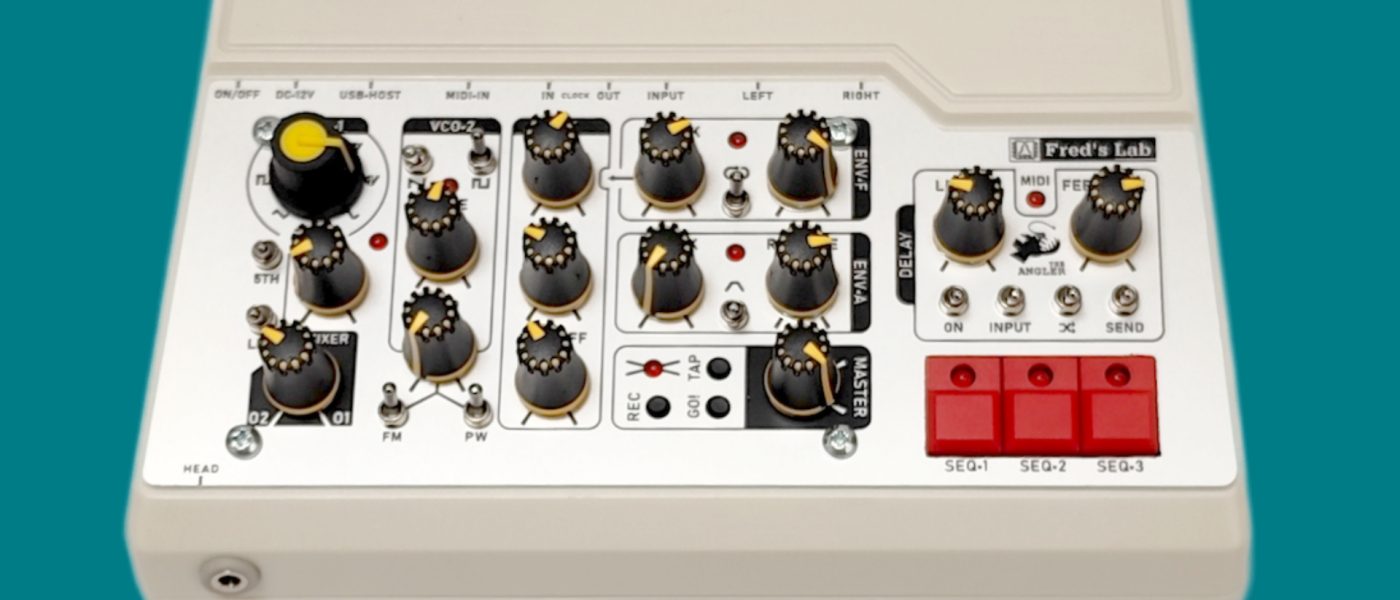
As SynthFest France 2026 kicks off, the booth of Frédéric Meslin—the mind behind the delightfully eclectic Fred’s Lab—holds a new offering. It’s not the keyboard version of the spectral Manatee some might have hoped for. Instead, for the company’s 10th anniversary, we get the Angler: a compact, cream-colored desktop synth that looks like it teleported from a 1970s engineering lab, complete with satisfying red clicky buttons. This is a deliberate, screen-free zone, a hands-on analog instrument that feels like a direct counterpoint to menu-diving.
At its core are two custom-designed analog linear relaxation VCOs. VCO 1 is the star, offering a selection of waveforms including sine, triangle, pulse with PWM, and a curious “custom CD4026” wave—a hint of digital grit in an analog circuit. It also features switches for a sub-octave (5th) and an LFO mode. VCO 2 sits beside it with two waveforms and a tuning control. Their interaction is classic yet thoughtfully implemented: you get linear FM and PWM from VCO 1 to VCO 2 via switches, with a dedicated knob to control the modulation depth. After a simple mixer, the signal hits the filter.
And what a filter it is. The Angler uses Fred’s Lab’s own FL A847, a 2-pole lowpass VCF found in their ZeKit and Töörö synths. This isn’t just a tone-shaper; it’s a character piece. It self-oscillates and, crucially, adds saturation. This suggests a filter designed not for pristine cleanliness, but for adding harmonic weight and a bit of desirable grit—a signature move that should give the Angler its distinct voice right out of the gate.
Modulation, Sequencing, and Stereo Sauce
The modulation section is straightforward but clever. Two analog envelopes offer AD or ASR modes, and the first envelope features a loop function, effectively turning it into a secondary modulation source or a simple LFO. The VCA also utilizes the FL A847 chip, promising a cohesive, slightly colored signal path from oscillator to output. It’s a simple architecture, but one with clear, immediate controls.
Where the Angler starts to get really interesting is in its additional features. First, there’s a built-in, clockable step sequencer capable of up to 96 steps, with quick pattern recall using those delightful red buttons. This isn’t an afterthought; it’s an integrated composition tool that makes the Angler a potent little groovebox. Second, and perhaps most notably, is the stereo effects section. Fred’s Lab has built in a PT2399-based analog delay, a chip beloved for its lo-fi, bucket-brigade-esque charm. It offers mono delay, stereo delay, chorus, and flanger modes, controlled by knobs for delay length and feedback.
The real kicker is the external stereo audio input. You can route an external signal—a drum machine, another synth, a guitar—into the Angler to be processed by that lush stereo delay. The source text notes the external signal likely bypasses the filter (a stereo filter would require a duplicate circuit), which is a slight shame, but having a dedicated stereo analog effects processor with multiple modes in a box that also contains a unique analog synth is a tremendous value-add. It transforms the Angler from a mere monosynth into a potential studio hub for final-stage seasoning.
Connectivity and Control Philosophy
The Angler’s back panel reveals a thoughtful approach to integration in the modern studio. Alongside the obligatory 12V power input, you find stereo 1/4″ audio in and outs, a headphone jack, and 3.5mm MIDI In/Out (Type A & B) with separate clock I/O jacks that transmit start/stop signals. The standout feature here is the USB-A port, configured as a MIDI host. This means you can plug in a class-compliant USB MIDI controller directly—no computer or host box required—making it incredibly easy to play or sequence from a wide range of devices.
Furthermore, the Angler is fully MIDI controllable via CC messages. Parameters like both VCO pitches, VCO 1’s waveform and pulse width, envelope times and modes, and even the delay line length and modulation can be automated from your DAW or hardware sequencer. This level of control is impressive for a compact, ostensibly beginner-friendly instrument. It respects the hands-on ethos while not walling itself off from a larger setup. It’s a synth that can live on a desk for quick inspiration or be neatly patched into a complex modular or DAW-based environment.
This blend of immediate tactile control and deep electronic integration is a hallmark of Fred’s Lab’s design philosophy. They build instruments that feel alive in your hands but speak the language of the modern studio fluently. The Angler seems to be a distillation of that idea into a more accessible, focused package.
Who Is The Angler For?
Fred’s Lab explicitly mentions the Angler is “more beginner-oriented.” The straightforward panel, lack of a screen, and integrated sequencer and effects support that claim. It’s an all-in-one analog voice that you can understand quickly and make complete tracks with. For someone starting their hardware journey, it’s a compelling package that teaches synthesis fundamentals without feeling limiting.
However, to dismiss it as merely a beginner synth would be a mistake. The custom VCOs, that characterful, saturating filter, and the high-quality stereo FX processor with external input make it a serious tool for seasoned sound designers and performers. The limited, hand-assembled nature of the production runs (in both semi-kit and fully assembled forms) and the unique circuit design will appeal to collectors and players looking for an instrument with distinct personality, not just another clone.
Pricing and exact availability are still “TBA,” but the announcement comes with a 15% discount code (SFF2026) for the duration of SynthFest France 2026. This suggests a direct-to-customer model, typical of smaller boutique operations. In a market saturated with reissues and homages, the Angler stands out by being resolutely itself: a compact, French, analog oddity with a big heart, a clever sequencer, and a fantastic stereo delay. It’s not trying to be a minimoog or a 303. It’s trying to be an Angler, and that might just be its greatest strength.
Frequently Asked Questions
Can the Angler’s filter process external audio?
Based on the available information, it appears the external stereo audio input routes directly to the mix and the stereo delay processor, bypassing the analog filter. This is likely a practical decision, as implementing a true stereo analog filter would require a duplicate circuit, increasing cost and complexity.
What does “semi-kit” version mean?
A “semi-kit” typically means the unit comes partially assembled, requiring the buyer to complete some portion of the build, such as soldering components or assembling the final casing. This is a popular option for DIY enthusiasts and often comes at a lower price point than the fully assembled version. Fred’s Lab has experience with this model, offering a path for both builders and players.
Is the Angler polyphonic or paraphonic?
The Angler is described as a monophonic analog synthesizer. This means it generates one note at a time. The two VCOs can be tuned to different intervals, but they are mixed before the single filter and amplifier path, defining it as a classic monosynth architecture, not a paraphonic one (where multiple oscillators have independent pitch but share a filter).
Now, if you’ll excuse me, I need to see if my French press can handle the pressure of waiting for the first Angler demos to drop. The anticipation is almost as rich as the coffee.