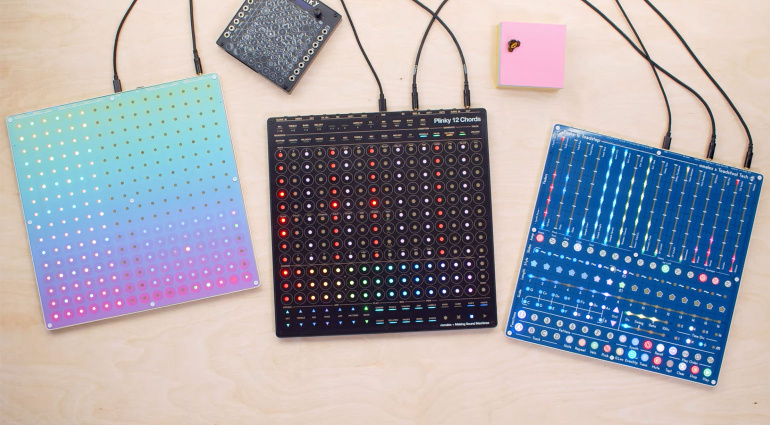
TL;DR: Making Sound Machines has teamed up with Plinky creator Alex Evans and Toadstool Tech to announce Plinky 12, a radical evolution of the cult-favorite touch synth. It’s a single hardware base that transforms into three distinct instruments—a chord machine, a sequencer/groovebox, and a clip-launching play surface—via swappable touch panels. Aiming for a Summer 2026 release, it promises a sample-based engine, deep connectivity, and a future web editor for custom panels.
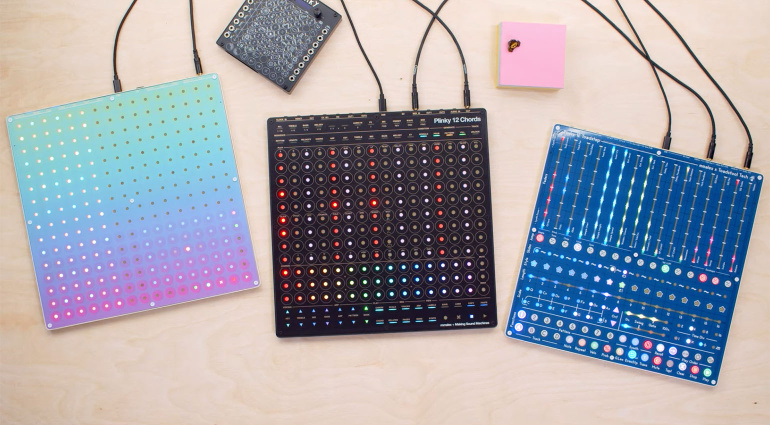
- Three-in-One Concept: One Plinky 12 hardware base works with three different, swappable touch panels (Chords, Toadstep, Blocks), each offering a unique instrument.
- Sample-Based Wavetable Engine: A polyphonic synth core that can morph samples into frozen wavetables, shared across all panels.
- Pro-Level Connectivity: Packed with CV/Gate I/O (4x total), dual TRS MIDI Out, USB MIDI, stereo audio I/O, and monome grid compatibility.
- Panel-Specific Superpowers: “Chords” is a harmonic playbox; “Toadstep” is a four-track CV/MIDI sequencer; “Blocks” is a clip-launching performance surface.
- Future-Proof Design: A forthcoming web-based editor will let users code and design their own custom panels for the hardware.
Reading time: 5 min
Want more synth news before your next coffee break? Join the Noxal newsletter — no spam, just gear worth knowing about.
From Plinky to Plinky 12

Some instruments arrive with a whimper; others, like the original Plinky, arrive with a beautifully melancholic sigh that resonates deeply with a certain crowd. That DIY, eight-voice touch-panel synth, born from the mind of developer Alex Evans (mmalex), felt less like a product and more like an emotional statement—fragile, icon-plastered, and profoundly expressive. It was the kind of gear that spawned cult followings, not marketing campaigns. Now, in a move that feels both logical and wildly ambitious, the concept has been professionalized and expanded through a partnership between Evans, Making Sound Machines, and Eurorack outfit Toadstool Tech. The result is Plinky 12.
The “12” denotes its form factor: a 12-inch square panel, 12mm deep. But the real number to focus on is three. Plinky 12 is not one synthesizer. It’s a hardware base unit designed to host three completely different, swappable touch panels, each representing a distinct instrument. You buy the base and one panel (Chords, Toadstep, or Blocks), with the others available separately. A few screws later, you’ve fundamentally changed what the box on your desk does. It’s a chameleon in an era of single-purpose tools, and that alone is worthy of our caffeinated attention.
Beneath this modular exterior lies a consistent core: a polyphonic, sample-based synthesis engine that, in the developers’ words, “can turn samples from simple sounds to frozen wavetables.” This engine, along with system-level features like presets, LFOs, envelopes, and a promised web-based sound editor, forms the common DNA. The magic—and the radical shift in workflow—comes entirely from the panel you slot on top.
The Hardware Base: A Connector’s Delight
Before we dive into the personalities of each panel, let’s appreciate the body they all share. The Plinky 12 base is, in a word, well-connected. This isn’t some insular desktop toy; it’s built to be the hub of a setup. For the CV/Gate crowd, there’s Clock In/Out, Reset In, two CV inputs (-5V to +5V), and two CV outputs (0-5V). For the MIDI-minded, you get a TRS MIDI In, two TRS MIDI Outs, and full USB MIDI. Audio I/O is stereo unbalanced, and there’s even a stereo microphone and accelerometer baked in for good measure. The inclusion of monome grid compatibility is a chef’s kiss for the experimental community.
The touch surface itself is a 16×16 grid of RGB, pressure-sensitive capacitive pads sitting beneath the panels. The brain is an RP2350 microcontroller with 512K of RAM, and crucially, an SD card slot for storing the lifeblood of the device: presets, samples, and songs. This hardware spec sheet reads like a wish list for a modern, performative desktop instrument. It has the I/O to command a modular rack, the MIDI to conduct a studio, and the self-contained sensors to be played intimately. They’ve built a remarkably capable vessel. Now, about the three very different ships that sail in it.
The Three Faces of Plinky
This is where the concept sings, whispers, or sequences a brutal four-track pattern. Each panel is a distinct instrument with a unique philosophy.
First, Chords. This is the immediate, play-focused incarnation. It offers six chord voices and six melody voices, organized into 13 palettes of 45 chords each. Four polyphonic melody surfaces dynamically adjust to match your selected harmonies. It features a polyphonic arpeggiator, circle-of-fifths transposition, and a 128-step sequencer for chord shapes. Sound-wise, it divides the engine into bass, treble, and melody sections with XY morphing, and includes delay and reverb FX that can process external audio. It can also function as a MIDI controller. This is the panel for when you want to get lost in harmonic exploration without touching a traditional keyboard.
Second, Toadstep, born from the collaboration with Toadstool Tech. This is the brain of the operation. It’s a four-track MIDI/CV sequencer and groovebox, citing inspiration from the likes of the RYK M185 and Intellijel Metropolis but with its own spin. It offers step repeating, ratcheting, per-step slides, probability, and randomization. You can use it to control your external Eurorack or MIDI gear, or drive the internal Plinky engine polytimbrally with a different sound per track. It has the same XY modulation and FX as Chords. This panel transforms Plinky 12 from an instrument into a compositional centerpiece.
Third, Blocks, designed by original Plinky creator mmalex. This panel feels like the spiritual successor to the first Plinky’s ethos. It’s described as “almost entirely distraction- and label-free.” On the left is a six-stringed polyphonic play surface; on the right, a clip launcher and XY pad. Each clip is a full 128-step polyphonic sequence with performance features like muting, shuffling, and per-step probability. Its minimalist design makes it the intended conduit for monome grid compatibility and the forthcoming web-based coding environment. This is the panel for the tinkerer, the performer, and the coder.
Who Is This For (And When Can You Get It)?
Plinky 12 is a fascinating proposition that sits at multiple crossroads. It’s for the Plinky nostalgist who craved a more robust, supported version of that original spark. It’s for the desktop performer who wants one device that can switch roles between chord generator, sequencer, and clip launcher without a laptop. It’s for the modular enthusiast who needs a powerful, touch-friendly sequencer and sound source that also happens to have extensive CV. And perhaps most intriguingly, it’s for the creative coder, lured by the promise of a web editor to design entirely new panels. It’s a niche device, but its niches intersect in a compelling way.
As for the practicalities, the team is targeting a Summer 2026 release, with a planned showcase at Superbooth 2026. It will be sold pre-assembled, a significant shift from the DIY origins. Pricing remains a mystery, with Making Sound Machines only committing to being “as competitive as we can make it.” Given the hardware involved and the three-panel ecosystem, one can assume it won’t be impulse-buy territory. The value proposition hinges entirely on whether you see the need for two or more of its personalities. If you do, it starts to look less like a luxury and more like a modular desktop system in a single, clever box.
Frequently Asked Questions
Is the original Plinky synthesis engine the same in Plinky 12?
While it carries forward the sample-based, wavetable-morphing philosophy of the original, the Plinky 12 engine is a significant advancement tied to the new, more powerful RP2350 hardware. It’s the shared core across all three panels, capable of polyphonic playback and the frozen wavetable manipulation the developers describe. Think of it as the spiritual successor, rebuilt for this new multi-instrument platform.
Can I use multiple panels at the same time?
No. The Plinky 12 is a single hardware base that physically hosts one touch panel at a time. You cannot run the Chords and Toadstep software simultaneously. The transformation is a physical swap. However, the system is designed for this—swap the panel, power on, and it recognizes the new instrument. Your presets and samples on the SD card remain accessible.
How does the web-based panel editor work?
Details are still forthcoming, but the concept is revolutionary for a hardware instrument. The idea is that users will be able to code and design their own custom touch interfaces and functionalities in a web environment, which can then be loaded onto the Plinky 12 hardware. This opens the door for a community-driven ecosystem of custom panels, far beyond the three offered at launch. It turns the device from a product into a platform.
I’ll need a second espresso to decide which panel I’d buy first, but I already know I’d spend the entire afternoon unscrewing and rescrewing them, just for the thrill of the transformation. Some rituals are worth the caffeine.