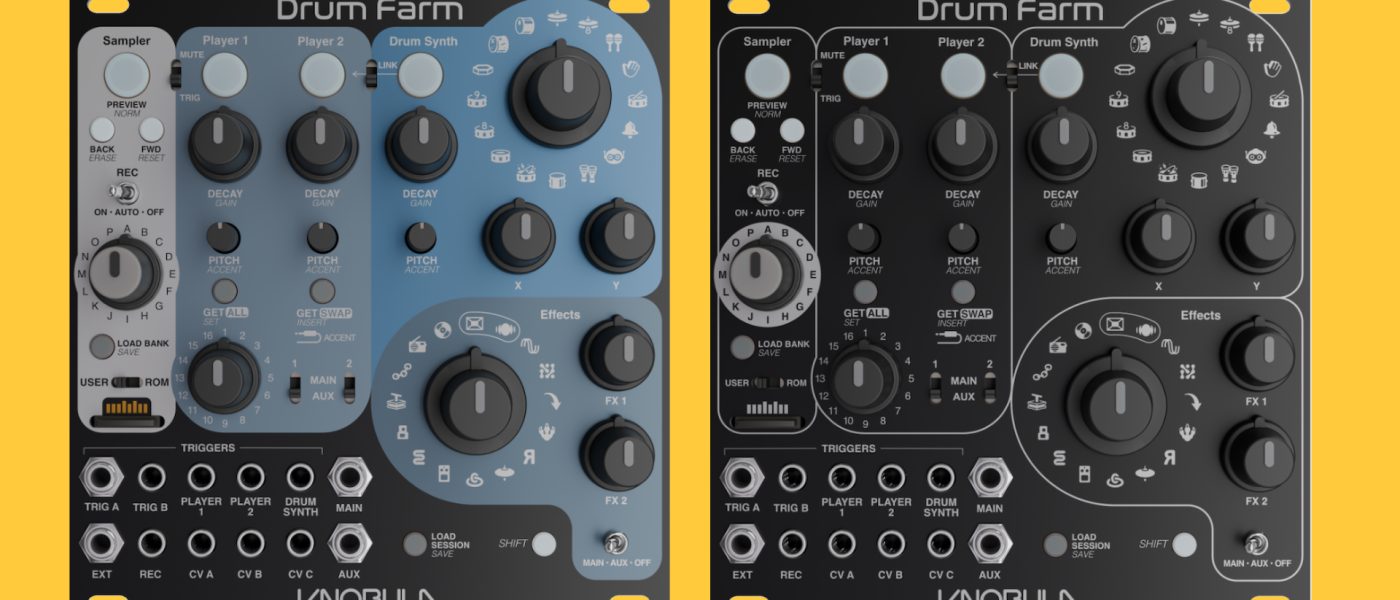
TL;DR: Knobula has unveiled the Drum Farm, a 24HP Eurorack drum voice module for Superbooth 2026 that blurs the line between synthesis and sampling. It combines a multi-model drum synth, a live-sampling engine, and multi-FX into a single, performative hub for building and capturing complex percussion. It’s priced at £449 and is expected in June 2026.
- A hybrid drum voice merging synthesis (16 models), live sampling (3 voices), and multi-FX (16 processors).
- Core workflow revolves around sculpting sounds and instantly sampling them into 16 buffers for layering and kit-building.
- Performance-focused with five trigger inputs, four CV inputs, and full parameter assignability for generative or hands-on control.
- Includes an external audio input for sampling any source and a microSD slot for storing 32 session banks.
- No screen or deep menus; interface is knob-per-function with secondary functions accessed via button combos.
Reading time: 5 min
Want more synth news before your next coffee break? Join the Noxal newsletter — no spam, just gear worth knowing about.

The Farm Philosophy: Don’t Choose, Do Both

Here at Noxal, we’ve long held that the eternal debate between synthesized drums and sampled drums is a bit of a studio parlor game. Synthesis offers infinite sculptability from nothing; sampling offers instant character and realism. The “right” answer has always been “both, but that requires more modules, more cables, more headache.” Knobula, with the Drum Farm, appears to have looked at this tired debate, shrugged, and built a module that simply refuses to participate. It is, unabashedly, both.
The premise is elegantly simple yet profound in execution: a 24HP performance-focused drum voice that is a synthesizer, a sampler, and an effects unit, all inextricably linked. It’s not a drum machine with preset sounds; it’s a drum sound *sculpting hub*. The synthesis side offers 16 drum models spanning virtual analog, physical modeling, and spectral techniques, each with decay, pitch, and two model-specific X/Y controls for tweaking. This isn’t just about triggering a kick, snare, and hi-hat. It’s about having a raw, generative sound source that provides subtle variation on every trigger—a living, breathing synth voice dedicated to percussion.
What makes the Farm concept unique isn’t just the quality of these models (which we’ll have to hear), but their intended role. They are the raw clay. The sampler isn’t a separate sample-playback section; it’s the kiln. It’s designed to capture everything you do with that clay—the synth sound alone, the synth with effects, the synth layered with other samples—in real-time. This immediate feedback loop between creation and capture is the module’s beating heart, a concept that feels more like an instrument than a sound module.
Sculpt, Sample, Repeat: The Core Workflow
Let’s walk through the promised workflow, because this is where the Drum Farm either becomes indispensable or overly complex. You start with a drum synth voice. You tweak its model and parameters until you have a compelling percussive hit. Now, instead of just patching that audio out to a mixer, you can instantly sample it into one of the module’s 16 sequential audio buffers. The sampler runs automatically in the background, waiting to capture your moments of inspiration.
This is where it gets interesting. You now have that captured hit as a sample, which can be pitch-shifted, given a different decay, or muted independently. You can then layer it back with the live synth voice, or combine it with a completely different sample from the external input (think: a field recording of a metal pipe). You can run this hybrid sound through one of the 16 real-time multi-FX processors (with up to three usable simultaneously) and then—you guessed it—sample *that* result into another buffer. The potential for building deeply layered, evolving percussion structures or loops, entirely within one module, is staggering.
Knobula has wisely avoided putting a screen on the front panel. This forces a knob-per-function, performance-oriented interface, with secondary functions likely accessed via button combinations. The goal is clear: keep you turning knobs and hitting triggers, not scrolling through menus. Every parameter is CV- and trigger-assignable, meaning you can have an external sequencer morph the drum model, switch the active effect, or jump sample buffers, making it a powerhouse for generative patches or tightly choreographed live performances.
Specs and Connections: A Well-Stocked Toolbox
On paper, the Drum Farm is generously appointed. It offers up to four drum voices: three main voices (which can be a mix of synth and sample playback) and a dedicated preview voice. You get five trigger inputs for firing those voices or functions, four CV inputs for modulation, and an external audio input for bringing in any sound source to sample. Output is handled by main and AUX audio outs for flexible routing.
The sampler itself supports up to three playback voices (two main plus preview), each with independent mute, decay, pitch, and accent controls. The inclusion of accent control is a crucial detail often glossed over in compact drum modules; proper dynamic response is what makes electronic percussion feel alive. We’ll be keen to test how well this is implemented. Storage is via a microSD slot, capable of holding 32 banks of complete sessions—saving everything from samples to synth settings and effects chains.
Comparing it to other players in the space is inevitable. The commenter on the source article rightly mentions the VPME QD, which is a formidable quad drum voice. The Drum Farm differentiates itself by having a true live-sampling *recorder* at its core, not just a sample player. This also evokes the spirit of the Vermona DRM1 MkIV’s “DrumThing” function, but integrated into a modern, CV-able Eurorack format. It’s not a clone of anything; it’s a distinct fusion of ideas aimed at a specific, creative workflow.
Who Is This For? The Eurorack Percussionist’s Dilemma
So, who is the ideal farmer for this Drum Farm? It’s not for the musician who wants to load a 909 kit and be done by lunch. It’s for the sound designer, the live performer, and the patcher who views drum synthesis as a compositional process in itself. If your ideal percussion setup involves resampling, layering, and creating sounds that morph throughout a track, this module is practically a bespoke solution. It condenses what might take three or four modules (a drum synth, a sampler, a mixer, an FX unit) into a single, interoperable system.
However, that integration comes with a trade-off: complexity and focus. This is a deep module. While the lack of a screen is a boon for immediacy, learning the button combinations and managing the 16 sample buffers will require dedication. It’s a module that demands engagement. For someone who just needs a handful of great, static drum sounds, it might be overkill. But for the artist who considers sound design part of the performance, it could be a centerpiece.
Priced at £449, it sits in the upper-mid range for a sophisticated digital drum module. When it arrives in June 2026, its success will hinge entirely on the execution: the quality of the core synth models, the intuitiveness of the sampling workflow, and the responsiveness of the dynamics. If Knobula sticks the landing, the Drum Farm won’t just be another drum module; it will be a compelling new paradigm for integrated percussion synthesis in the rack.
Frequently Asked Questions
Can the Knobula Drum Farm play back pre-existing sample libraries?
Primarily, no. The Drum Farm’s sampler is designed as a live capture and resampling engine for sounds you create within the module or feed into its external input. It’s for building your own kits from scratch or from external audio, not for loading classic drum machine ROMs. Storage is for saving the sessions you create.
How does the “preview” voice function?
The preview voice acts as a fourth, temporary voice. It’s typically used for auditioning a new drum synth sound or a sample before you commit it to one of the three main voice slots. This allows you to tweak and test a sound in context without interrupting your existing pattern or kit.
Is the Drum Farm a good first drum module for a beginner’s rack?
Probably not. Its power lies in the sophisticated interplay between synthesis, sampling, and effects. A beginner might be better served by a more straightforward sample-based drum module or a dedicated analog drum synth to learn the basics. The Drum Farm is for those ready to dive deep into a holistic, performative sound-design process.
I’ll need a second espresso just to contemplate the cable management I’ve avoided by this thing existing. Now, to clear 24HP of space by 2026.