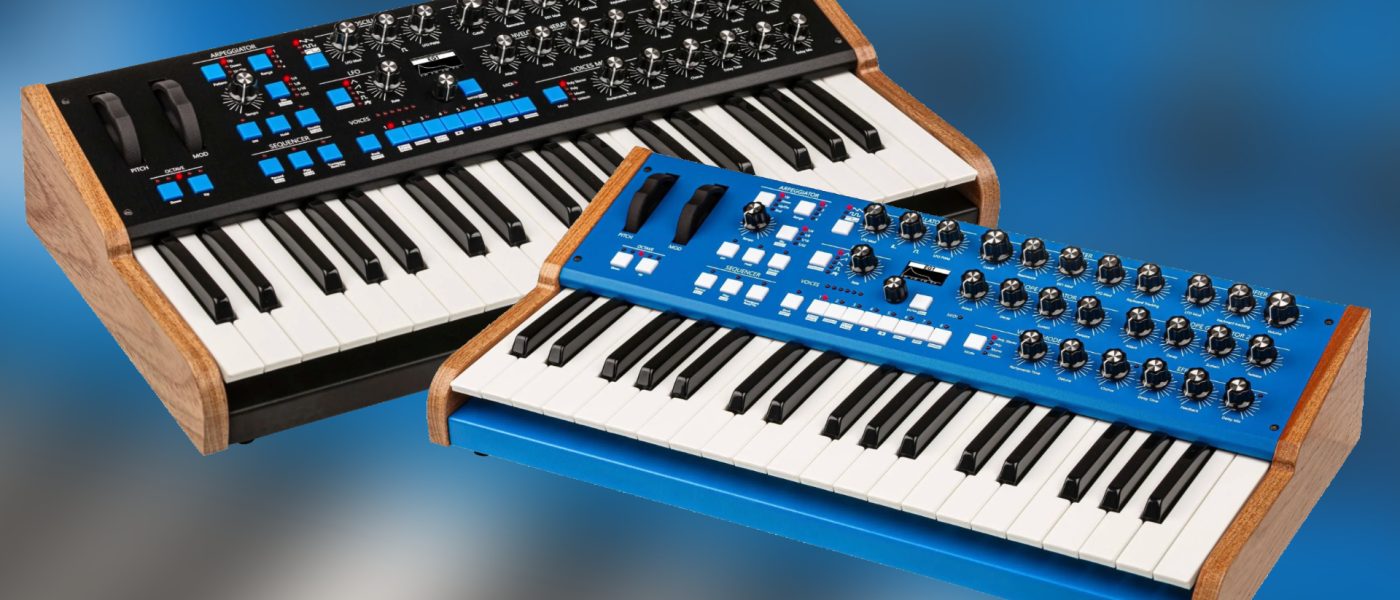
TL;DR: GS Music has officially launched the Bree6 Keyboard, a 6-voice analog polysynth with a semi-weighted keybed. It’s essentially the desktop module we saw last year, now with velocity, aftertouch, pitch/mod wheels, and pedal inputs, all for $1699. The signal path remains fully analog and knob-per-function, offering a classic, hands-on Juno-esque experience.
- The Bree6 Keyboard is a 6-voice analog poly with a semi-weighted keybed featuring velocity and aftertouch.
- It retains the desktop version’s fully analog signal path, 4-pole ladder filter, and one-knob-per-function interface.
- New physical controls include pitch/mod wheels, octave switches, and configurable sustain/expression pedal inputs.
- Onboard effects include an ensemble chorus and a stereo delay, with 512 memory slots for patches.
- Priced at $1699, it’s a hand-built, traditional polysynth positioned against more feature-rich competitors.
Reading time: 4 min
Want more synth news before your next coffee break? Join the Noxal newsletter — no spam, just gear worth knowing about.

The Keyboard Arrives

We at Noxal have a soft spot for a well-executed sequel. Not the cinematic kind, but the hardware kind—when a compelling desktop module graduates to a full-fledged keyboard instrument. GS Music, the Argentinian outfit, has done precisely that. After introducing the Bree6 desktop polysynth in early 2025 to nods of approval from the analog faithful, they’ve now unveiled the Bree6 Keyboard ahead of Superbooth 2026. It’s the same synth, but now it has a proper home for your fingers.
The transition from module to keyboard is often fraught with compromise. Sometimes the keybed feels like an afterthought, or the layout becomes awkward. GS Music appears to have avoided the first pitfall by equipping the Bree6 with a semi-weighted keybed that includes both velocity and aftertouch sensitivity. This isn’t just a controller slapped onto a box; it’s an integrated instrument designed for playability. The addition of pitch and mod wheels, plus octave up/down buttons, completes the expected physical interface. It’s a logical, almost inevitable evolution for a synth whose architecture has always whispered “play me.”
I remember seeing the prototype at Superbooth 2025, sitting there in its blue and black livery, looking both familiar and promising. Now it’s a real product you can buy. In a market saturated with reissues and clones, there’s something quietly commendable about a small company steadily iterating on its own original design, building them by hand in Argentina, and delivering a complete keyboard instrument. It speaks to a focus that’s increasingly rare.
What’s In The Box (Besides Keys)
So, what do you get for your $1699 beyond the new keybed? The core engine is, as noted, identical to the desktop Bree6. That means a fully analog signal path with a straightforward, one-knob-per-function interface that proudly avoids menu diving. The architecture will feel instantly familiar to anyone who has spent time with a certain lineage of 80s polysynths: a single oscillator per voice (with sub-oscillator), into a filter, into an amp, with two ADSR envelopes and an LFO handling modulation duties.
The new physical amenities are thoughtful. Beyond the wheels, you get dedicated inputs for both sustain and expression pedals. The expression pedal input is configurable, allowing you to assign it to filter cutoff, volume, or other parameters, and you can even adjust its response range. These are small details that show an understanding of how players interact with an instrument beyond the preset buttons. On the rear panel, connectivity is solidly traditional: a full 5-pin MIDI In/Out/Thru, stereo outputs with a mono switch, a headphone jack, USB for data, and a power input. It’s everything you need and nothing you don’t.
Storage is handled by 512 memory locations, which is more than ample for a synth of this nature. And in a welcome modern touch, it features full MPE (MIDI Polyphonic Expression) support. While the synth itself isn’t MPE-native in its sound generation, having the capability to receive and respond to MPE data from controllers like the Roli Seaboard or LinnStrument future-proofs it in a small but significant way.
The Analog Heart
Let’s talk about the sound. The Bree6’s voice is defined by its 4-pole ladder lowpass filter, complete with cutoff, resonance, and keyboard tracking controls. It’s a classic, creamy-sounding topology that excels at everything from soft pads to resonant bass sweeps. The signal then runs into a multi-FX processor, which houses two key effects: an ensemble chorus and a stereo delay.
The chorus is explicitly designed to simulate a string or vocal ensemble, using multiple delay lines modulated by dedicated LFOs. It’s the kind of effect that can instantly drench a simple waveform in that iconic, shimmering 80s nostalgia. The stereo delay offers up to 1 second of delay time with controls for time, feedback, and mix. These are the perfect companion effects for this synth, reinforcing its character rather than distracting from it. The modulation section is straightforward but effective: two ADSRs (for filter and amp) and a multi-wave LFO that can modulate oscillator pitch/PWM, filter cutoff, and VCA.
Playing it, you’re struck by its immediacy. There are no hidden modes, no shift functions to memorize. What you see is what you get. This purity is its greatest strength and, depending on your needs, its potential limitation. It won’t do wavetables, it won’t do FM, and it has one oscillator per voice. But what it does, it does with a focused, musical simplicity that encourages creativity within its boundaries. The sound, from what I’ve heard of the desktop version, is rich, warm, and unapologetically analog.
Context and Competition
Positioning the Bree6 Keyboard in the market is an interesting exercise. At $1699, it enters a crowded field. You have the likes of the Sequential Take 5, the ASM Hydrasynth Explorer, and various offerings from Behringer vying for attention. The source text even mentions Behringer’s upcoming projects, like the STX (an Elka Synthex clone) and the $99 JT Mini, highlighting the vast spectrum of price and capability out there.
As the source text candidly states, the Bree6 Keyboard is “certainly one of the least equipped” analog polysynths in its price range. It doesn’t have bi-timbrality, extensive modulation matrices, or digital oscillators. Its value proposition is different: it’s about tactile simplicity, a pure analog signal path, and a specific, classic sonic character. It’s for the player who wants to turn knobs, not navigate menus; who values the journey of sound design as much as the destination.
We at Noxal appreciate that GS Music isn’t trying to be everything to everyone. In an era of feature-checklist one-upmanship, the Bree6 Keyboard is a deliberate, almost anachronistic choice. It’s a hand-built instrument with a clear point of view. It won’t win a spec sheet battle, but it might win over a player’s heart with its straightforward charm and solid build. It’s a reminder that sometimes, less—executed with conviction—is genuinely more.
Frequently Asked Questions
Is the Bree6 Keyboard sound engine different from the desktop module?
No, the sound engine is identical. The keyboard version adds the physical interface (semi-weighted keybed with aftertouch, pitch/mod wheels, pedal inputs) but the analog voice architecture, filter, effects, and modulation are exactly the same as the desktop Bree6.
Does it have patch memory?
Yes, it has 512 memory locations for storing your own sounds, which is quite generous for a synth of this type.
Who is the Bree6 Keyboard best suited for?
It’s ideal for players and producers seeking a classic, immediate, “knob-per-function” analog polysynth experience. It’s great for Juno-style pads, basses, and leads, and will appeal to those who dislike menu diving. It’s less suited for sound designers craving complex modulation or digital/wavetable capabilities.
Now, if you’ll excuse me, I need to pour a fresh cup and contemplate whether a black and blue synth would clash with my studio’s predominantly grey and regret color scheme.