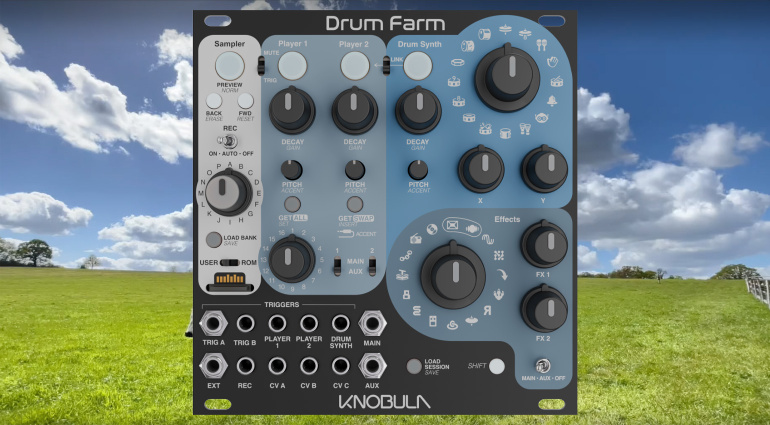
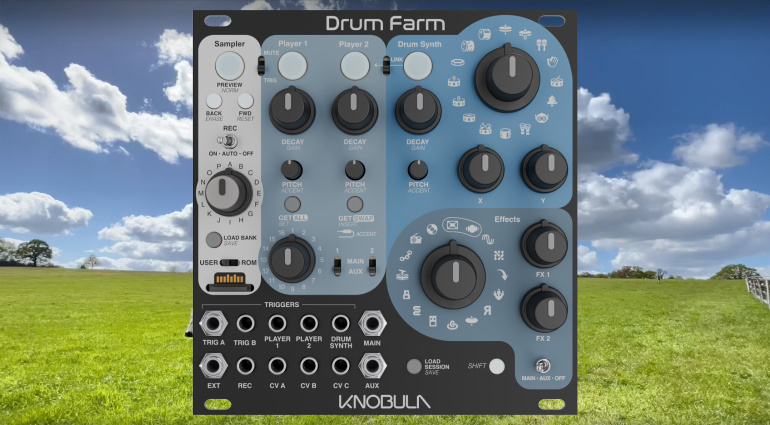
TL;DR: Knobula has announced the Drum Farm, a creative Eurorack drum module that synthesizes, samples, and processes on the fly. Its core trick is a background sampler that continuously records your sound design experiments, ensuring you never lose a happy accident. It’s a £375 playground for generative percussion, set to ship by June 2026.
- Combines 16 drum synthesis models, 16 effects, and a live sampling engine in one 26HP module.
- Background “Undo queue” sampler automatically records 16 sequential buffers of your sound design process.
- Features two sample players for layering with the synth, plus a preview sample, for up to four simultaneous sounds.
- Allows for saving sample banks and full module snapshots to an SD card.
- Includes three assignable CV inputs for external modulation of any panel control.
Reading time: 4 min
Want more synth news before your next coffee break? Join the Noxal newsletter — no spam, just gear worth knowing about.
What Is the Knobula Drum Farm?

Knobula, a company that has steadily carved out a niche for itself with clever, performance-focused Eurorack modules, is back with what might be its most intriguing offering yet. The Drum Farm is not just another drum voice. It’s a self-contained ecosystem for percussion, announced just ahead of Superbooth 26. The premise is in the name: this is a module where you plant a seed of a sound and watch—or rather, listen—as it grows into something entirely new. It combines three major pillars of modern sound design—synthesis, effects processing, and sampling—into a single 26HP panel, promising a workflow that is as much about happy accidents as it is about intentional design.
We at Noxal have a soft spot for modules that encourage play over programming. The Drum Farm seems built for that exact mindset. It’s a sound design powerhouse that wants to be tweaked, layered, and mangled in real-time. While many drum modules give you a solid palette of sounds, the Drum Farm gives you the tools to mutate that palette beyond recognition and, crucially, capture every step of that mutation. It feels less like a static instrument and more like a collaborative partner in your rack, one that’s constantly taking notes on your creative process.
The Core Trick: A Sampler That Never Sleeps
Let’s cut to the chase: the most compelling feature here is the background sampler. In a move that feels like a gift to every musician who has ever cried out, “How did I make that sound?!” the Drum Farm runs a sampler that continuously records your output into 16 sequential audio buffers. Knobula aptly calls it an “Undo queue.” This isn’t just a record button; it’s a sonic safety net. As you twist knobs, swap effects, and layer samples, the module is silently archiving the last 16 moments of audio. That brilliant, fleeting snare you created by accident at 3 AM? It’s not lost. You can scroll back and trigger it.
This feature fundamentally changes the module’s role. It transforms it from a sound source into a creative journal. You can, of course, sample manually or via an external trigger, and you can even feed external audio from your rack into its input. But the magic is in the automation. It encourages a fearless, exploratory approach. Crank the distortion until it collapses into noise, then dive into the reverb—the sampler has your back. You can then take any of these captured moments, load them into one of the two dedicated sample players, and begin the layering process all over again. It’s a feedback loop of creativity.
Specs and Sound Design Philosophy
So, what are you actually manipulating in this loop? The foundation is a drum synth with 16 models covering the essentials: kicks, snares, hi-hats, and percussion, including flavors inspired by the iconic TR-808 and 909. Each model has a decay control plus two assignable X/Y parameters for shaping. It’s a curated, immediate starting point. Then comes the 16-effect engine, which is where the “Farm” concept really takes root. Beyond standard fare like reverb and delay (which can be set to “always on”), you get characterful processors like Pitch Dive, Octave Warp, and the wonderfully named “Multitude,” which generates eight random variations of your sound.
The architecture is designed for stacking and interaction. You have the main drum synth voice, two sample players (each with its own trigger input), and the ability to individually trigger the currently previewed sample from the buffer. That’s up to four concurrent sound sources that can be fed through the effects and resampled. Three assignable CV inputs mean you can let your modular system modulate any parameter on the panel, from effect selection to sample start points. For preservation, entire snapshots of the module’s state and sample banks can be saved to an SD card. This isn’t a module you use; it’s a patch you cultivate.
Who Is This For, and When Can You Get It?
The Drum Farm sits at a fascinating intersection. It’s for the percussion obsessive who finds standard sample-playback modules too rigid and single-voice analog drum synths too limited. It’s for the live performer who needs to build and mutate a drum part on stage, with the confidence that every unique moment can be captured and reused. It’s also a potent tool for the studio-based sound designer looking to generate a vast library of unique, organic percussion hits without ever leaving the rack. In short, it’s for anyone who views drum synthesis as a process, not just an outcome.
As for availability, Knobula states the Drum Farm will ship before the end of June 2026. The pre-order price is set at £375 plus VAT. In a market where complex digital modules can easily crest the £500 mark, this price feels strategically competitive for the feature set. It positions the Drum Farm as a potential centerpiece for a percussion-focused rack, rather than a peripheral luxury. We’re keen to get our hands on one to see if the workflow is as fluid and inspiring as it promises to be on paper. If it delivers, it could very well redefine what we expect from a drum module.
Frequently Asked Questions
Can the Drum Farm’s background sampler record external audio?
Yes. While its primary function is to record the module’s own output, the Drum Farm has a dedicated audio input. This allows you to sample sounds from anywhere else in your Eurorack system, making it a useful hub for capturing and mangling external audio sources within its ecosystem of effects and layering.
How do the two sample players work with the main synth?
The two sample players are independent voices with their own trigger inputs. You can layer a sampled kick with the synthesized kick, run them both through the same effect, and then resample the combined result back into the buffer. This “stack and capture” approach is central to the module’s sound-design philosophy, allowing for deeply complex, evolved sounds from simple starting points.
What does the “Multitude” effect actually do?
According to Knobula, Multitude generates eight random variations of the input signal. While the exact algorithm isn’t specified, this suggests a granular or buffer-based effect that creates a shifting, chaotic texture from your source sound. It’s the kind of experimental, generative effect that perfectly complements the module’s goal of fostering unexpected, “grown” percussion sounds.
I’ll be testing this module with a quadruple-shot espresso nearby. Something tells me I’ll need the caffeine to keep up with its own generative energy—and to remember which of the 16 buffers holds that perfect, accidental clang.