
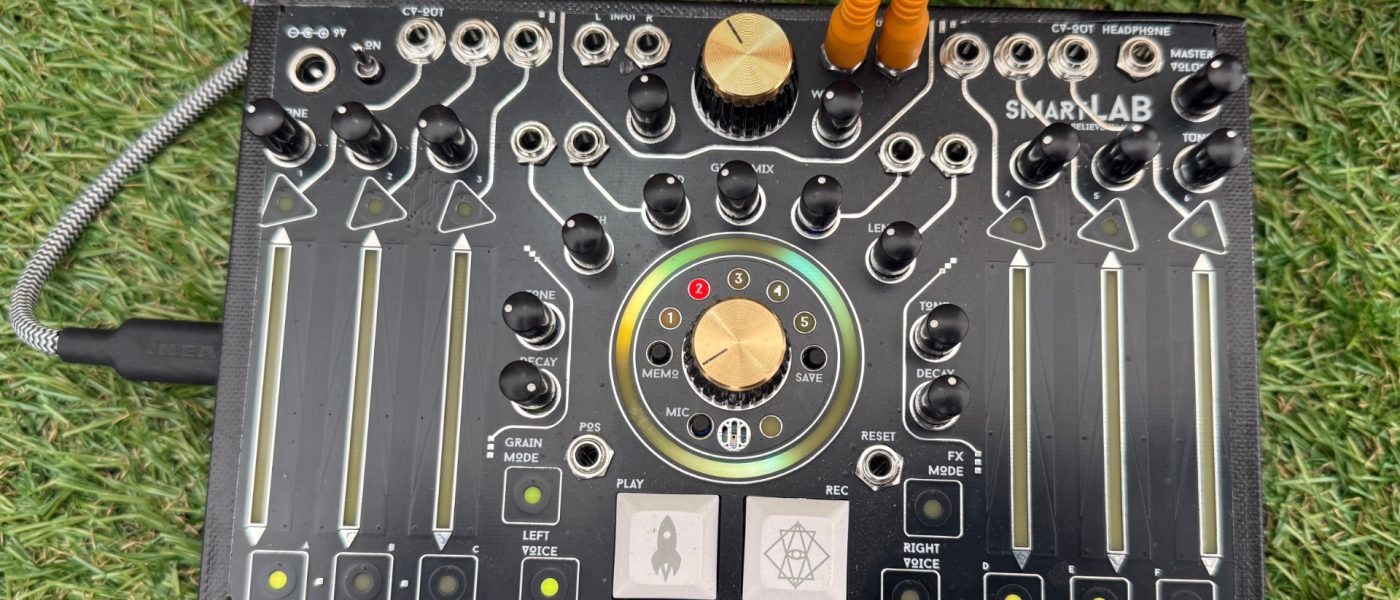
TL;DR: Error Instruments and This Is Not Rocket Science (TINRS) have merged their Kharper string synth and Brinta granular sampler into a single desktop instrument called SmartLab. It offers six physical modeling voices, a granular engine with direct internal routing, and a built-in looper per touch strip — all for around €600–700.
- SmartLab combines two Kharper engines (6 voices total) with one Brinta granular sampler/processor, plus a White Rabbit FX module.
- Physical modeling via Karplus-Strong synthesis meets real-time granular processing, with direct internal routing from Kharper to Brinta.
- Each of the six touch strips has its own looper, a built-in microphone feeds the granular engine, and every strip outputs CV for external control.
- Desktop format with patch points for Eurorack integration, stereo I/O, headphone out, and USB-C power (in the final version).
- Priced at €600–700, expected later in 2026.
Reading time: 4 min
Want more synth news before your next coffee break? Join the Noxal newsletter — no spam, just gear worth knowing about.

What Is the SmartLab?

Error Instruments has a reputation for building weird, wonderful, and occasionally bewildering gear in small batches. Their collaborations with This Is Not Rocket Science (TINRS) have produced two standout Eurorack modules: the Kharper string synthesizer voice and the Brinta sampler/processor. Both have earned cult followings among experimental sound designers. At Superbooth 2026, the two Dutch developers revealed the SmartLab — a desktop synth that fuses both modules into one cohesive instrument.
SmartLab is not a Eurorack module, though it retains enough patch points to keep modular enthusiasts happy. It’s a self-contained box with two Kharper engines (left and right), one Brinta granular engine in the center, and a White Rabbit FX processor for good measure. Each Kharper engine offers three voices, giving you six physical modeling strings in total. That’s half the voice count of the standalone Kharper module (which has nine), but the SmartLab compensates with a significantly expanded architecture: 36 engines or interactions are available, some of which are reserved for the granular sampler.
If you’ve ever wanted to pluck a virtual string and immediately granulate the result without patching a single cable, this is your machine.
Physical Modeling Meets Granular
The core of SmartLab’s sound lies in the marriage of physical modeling and granular synthesis. The Kharper engines use Karplus-Strong synthesis — essentially a digital waveguide that simulates a vibrating string — to create everything from plucked tones to bowed textures. It’s a well-trodden technique, but Error Instruments and TINRS have pushed it into strange, expressive territory. Each of the six touch strips responds to pressure and position, letting you shape pitch, timbre, and articulation in real time.
What makes SmartLab genuinely interesting is the direct pipeline from the Kharper engines into the Brinta granular sampler. You can capture any physical modeling sound and instantly granulate it — chopping it into grains, scattering it across time, or layering it into dense clouds. Alternatively, you can feed external signals into Brinta via the 3.5mm input, keeping the granular engine independent. This dual-routing flexibility means you can use SmartLab as a self-contained sound design station or as a processor for external gear.
There’s also a built-in microphone for recording ambient sounds or vocal snippets directly into the granular engine. It’s a small addition, but one that turns SmartLab into a surprisingly capable field-recording instrument.
Playability and Connectivity
SmartLab is played primarily through six vertically arranged touch strips, each backlit for visibility on dimly lit stages. Every strip has its own dedicated looper, allowing you to record and loop gestures in real time. This turns the instrument into a kind of tactile phrase sampler — you can build layered compositions without ever touching a sequencer or DAW.
On the connectivity front, each touch strip outputs its own CV signal. That means you can use SmartLab as a controller for other Eurorack gear, sending pressure and position data to modulate filters, VCAs, or pitch. There’s stereo I/O via 3.5mm jacks (L+R mono), a headphone output, and additional CV inputs for external modulation. The release version will also include USB-C power, which is a welcome convenience for a desktop unit.
It’s worth noting that SmartLab is not a fully modular instrument — you can’t reconfigure the signal path with patch cables in the traditional sense. But the CV connectivity ensures it plays nice with a Eurorack system, making it a viable centerpiece for a hybrid setup.
Market Context and Who It’s For
At €600–700, SmartLab sits in a sweet spot for experimental hardware. It competes with devices like the Tasty Chips GR-1 (a dedicated granular synth) and the Soma Lyra-8 (an organic drone machine), but SmartLab’s combination of physical modeling and granular processing is genuinely unique. The GR-1 is more focused on sample manipulation, while the Lyra-8 is purely analog chaos. SmartLab straddles the line between digital synthesis and tactile control, offering a playground for sound designers who want to sculpt sounds from scratch.
Who is this for? If you’re a modular user looking for a standalone instrument that can also control your rack, SmartLab is a strong candidate. If you’re a fan of Error Instruments’ previous work — the Cabinet of Curiosities or the Brinta module — you’ll feel right at home. And if you’re someone who just wants to make weird, beautiful noises without staring at a screen, this might be your new favorite box.
I have a soft spot for instruments that prioritize exploration over predictability. SmartLab looks like exactly that kind of device.
Frequently Asked Questions
Does SmartLab require Eurorack to function?
No. SmartLab is a fully self-contained desktop synthesizer with its own power supply (USB-C in the final version). It includes patch points for CV connectivity, but you can use it entirely on its own.
Can I use the granular engine independently of the physical modeling voices?
Yes. The Brinta granular sampler has its own external input, allowing you to process any audio source — including external gear, microphones, or line-level signals — without routing through the Kharper engines.
How many voices does SmartLab have?
SmartLab offers six physical modeling voices (two Kharper engines with three voices each) plus the Brinta granular engine, which can layer multiple grains simultaneously. The total polyphony depends on how you route and layer sounds.
I’m already imagining the morning ritual: pour a coffee, touch a strip, and let the granulated string textures fill the room while the espresso machine hisses in protest. Some things just belong together.