
TL;DR: Icelandic startup Love Synthesizers is finally shipping the First Love, a multi-timbral FM synthesizer with a playful touchscreen interface, after debuting prototypes at Superbooth 2024 and 2026. Pre-orders are open now at $699/€595, with units expected to land in September 2026. It’s a 4-part, 4-operator FM beast designed to make FM synthesis accessible without turning your brain into a tangled algorithm.
- Four-part multi-timbral FM engine — Each part is a 4-operator FM synth with user-definable algorithms, waveshaping, and morph envelopes for evolving sounds.
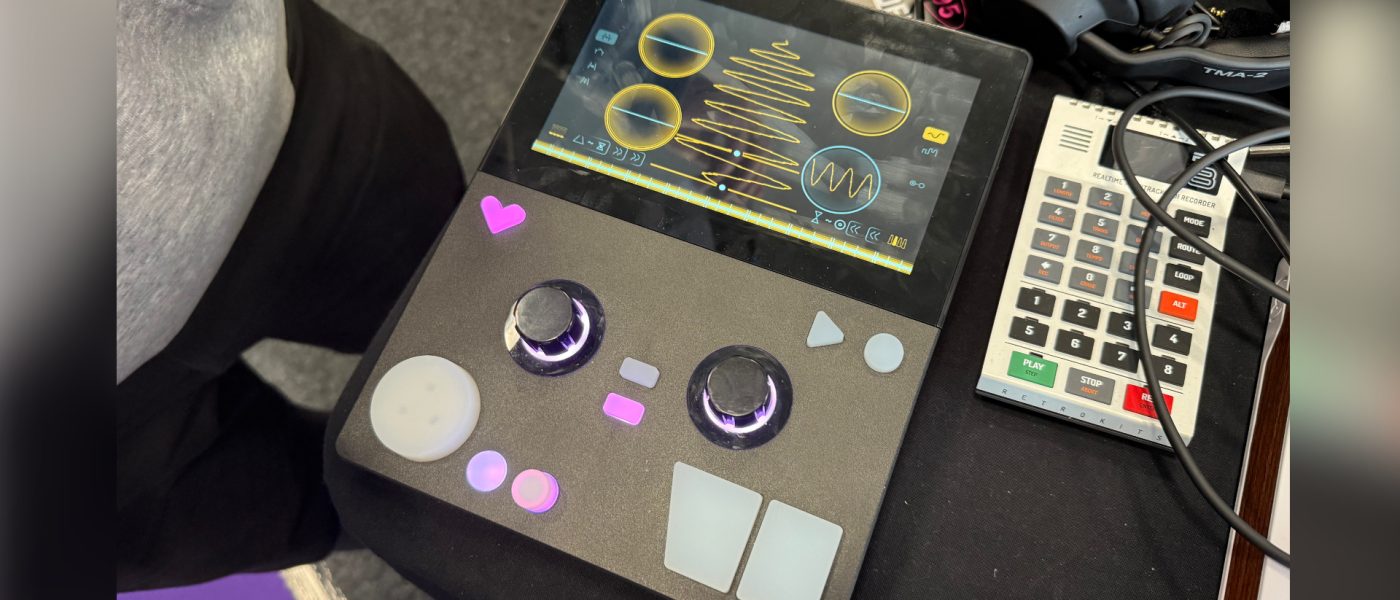
- Playful touchscreen interface — A 7-inch color touchscreen lets you swipe oscillators together to create FM pairs, complemented by knobs and buttons for hands-on tweaking.
- “The Playground” performance suite — Includes an arranger, sequencer, arpeggiator, microtonal quantizer (up to 256 user scales), strum generator, chord presets, and a built-in MIDI looper.
- Onboard FX and connectivity — Dedicated reverb, delay, chorus, and freezer per part; four stereo/mono outputs, 5-pin MIDI, USB-C power/data, analog sync, Bluetooth, and built-in stereo speakers.
- Pre-order now, ships September 2026 — Price is $699/€595, and it runs on USB-C or four lithium batteries, making it truly portable.
Reading time: 4 min
Want more synth news before your next coffee break? Join the Noxal newsletter — no spam, just gear worth knowing about.

What is the First Love?

Iceland is known for glaciers, volcanoes, and Björk — not necessarily for synthesizers. But Love Synthesizers, founded by Kári Halldórsson, is changing that narrative with the First Love, a desktop FM synth that’s been gestating since Superbooth 2024. After two years of iterative prototypes and public teasing, the final product is almost here: a 19 x 24 cm tabletop unit with a 7-inch touchscreen, four knobs, and a button array that promises to make FM synthesis feel more like a game than a math problem.
The First Love is not your grandfather’s DX-7. Instead of drowning you in operator matrices and algorithm tables, it offers a visual, tactile approach. Each of its four timbres is a 4-operator FM voice, but you can create your own algorithms by dragging oscillators on the screen. Want to swipe one operator into another? Go ahead. The interface uses animated graphics and color coding to show signal flow in real time, which is both intuitive and genuinely refreshing.
Beyond the basic FM engine, each operator includes a dynamic wavefolder and a sine-to-square wave morph, allowing for additive synthesis or hybrid FM-additive patches. There’s also a morph envelope that lets you snapshot operator values at different points in a note’s lifetime, then smoothly interpolate between them — great for evolving pads or percussive stabs that change character over time.
FM Synthesis Made Fun
We at Noxal have seen countless FM synths that promise accessibility but deliver only confusion. The First Love, however, seems to actually understand the problem: FM is inherently mathematical, but music shouldn’t be. Love Synthesizers’ solution is “The Playground,” a dedicated performance mode that includes a versatile arranger, sequencer, arpeggiator, microtonal quantizer with up to 256 user scales, a strum generator, and ready-to-use chord slots. You can assign each of the four FM engines to play independently or together, and capture your performances in the onboard MIDI looper.
This isn’t just a gimmick. The Playground transforms the First Love from a sound design tool into a live performance instrument. Want to layer a lush pad with a rhythmic arpeggio and a bassline, all from one box? The First Love can do that. The four parts can be assigned to separate MIDI channels for multi-timbral use or stacked on the same channel for unison-style thickness. Each timbre has its own amp envelope, and a global mixer lets you balance everything.
I’ll admit, I was skeptical when I first read about “swiping” oscillators. It sounded like a tablet app dressed in synth clothing. But after seeing the prototype footage from Superbooth 2026, I’m convinced this is a legitimate evolution of FM interface design. The developers have clearly spent time making the visual feedback immediate and rewarding — something the cold, numerical DX-7 interface never managed.
Specs and Connectivity
Under the hood, the First Love packs four polyphonic FM synthesizers (each 4-operator), a dedicated FX engine per part with reverb, delay, chorus, and a freezer effect, plus a built-in MIDI looper. The FX can be assigned independently to each timbre, which is a luxury usually reserved for higher-end workstations.
On the I/O side, you get independent outputs: two stereo pairs or four mono outputs, a headphone jack, 5-pin MIDI in and thru, USB-C for both power and data, and analog sync I/O. There’s also built-in Bluetooth for wireless MIDI control, and — this is a nice touch — stereo speakers built into the unit. Power can come from USB-C or four lithium batteries, making the First Love genuinely portable for studio jams or park bench sound design sessions.
The developer confirmed that the final unit will have a 19 x 24 cm footprint, which is roughly the size of a paperback novel lying flat. It’s not a handheld synth (despite early rumors), but it’s compact enough to fit on a crowded desk or slip into a backpack alongside a laptop and a bag of coffee beans.
Pre-orders are live at $699/€595, with shipping slated for September 2026. That price puts it in direct competition with things like the Korg opsix module or the Elektron Digitone, but the First Love’s touchscreen and Playground features give it a distinct identity.
Market Context and Who It’s For
The FM synth market has seen a renaissance in recent years, with Korg’s opsix, Yamaha’s Reface DX, and various Volca FM iterations proving there’s still hunger for frequency modulation. But most of these are either too menu-divey (opsix) or too limited (Reface DX). The First Love aims for a sweet spot: deep enough for sound designers who want to craft complex evolving patches, but playful enough for live performers who just want to jam without reading a manual for two hours.
Who is this for? If you’re a producer who loves FM but hates the workflow, this is your synth. If you’re a live performer looking for a compact multi-timbral box that can handle bass, leads, and pads simultaneously, this is also for you. And if you’re a collector who just wants something unique from an Icelandic startup with a cool backstory — well, you’re our people.
We at Noxal appreciate that Love Synthesizers didn’t rush to market. They’ve spent two years refining the interface, adding the Playground, and ensuring the sound engine is robust. The result is a synth that feels like it was designed by musicians, not engineers — and that’s increasingly rare in a world of feature-bloat and spec-sheet wars.
Frequently Asked Questions
Is the First Love a handheld synth?
No. Despite early speculation, the First Love is a tabletop unit measuring 19 x 24 cm with a 7-inch touchscreen. It’s compact but not pocket-sized.
Can I use it as a multi-timbral sound module?
Yes. It has four independent FM engines, each playable on separate MIDI channels or stacked on the same channel. You can route each timbre to its own audio output for external processing.
What power options does it have?
It runs on USB-C power or four lithium batteries, making it portable for mobile studios or live setups without wall outlets.
I’ll be pre-ordering one the moment I finish my third espresso of the morning — and I’ll probably name it after a volcano. Because that’s how Iceland rolls.