TL;DR: 4ms has debuted two new Eurorack modules at Superbooth 2026: the MESA, a hardware incarnation of the beloved VCV Rack Valley Plateau stereo plate reverb, and the LEQA, a vintage-inspired leveling EQ amplifier that merges an LA2A-style compressor with a 1073-style three-band EQ. The MESA costs $399 and arrives August 2026, while the LEQA is $345 and lands June 30, 2026.
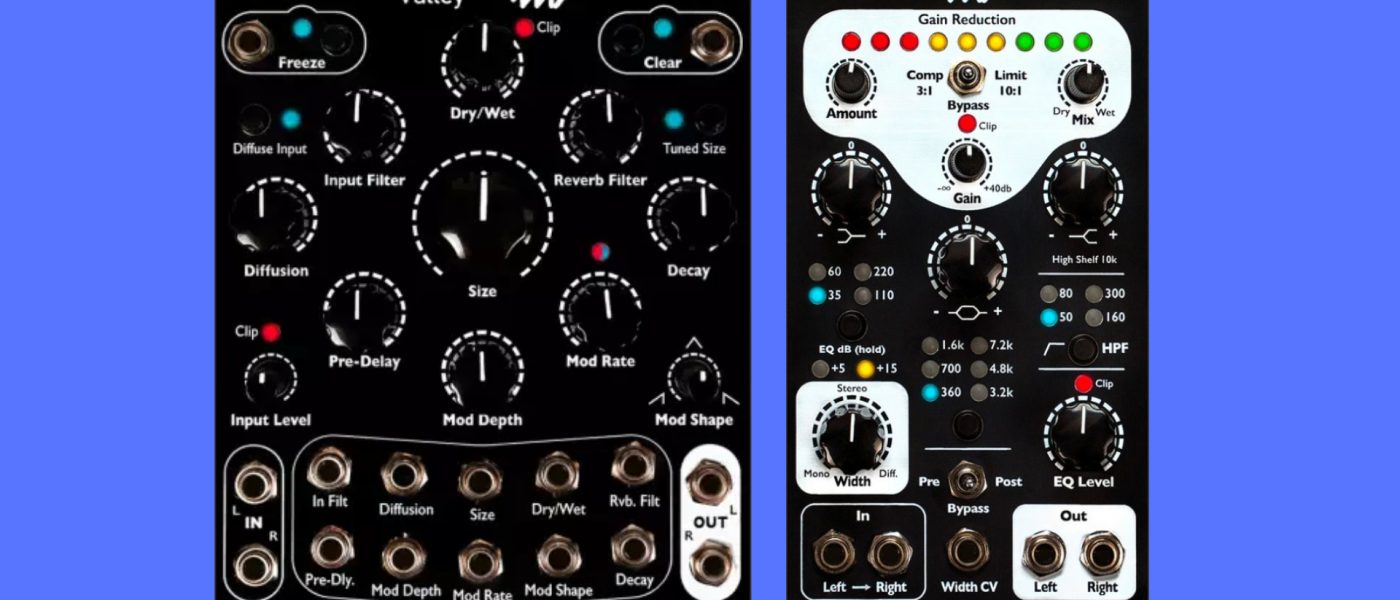
- MESA is a dedicated hardware version of the Valley Plateau reverb from VCV Rack, using the classic Dattorro 1997 algorithm with stereo I/O and CV control over 10 parameters including freeze.
- LEQA packs a compressor/limiter (3:1 and 10:1 ratios) with a three-band EQ (four switchable frequencies per low/high shelf, six mid frequencies), plus a high-pass filter and CV-controllable stereo width.
- Both modules are built to 14HP, offering hands-on knob control that the original VCV Rack version lacked due to cramped layout.
- MESA excels at endless, modulated reverb tails but also handles shorter, more restrained sounds — essentially a studio-grade plate reverb in modular form.
- LEQA targets master bus duties with its vintage-inspired tone shaping, making it a Swiss Army knife for final mix compression and EQ in a compact footprint.
Reading time: 4 min
Want more synth news before your next coffee break? Join the Noxal newsletter — no spam, just gear worth knowing about.

MESA: Hardware Reverb from VCV Rack

We at Noxal have a complicated relationship with VCV Rack. On one hand, it’s a sandbox of infinite possibility, a place where you can patch a reverb that sounds like a cathedral made of wet cardboard. On the other hand, every time we see a hardware module based on a software plugin, we feel a twinge of existential dread — like watching a ghost buy a house. But then 4ms goes and does something like the MESA, and we remember why we love hardware in the first place.
The MESA is a stereo plate reverb based on the Valley Plateau module from VCV Rack, which itself is a loving implementation of the Dattorro 1997 algorithm — the same algorithm that powers many classic digital reverbs. The difference here is that 4ms has taken the cramped, knob-dense interface of the software version and given it the room to breathe. You get control over reverb size, diffusion, pre-delay, modulation depth and rate, decay, and more, all with proper knob spacing that doesn’t require tweezers.
What makes the MESA genuinely interesting is the freeze function with its own CV input. Valley Plateau was always praised for its ability to generate endless, evolving reverb tails that feel alive rather than static. In hardware form, with CV control over 10 parameters including diffusion, size, and dry/wet, you can now modulate those tails in real-time with external sequencers or LFOs. That’s the kind of happy accident generator that justifies the price tag.
LEQA: Vintage Leveling EQ for Master Bus
The LEQA is a different beast entirely. Where the MESA is about atmosphere and space, the LEQA is about polish and power. It’s a vintage-inspired leveling EQ amplifier that combines a compressor/limiter inspired by the legendary LA2A with a 1073-style three-band EQ. Yes, that’s right: two of the most revered pieces of studio outboard gear, crammed into 14HP of Eurorack real estate.
The compressor section offers two switchable ratios — 3:1 for gentle leveling, 10:1 for brickwall limiting — along with a gain reduction meter, controls for amount, mix, and makeup gain. The EQ section is equally generous: four switchable frequencies each for the low and high shelving bands, plus a mid band with six frequency ranges. There’s also a high-pass filter and a CV-controllable stereo width processor, because 4ms apparently believes in giving you more than you asked for.
As someone who has spent far too many late nights in front of a DAW trying to get a mix to sit right, I can tell you that having this kind of processing in the modular domain is both liberating and dangerous. Liberating because you can patch it into a feedback loop and watch your mix dissolve into beautiful chaos. Dangerous because you might never leave the studio again.
Specs and Practicalities
Let’s talk nuts and bolts. The MESA is a stereo reverb module with stereo I/O, CV control over 10 parameters, and that freeze function mentioned earlier. It runs on the Dattorro algorithm, which is known for its dense, smooth plate reverb character — think less spring tank, more EMT 140. The hardware version gives you the same sound but with the tactile immediacy that VCV Rack can’t replicate, no matter how nice your mouse is.
The LEQA is also 14HP and features stereo I/O on mini jacks. The compressor section’s two ratios cover everything from subtle compression to heavy limiting, and the EQ’s multiple frequency points mean you can sculpt sounds from bass-heavy thump to airy top end. The stereo width processor is CV-controllable, which opens up creative panning effects that would be tedious to automate in a DAW.
Pricing is $399 for the MESA (available August 2026) and $345 for the LEQA (available June 30, 2026). These are not budget modules, but they’re also not outrageous for what you’re getting — especially when you consider that a standalone LA2A clone or 1073 EQ costs several times that. In modular terms, you’re paying for the convenience of having professional-grade processing in a format that integrates with your existing setup.
Market Context and Who’s It For
We at Noxal have seen the Eurorack market evolve from a niche of oscillator-and-filter basics to a place where you can build an entire mixing console. The MESA and LEQA represent that evolution in full force. They’re not sound sources; they’re sound shapers. They’re the modules you buy when you’ve got your oscillators sorted and you’re ready to make everything sound better.
The MESA is for the patcher who wants a reverb that can go from subtle room ambience to cavernous, modulated soundscapes without losing clarity. It’s for the VCV Rack user who wants to bring their favorite software reverb into the physical world. The LEQA is for the performer or producer who wants to polish their master bus without relying on outboard gear or a DAW. It’s for anyone who’s ever looked at their Eurorack case and thought, “This needs some LA2A magic.”
Who are they not for? The budget-conscious builder who’s still filling out their basic voice. The purist who thinks compression has no place in modular. The person who already owns a hardware LA2A and a 1073 and has the desk space to use them. For everyone else, these modules offer a tantalizing glimpse of what Eurorack can be when it stops trying to be a synthesizer and starts being a studio.
Frequently Asked Questions
Is the MESA reverb a direct copy of the VCV Rack Valley Plateau module?
Yes, it’s a hardware implementation of the same Dattorro 1997 algorithm used in Valley Plateau, but with improved ergonomics and CV control over 10 parameters that the software version lacks in physical form. Think of it as the module you always wished VCV Rack could be.
Can I use the LEQA as a standalone compressor without the EQ?
Yes. The compressor and EQ sections are independent, so you can engage the compressor without the EQ active, or use the EQ without compression. The module also has a mix control for the compressor, allowing for parallel compression if you patch creatively.
What’s the HP size for both modules?
Both the MESA and LEQA are 14HP modules, making them relatively compact for the features they offer. They’ll fit comfortably in most Eurorack cases without dominating the real estate, though you’ll want to leave some room for patch cables given the stereo I/O.
Now if you’ll excuse me, I need to figure out how to explain to my accountant why a $400 reverb module is a legitimate business expense. At least with these two, I can say I’m investing in mix infrastructure, which sounds much more responsible than “I wanted endless modulated tails.”