TL;DR: Erica Synths has officially released the Resonant Filterbank desktop unit at Superbooth 2026 — a stereo analog filterbank with 10 bandpass filters, digital control, and a built-in modulation engine featuring 20 LFOs and 20 envelope followers. It is a standalone version of the Eurorack module, adding dedicated faders for each band, preset recall, and MIDI CC support for $859/769€.
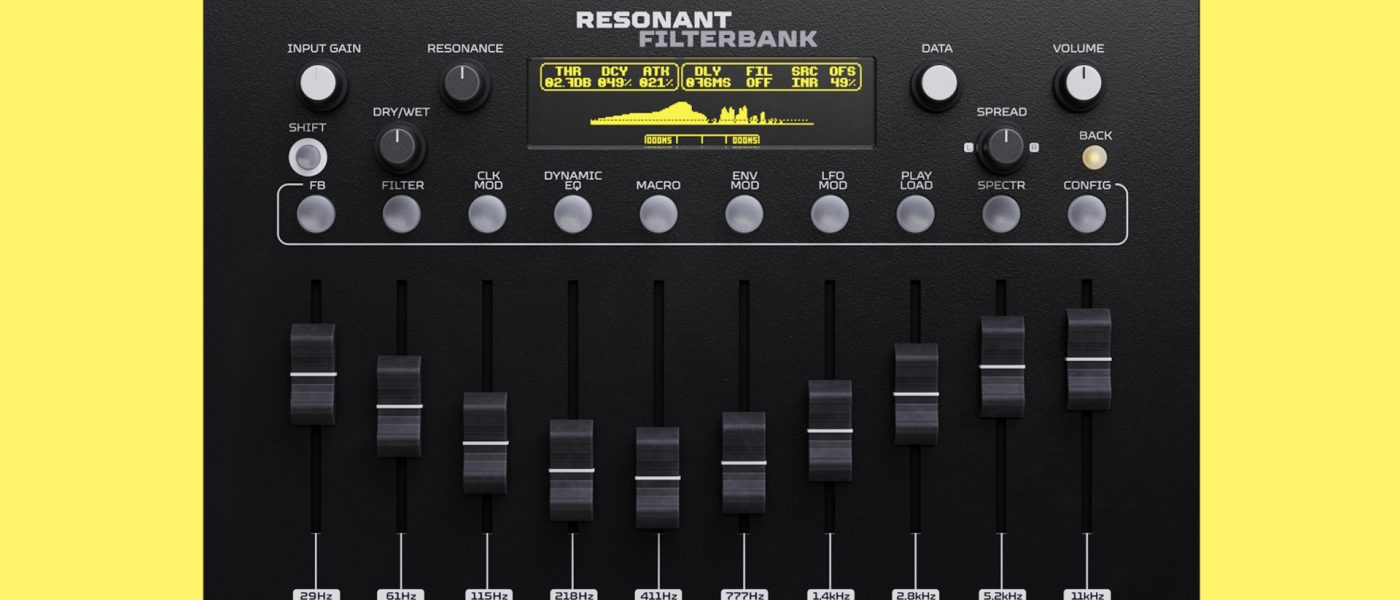
- 10-band analog filterbank with frequencies from 29 Hz to 11 kHz, slope of 17 dB/decade, and dedicated faders for hands-on boost/cut per band.
- Includes 20 independent LFOs and 20 envelope followers for internal modulation, enabling morphing filter, spectral analyzer, and dynamic spectral compressor modes.
- Analog gain stage supports inputs up to +24dB, making it compatible with synths, drum machines, and guitars.
- Preset storage via snapshots, MIDI CC support for DAW integration, and rear connectivity with 6.3mm jacks, 5-pin MIDI In/Thru, and USB-C.
- Priced at $859/769€ — a premium but justified cost for a rare stereo analog filterbank with deep modulation capabilities.
Reading time: 4 min
Want more synth news before your next coffee break? Join the Noxal newsletter — no spam, just gear worth knowing about.

What is the Erica Synths Resonant Filterbank Desktop?

Let’s get one thing straight: this is not just another Eurorack module crammed into a metal box with a power brick. The Erica Synths Resonant Filterbank desktop is a fully independent, stereo analog filterbank that takes the 2024 module and gives it the standalone treatment it deserved from the start. At its core, it is a ten-band analog filterbank with frequencies ranging from a rumbling 29 Hz all the way up to a crisp 11 kHz, each with a slope of 17 dB/decade. That’s a specific, almost surgical curve that sits somewhere between the gentleness of 12 dB and the aggression of 24 dB — perfect for both subtle sculpting and brutalist frequency mangling.
Where the Eurorack module required an additional expander to get hands-on slider control, the desktop version comes with dedicated faders for each band right out of the box. This is the kind of design choice that makes me suspect Erica Synths’ engineers actually use their own gear in the real world. Each fader lets you boost or cut the respective band in real time, turning the filterbank into a tactile performance instrument rather than a menu-diving nightmare. And yes, there is a larger screen than the 20HP module, so you can actually see what you are doing without squinting like a studio gremlin.
What Makes It Interesting Beyond the Faders?
If it were only a static filterbank with sliders, we would probably yawn and move on to the next press release. But Erica Synths has stuffed this thing with a modulation engine that is frankly excessive in the best possible way. Twenty independent LFOs and twenty independent envelope followers are available to animate individual bands or other parameters. That is not a typo. Twenty LFOs. Twenty envelope followers. In a filterbank. This is the kind of spec sheet that makes you wonder if the R&D team was fueled by something stronger than Latvian coffee.
These modulators allow you to go far beyond simple filtering. The unit offers advanced filter configuration modes that transform the bandpass filters into a morphing filter, a spectral analyzer, or even a dynamic spectral compressor. At high resonance settings, you can push it into no-input-like feedback territory, effectively using it as an experimental sound generator. It is a filterbank that can double as a chaotic noise machine — exactly the kind of dual personality we at Noxal appreciate. The internal modulation also means you can create evolving textures without touching a single patch cable, which is a godsend for live performers who already have enough things to trip over.
Key Specs and Connectivity
Let’s talk numbers because that is what we do between coffee refills. The Resonant Filterbank features an analog gain stage that can boost incoming signals up to +24dB. This is crucial because it means you can plug in not just your synthesizers and drum machines, but also guitars, bass, or even a microphone if you are feeling reckless. The input and output connectivity is handled via 6.3mm jacks (balanced, one assumes, though the source is maddeningly silent on this), and MIDI is covered with 5-pin In and Thru ports plus a USB-C port for modern convenience. There is no CV connectivity, which mirrors the module version and may disappoint the modular crowd, but the internal modulation engine arguably compensates for this — at least for those who are not allergic to digital control.
Presets can be stored as snapshots, and MIDI CC support means you can record fader movements directly into your DAW. This is a feature that separates performance gear from studio toys: you can actually recall your sweeps later, rather than relying on muscle memory and blind luck. The unit also has an on/off switch on the rear, which is a minor luxury that we appreciate more than we should. No more yanking power cables like a barbarian.
Market Context and Who It Is For
Modern stereo analog filterbanks are rare. Rarer still are those that integrate digital control without making you feel like you are operating a Soviet-era missile silo. The last notable standalone filterbank I can recall was the Sherman Filterbank, and that was a mono beast with a personality disorder. Erica Synths is filling a genuine gap here, and they are doing it at a price that, while not cheap at $859/769€, is reasonable for what you get: ten bands, twenty modulators, stereo operation, and a build quality that suggests it could survive a direct hit from a falling coffee mug.
Who should buy this? If you are a live performer who wants to add real-time spectral shaping to your set without relying on a laptop, this is your machine. If you are a studio producer who loves the sound of analog filters but wants the recallability and modulation of a digital system, this is also your machine. And if you are the kind of person who buys gear just to see if you can make it scream at high resonance settings — well, welcome home. It is a niche product, but it is a niche that deserves to be filled with something this well-executed. Erica Synths has done what we hoped they would: they took a great module, gave it faders, stereo, and a brain full of LFOs, and put it in a box you can actually take to a gig without needing a Eurorack case the size of a refrigerator.
Frequently Asked Questions
Is the Erica Synths Resonant Filterbank fully analog?
The filterbank itself is analog — the ten bandpass filters and the gain stage are pure analog circuitry. However, the control and modulation sections are digital, including the LFOs, envelope followers, and preset storage. This hybrid approach gives you the best of both worlds: analog warmth with digital precision.
Can I use the Resonant Filterbank with a guitar?
Yes. The analog gain stage can boost incoming signals up to +24dB, which is more than enough to handle guitar-level signals. You will need a standard 6.3mm jack cable, and the unit’s input impedance should work fine with passive pickups. Just be careful with the gain — high resonance and a boosted guitar can get very loud, very quickly.
Does the desktop unit have CV control like a Eurorack module?
No. The Resonant Filterbank desktop does not feature CV inputs or outputs. Erica Synths chose to rely on the internal modulation engine (20 LFOs, 20 envelope followers) and MIDI CC control instead. If you need CV control, you will want to look at the Eurorack module version, though that lacks the dedicated sliders found on the desktop unit.
I will be honest — I spent the first 20 minutes with this thing just sweeping faders and giggling like a synth-addled idiot. Then I had my third espresso and started actually reading the manual. The mod matrix is deep enough to get lost in, but that is exactly where I wanted to be. Now, if you will excuse me, I have ten bandpass filters to annoy.