
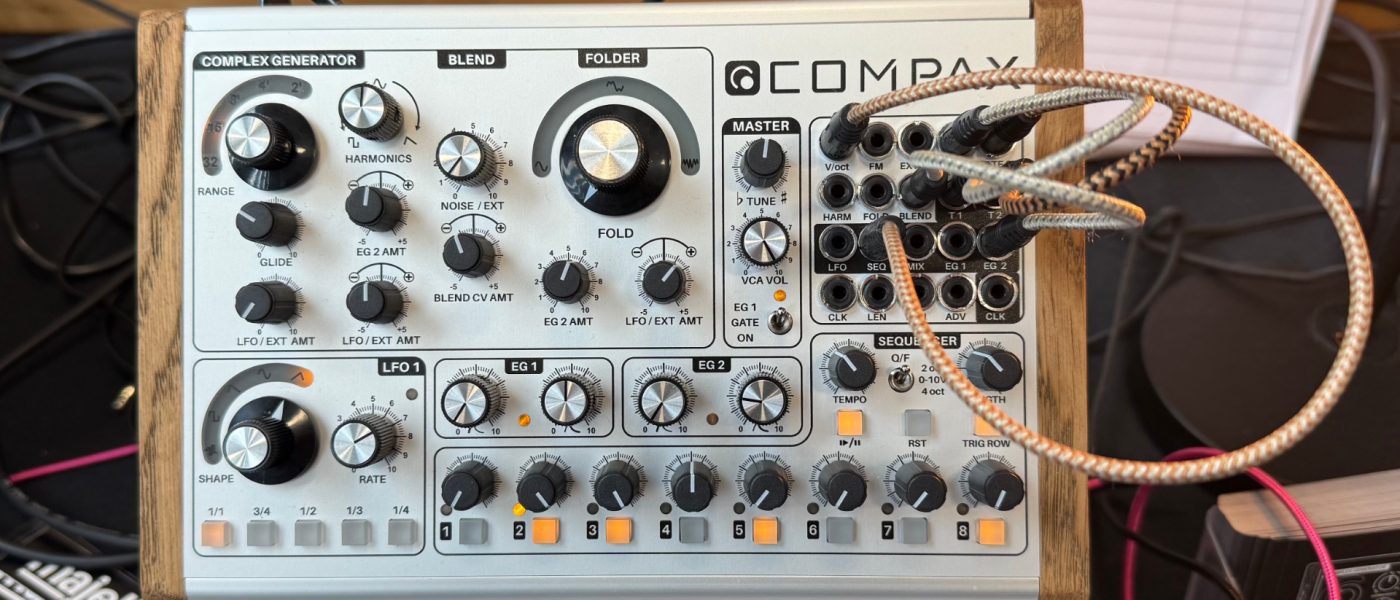
TL;DR: At Superbooth 2026, Dutch boutique synth maker Majella unveiled the Compax, a compact semi-modular analog synth rooted in West Coast synthesis. It borrows key blocks from their larger Implexus but ditches the filter and second oscillator for a wavefolder, dual rise-fall envelopes, and a built-in 8-step sequencer. Expected by year’s end for around €600-700, it’s a focused, hands-on box for harmonic mangling rather than subtractive sculpting.
- Complex oscillator with continuously variable waveforms (square → triangle → sawtooth) plus noise/Ext input with CV crossfade.
- No traditional filter — instead, a wavefolder with manual and CV control adds harmonics in true Buchla-inspired fashion.
- Built-in 8-step sequencer with CV-controllable length and run/advance inputs for external clocking.
- Patch matrix offers 12 inputs and 8 outputs, keeping it semi-modular but not overwhelming.
- Expected price between €600 and €700, release targeted for end of 2026.
Reading time: 4 min
Want more synth news before your next coffee break? Join the Noxal newsletter — no spam, just gear worth knowing about.

West Coast Compact: Not Just Another Subtractive Box

Let’s be honest, the compact analog synth market is stuffed. From the budget-friendly Behringers to the premium Dreadboxes, most of them follow the same recipe: oscillators into filters into envelopes. It works, it’s classic, and frankly, we at Noxal have reviewed enough of them to dream about filter sweeps in our sleep. But every so often, a company decides to walk the other path — the one less filtered, more folded. Enter Majella’s Compax.
Unveiled at Superbooth 2026 in prototype form, the Compax is a semi-modular analog synth that proudly wears its West Coast heritage on its sleeve. The Dutch company already gave us the Implexus, a larger desktop West Coast synth, and the Compax borrows blocks from that design. But make no mistake, this isn’t just an Implexus Mini. It’s a rethinking for those who want the harmonic richness of wavefolding without the complexity of a full modular wall. As someone who once spent an afternoon trying to explain wavefolding to a guitarist, I can tell you: this is a synth that rewards experimentation over familiarity.
The Sound Engine: Complex Oscillator Meets Wavefolder
The heart of the Compax is its complex oscillator, offering a range from 2′ to 32′ and continuously variable waveforms. You can morph from square to triangle to sawtooth without stepping through discrete shapes — a feature that feels deceptively simple until you start modulating it. Unlike the Implexus, there’s only one oscillator here. The second one has been sacrificed on the altar of compactness. Instead, you get a noise generator and an external input that can crossfade with noise via CV.
This is where things get interesting for West Coast enthusiasts. The signal path routes through a wavefolder, which can be controlled manually, via LFO, envelope, or external CV. There is no filter. None. Zero. If you need a low-pass, you’ll have to patch one externally or look elsewhere. But that’s the point: the Compax is about additive harmonic complexity, not subtractive sculpting. The wavefolder adds overtones that make simple waveforms grow teeth, then fangs, then a full set of harmonic jaws. The VCA offers three modes — envelope, gate, and drone — giving you classic West Coast sustain options.
At the prototype stage, it already sounds promising. We’ve heard demos that range from gentle, bell-like textures to snarling, metallic leads. For a box without a filter, it’s impressively versatile, though we suspect the lack of a filter will be a dealbreaker for some. To those people I say: try wavefolding before you judge. It’s like comparing espresso to drip coffee — both are valid, but one requires a different palate.
Modulation and Sequencing: Rise, Fall, and Eight Steps
Modulation is where the Compax shows its West Coast soul. Instead of the standard ADSR, you get two rise-fall envelope generators. These are the kind of envelopes that Buchla popularized — they don’t just go up and down; they can loop, slew, and behave more like function generators than simple envelopes. It’s a design that encourages you to think of modulation as a musical element, not just a utility.
There’s also a syncable LFO with five waveforms, which is perfectly adequate, though not groundbreaking. But the real surprise is the built-in 8-step sequencer. It’s straightforward: eight knobs, eight buttons, and you program it by ear. But it’s not simple. You get CV control over sequence length, a run input, and an advance input for external triggering. That means you can chain it, shuffle it, or abuse it with external clocks. In a compact synth, that’s a welcome addition — it turns the Compax into a self-contained performance tool rather than just a sound module.
The patch matrix offers 12 inputs and 8 outputs, which is a healthy amount for a semi-modular. You won’t be building a modular skiff around it, but you’ll have enough patching to keep things interesting. And for those of us who enjoy the ritual of plugging cables while our coffee gets cold, that’s exactly the right amount.
Patching and Context: Who Should Care?
At an estimated €600-700, the Compax sits in a competitive price bracket. You could buy a Moog Mavis for less, or a Make Noise 0-Coast for around the same money. But the Compax has its own personality. It’s not trying to be a do-it-all synth; it’s a focused West Coast machine with a built-in sequencer and a deliberately filterless signal path. That’s a specific audience, and Majella knows it.
Who should care? If you’re deep into East Coast subtractive synthesis and want to explore wavefolding without buying a Eurorack case, this is a solid entry point. If you already own a filter-heavy setup and want a harmonic complement, the Compax fills that role nicely. And if you’re a collector of interesting desktop gear, well, you probably already have a bookmark open for the pre-order page.
We at Noxal appreciate a synth that makes a statement, even if that statement is “I don’t need a filter.” The Compax is not for everyone, but for those who get it, it’s going to be a lot of fun. Just keep an external filter in your rack, just in case.
Frequently Asked Questions
Does the Majella Compax have a filter?
No. The Compax uses a wavefolder instead of a traditional filter. This is a deliberate design choice rooted in West Coast synthesis, where harmonic complexity is added rather than subtracted. If you need filtering, you’ll have to patch an external unit.
What is the price and release date of the Majella Compax?
The estimated price is between €600 and €700, with a release expected by the end of 2026. These are still estimates, as the unit shown at Superbooth 2026 was an early prototype.
Is the Compax compatible with Eurorack?
The Compax is semi-modular with a patch matrix of 12 inputs and 8 outputs, using standard CV/gate signals. While it’s not a Eurorack module, it can easily integrate with a Eurorack system via its patch points for external modulation and signal processing.
I’m going to need another espresso before I decide whether to pre-order or just build a wavefolder module myself. Either way, the coffee’s on.