TL;DR: Unusable Engineering returns with Partials & Discrepancies, an 8-voice additive synth plugin that marries up to 128 partials per voice with a slot-based circular sequencer. The result is a gloriously unstable, evolving sound engine that rewards the adventurous. Available now for 79€ as VST3/AU on macOS and Windows.
- 8-voice additive engine with up to 128 overtones per voice, each voice driven by a rotating circle of partial slots.
- Each slot stores a full partial shape with seven node handles, phase inversion, and six behaviour parameters (count, odd/even, distribution, etc.).
- Slot cycling supports sweep, step, slew, and key-follow transitions; also assignable per voice for eight distinct partial sets per note.
- Includes a “discrepancy” section for random voice variations in tuning, wave, slot position, plus a traditional subtractive chain (filter, envelopes, LFO).
- Supports MPE and microtonal tuning via MTS-ESP; UI is dense but functional.
Reading time: 4 min
Want more synth news before your next coffee break? Join the Noxal newsletter — no spam, just gear worth knowing about.

What Is Partials & Discrepancies?

We at Noxal have a soft spot for additive synthesis — not because it’s easy, but because it’s hard. Stacking sine waves to build complex sounds is conceptually simple, but the user interface often turns it into a spreadsheet nightmare. Unusable Engineering, a plugin house that seems to delight in making things interesting, has thrown its hat into the ring with Partials & Discrepancies, their second synth after the Bezier-wave-shaping Curves & Membranes.
This is an 8-voice polyphonic additive synth plugin for macOS and Windows (VST3/AU), priced at a reasonable 79€. It runs natively on Apple Silicon and Intel, which is a nice touch in a world where some developers still treat Intel as the default. The core idea is familiar — additive synthesis with up to 128 partials per voice — but the execution is where things get… cyclical.
The Additive Engine on a Wheel
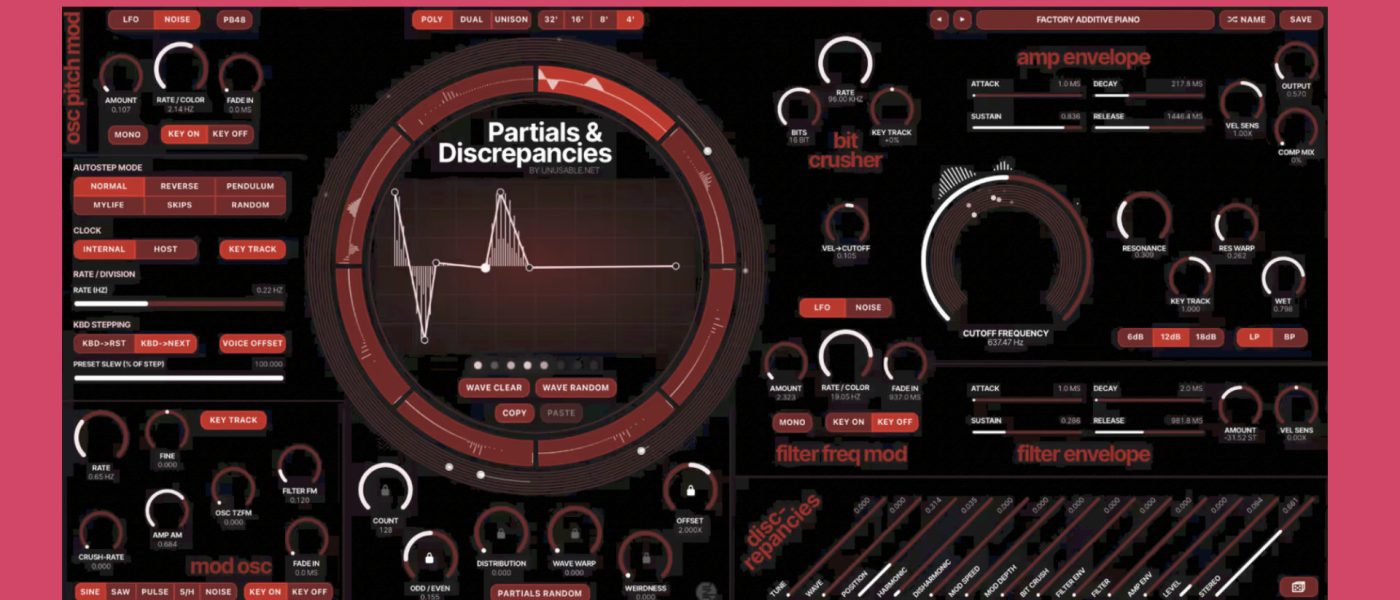
Here’s the clever bit: each voice gets a rotating circle divided into slots. Each slot stores a complete partial shape, which you can draw using seven node handles, with optional phase inversion in sub-areas. You can also let the random function do the heavy lifting, which is probably where most of us will start. The circle includes six behaviour parameters — count, odd/even, distribution, and others — that let you nudge the harmonic structure from angelic to broken in a few clicks.
The real magic, though, is the slot cycling. You set the circle in motion, and the synth sweeps through the slots. The transition between slots can be set to sweep, step, slew, or even key-follow. That last one is particularly tasty: lower notes move through the slots more slowly than higher notes, creating a kind of chaotic, pitch-dependent evolution that feels alive. You can also assign eight slots directly to the eight voices — one slot per voice — so each note gets its own partial configuration. The developer calls this an “Aphex Twin mode,” and honestly, that’s not far off. It’s like giving each key its own mini-synth.
There’s also an option to deactivate individual voices, inspired by a fault voice board on one of the developer’s hardware synths. This is the kind of “feature” that hardware enthusiasts will understand immediately: a broken voice that turns into a creative tool. We approve.
Bringing the Weirdness
If the cycling engine is the heart, the discrepancy section is the nervous system. You can inject random variations for each voice, affecting tuning, wave shape, slot position, and more. This is where the synth earns its name: the discrepancies between voices create a beautiful, unstable texture that additive synths often lack. Classic additive can sound too static, too perfect. This one sounds like it’s about to fall apart at any moment, and that’s exactly what we want.
Unusable Engineering hasn’t forgotten the basics, either. There’s a multimode filter, two ADSR envelopes, and an LFO — the traditional subtractive chain that lets you shape the sound after the additive engine has done its thing. MPE and microtonal support via MTS-ESP are also on board, so the weirdos who want to play in just intonation or with pitch bends per finger are covered.
My only gripe is the UI. It’s dense — everything is crammed onto a single page, and while that’s efficient, it can feel overwhelming. I found myself squinting at the circle editor more than once. But this is a synth for people who like to dig, not for those who want a preset machine. If you’re the type who enjoys tweaking every parameter until the sound breaks, you’ll be fine.
Market Context and Verdict
Additive synthesis is having a quiet renaissance. Melatonin’s Sine Machine showed that it can be approachable; Virsyn’s AddStation (still a favourite on iOS) proved that slot-based sweeping works. Partials & Discrepancies feels like a spiritual successor to that approach, but with a heavier dose of unpredictability. At 79€, it’s priced competitively against other niche synths — less than a single dinner for two in most cities, and infinitely more rewarding.
Who is this for? Not the beginner who wants instant gratification. This is for the synthesist who has a few too many modular cables lying around, who misses the chaos of an unstable hardware voice board, who wants to create pads that sound like they’re breathing. It’s for the person who reads the phrase “slot-based circular motion sequencer” and feels a little thrill.
We at Noxal give it a cautious thumbs up — with the caveat that you’ll need to invest time to unlock its full potential. But that’s the point, isn’t it?
Frequently Asked Questions
What platforms does Partials & Discrepancies support?
It runs as a VST3 and AU plugin on macOS (native Apple Silicon and Intel) and Windows. No AAX or standalone mode at launch.
Can I use it with MPE controllers?
Yes, MPE is fully supported. You can also use microtonal tuning via MTS-ESP, so your weird scales are welcome here.
How does the slot cycling compare to other additive synths?
It’s closest to Virsyn’s AddStation, but with more control over transitions (sweep, step, slew, key-follow) and the ability to assign different slot sets per voice. It’s more chaotic and less predictable than, say, Melatonin’s Sine Machine.
I’m writing this between sips of a third espresso, watching the partials cycle like a hypnotic wheel. At some point, I’ll have to clean the coffee mug. But not yet.