
TL;DR: Supercritical has released firmware 1.7 for the Redshift 6, adding a new Math page that introduces slews, crossfades, folding, and clipping for modulation. This update completes the synth’s front panel feature set, and also adds pitch bend as a mod source, master tune, and improved knob resolution.
- New Math page offers advanced modulation options: slews, crossfades, folding, and clipping.
- Front panel feature set is now complete, as originally envisioned by Supercritical.
- Pitch bend is now a modulation source, and master tune has been added.
- Vintage Chorus gets a wet level control; tap tempo is more stable.
- Five new presets and improved knob responsiveness for subtle tweaks.
Reading time: 8 min
Want more synth news before your next coffee break? Join the Noxal newsletter — no spam, just gear worth knowing about.

The Math Page: Where Modulation Goes to Gym
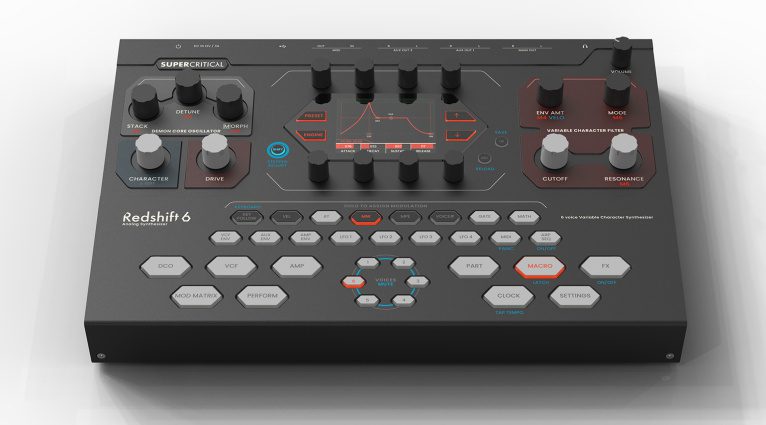
If you thought the Redshift 6 had enough modulation, you were wrong. Supercritical’s firmware 1.7 introduces a whole new page dedicated to mathematical operations on your modulation signals. Think slews that smooth out jerky movements, crossfades that blend between sources, folding that creates mirror-like reflections, and clipping that chops off peaks with barely concealed glee. It’s like a modular patch bay in a box, but without the rats’ nest of cables.
We at Noxal appreciate when a synth company doesn’t just fix bugs but actually adds new ways to mangle sound. The Math page is not a gimmick—it’s a genuine expansion of the instrument’s sonic vocabulary. Whether you want subtle, organic shifts or chaotic, brain-melting sweeps, this update gives you tools that were previously only available in the realm of eurorack or complex software environments. And it’s free. Yes, free. That deserves a respectful nod over a double shot of espresso.
Front Panel Completion: A Milestone or Just the Beginning?
Supercritical claims this update completes the full front panel feature set they envisioned when the Redshift 6 was conceived. That’s a big statement—like a chef saying the menu is finally finished. But given the synth’s history of receiving substantial updates (we’ve tracked 1.4, 1.5, 1.6, and now 1.7), it feels more like a pause than a full stop. The synth is now, arguably, the instrument it was always meant to be.
However, let’s not get too sentimental. The completion means that every knob, button, and jack on the front panel now has a purpose. No wasted space. It’s a satisfying feeling, like finishing a puzzle that’s been sitting on your desk for months. But knowing Supercritical, they’ll probably find a way to add a few more pieces anyway. We’re not complaining.
Pitch Bend, Master Tune, and Chorus Wetness
The update also brings pitch bend as a modulation source, which sounds basic but is actually a game-changer for expressive performances. Want your filter to sweep when you bend? Done. Want the LFO rate to go wild? Easy. Master tune is a welcome addition for those of us who insist on playing with other instruments that refuse to stay in A=440. And the Vintage Chorus now has a wet level control, so you can dial in just the right amount of that signature wobble without drowning your sound in syrup.
There’s also a mono output option for parts, which is great for layering and mixing in a DAW without phase headaches. And a new trigger source for per-part on/off gives you more control over which voices are active—handy for complex multitimbral patches. These are not headline-grabbing features, but they’re the kind of quality-of-life improvements that make a synth a joy to use over the long haul.
Other Tidbits and Bug-Squashing
Supercritical has also added five new presets to showcase the Math page. Expect squelchy, evolving pads and rhythmic, chaotic sequences that show off the new modulation options. The pots are now more responsive to slow movements—a subtle but important fix for those of us who spend hours tweaking filter cutoff by micro-millimeters.
Tap tempo has been stabilized, which is a relief for anyone who’s ever tried to sync a delay in a live setting only to have it drift like a sailor on shore leave. And yes, there are bug fixes. Lots of them. Because even the best firmware has gremlins, and Supercritical is methodically exorcising them one update at a time.
Who Is This For?
The Redshift 6, with this update, is for the synthesist who wants deep analog sound paired with digital flexibility. It’s for the person who loves modulation but hates menu-diving—the Math page is logical and intuitive once you spend five minutes with it. It’s for the multitimbral enthusiast who wants six voices of analog goodness with per-part effects and sequencing.
And honestly, it’s for anyone who appreciates a company that supports its products long after the initial sale. Supercritical is setting a standard that other manufacturers should envy. If you have a Redshift 6, download the update immediately. If you don’t, well, this might be the nudge you need.
Frequently Asked Questions
Is the firmware update free?
Yes, the firmware 1.7 update is free for all Redshift 6 owners. You can download it from the Supercritical website.
Does the Math page replace any existing modulation options?
No, the Math page is an addition to the existing modulation matrix. It provides new operations (slews, crossfades, folding, clipping) that can be applied to modulation signals, but all previous modulation sources and destinations remain available.
Will there be more updates after 1.7?
Supercritical has stated that the front panel feature set is now complete, but historically they have continued to release updates with improvements and bug fixes. We wouldn’t be surprised to see further refinements.
I’m going to celebrate this update by making a cup of pour-over coffee and spending the next hour feeding the Redshift 6 random modulation curves until it cries for mercy. You should too.