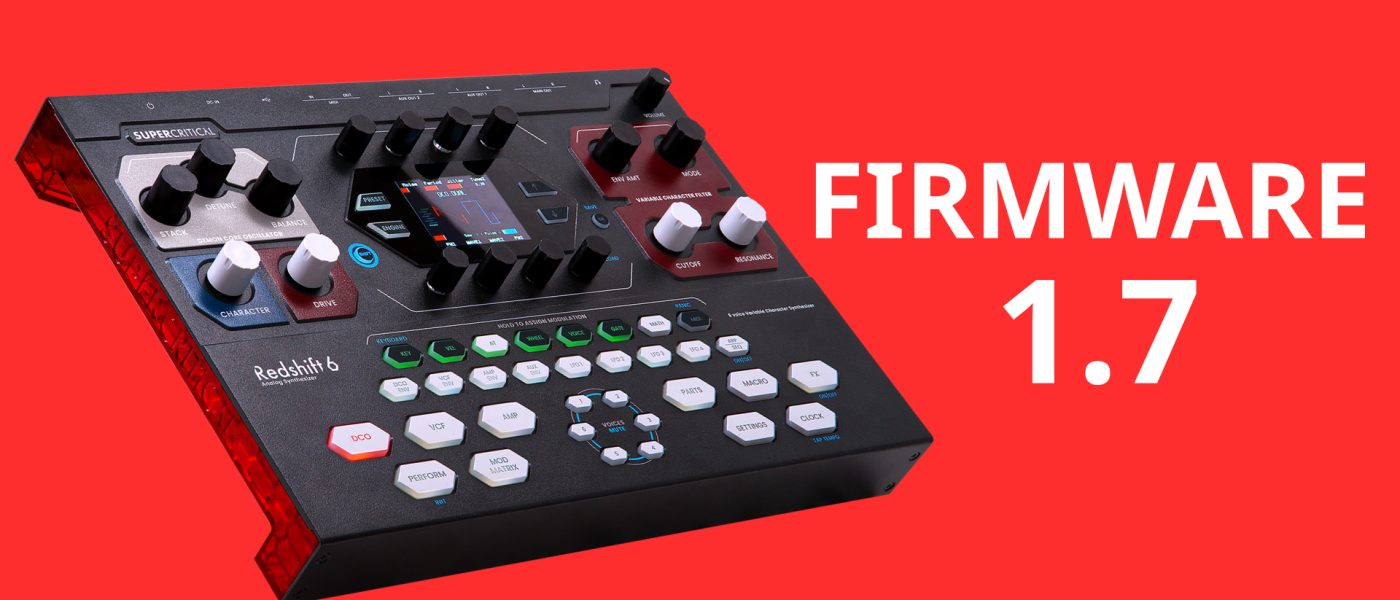
TL;DR: Supercritical Synthesizers has released firmware 1.7 for their Redshift 6 desktop analog polysynth, introducing a new math page that adds mathematical operators, slew, quantize, and sample-and-hold to the modulation engine. While the DCO phase sync engine previewed at Superbooth 2026 hasn’t made this cut, the update also improves the vintage chorus, pot responsiveness, and sequencer behavior. It’s a free update for existing users, with more DCO and VCF engines promised for later this year.
- Firmware 1.7 adds a math page with operators like slew, quantize, fold & clip, sample & hold, track & hold, and crossfade for deeper modulation shaping.
- The DCO phase sync engine teased at Superbooth 2026 is not included in this release — expect it in a future update.
- Vintage chorus gains a wet level parameter; potentiometer response has been improved for slow tweaking.
- Sequencer now continues playing when loading a different preset — a small but welcome workflow fix.
- Redshift 6 remains a 6-voice analog polysynth with 16 DCOs per voice, priced at $1299/1349€, with free firmware updates since launch.
Reading time: 4 min
Want more synth news before your next coffee break? Join the Noxal newsletter — no spam, just gear worth knowing about.

The Math Page: Modulation That Thinks for Itself
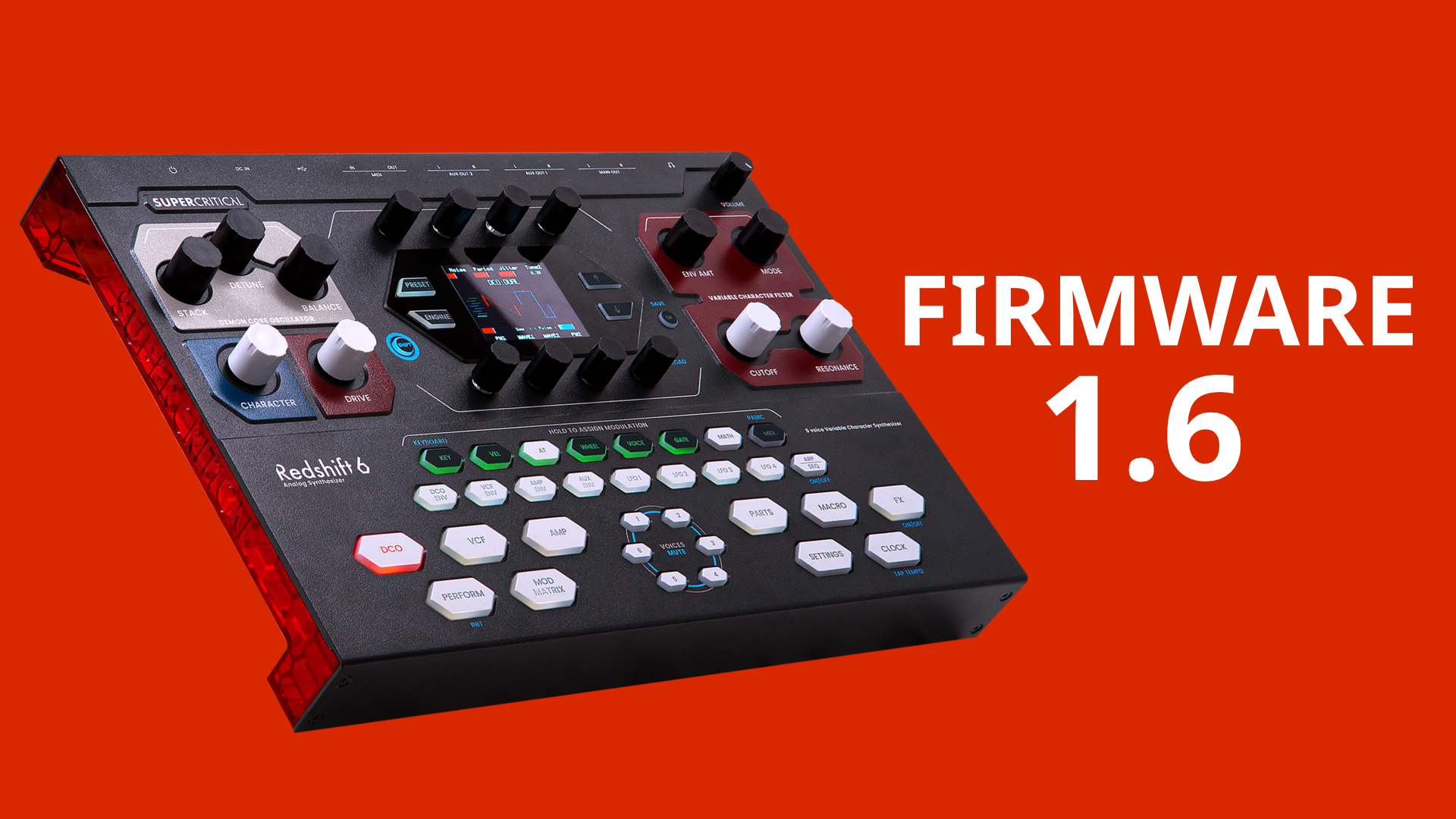
Let’s be honest: modulation routing on most synths is like a dinner party where everyone talks at once. You get a lot of noise, but little nuance. Supercritical’s firmware 1.7 for the Redshift 6 aims to fix this with a new math page that turns your modulators into something resembling a small, polite mathematics department.
The math page introduces operators that process modulation signals before they hit their destinations. This isn’t just about adding more LFOs — it’s about bending, folding, clipping, and slewing the ones you already have. Functions like slew, quantize, fold & clip, sample & hold, track & hold, switch, and crossfade let you turn a simple sine wave into something that sounds like a malfunctioning satellite. Or, if you prefer, something that moves with organic unpredictability.
In practice, this means you can take a single LFO, run it through a sample-and-hold with quantize, and produce a stepped, musical sequence without touching a sequencer. Or you can use the fold & clip operator to add harmonic complexity to a slow modulation, making filter sweeps feel less predictable. It’s the kind of feature that rewards experimentation — and that’s exactly what we like to see in a firmware update.
What Didn’t Make the Cut: The Missing DCO Phase Sync Engine
At Superbooth 2026, Supercritical teased a new DCO phase sync engine that promised to reconfigure the Redshift 6’s Demon Core oscillator architecture. The idea was to keep multiple DCOs in the same tuning while spreading their relative phases, producing flangy, sweepy tones that sound like a 90s digital synth having an analog dream. It sounded genuinely interesting.
Firmware 1.7 does not include this engine. The developers have confirmed it’s still on the roadmap, but for now, users will have to make do with the math page and the other improvements. I’ll admit, I was hoping to hear those phase-synced sweeps — but the math page is a substantial consolation prize. And given Supercritical’s track record of delivering on promises (multi-timbral support, poly sequencers, multi-FX), I’m willing to wait.
If you’re the type who pre-orders firmware features before they ship, you might feel a twinge of disappointment. But if you’ve owned a Redshift 6 for more than a year, you know that Supercritical updates are like buses: you wait ages, then two come at once. This one just happens to be the math bus.
Quality-of-Life Fixes: Chorus, Pots, and Sequencer Behavior
Not every firmware update needs to reinvent the wheel. Sometimes, you just want the wheels to roll a little more smoothly. Firmware 1.7 addresses three small but meaningful pain points.
First, the vintage chorus effect now has a wet level parameter. Previously, you had to route it through the mixer or rely on a global send — now you can dial in exactly how much of that wobbly, 80s-flavored sheen you want. It’s a small addition, but for anyone who uses the Redshift 6 for pads or ambient textures, it’s a welcome one.
Second, potentiometer response has been improved when turning knobs slowly. If you’ve ever tried to dial in a precise filter cutoff and felt like the pot was skipping steps, this fix is for you. It’s the kind of detail that doesn’t make headlines but makes a synth feel more like an instrument and less like a beta test.
Third, the sequencer now continues playing when you load a different preset. This might sound trivial, but anyone who’s ever lost a groove mid-performance knows the pain of a sequencer that stops dead. This change keeps the music flowing, which is exactly what we want from a hardware synth in a live setting.
The Bigger Picture: Redshift 6 in 2026
The Redshift 6 launched in late 2024, and since then, Supercritical has released firmware updates that have transformed it from a capable analog polysynth into a genuinely deep instrument. Multi-timbral support, polyphonic sequencers, multi-FX, and now a math page — all free. That’s a rare commitment in an industry where some companies charge for patches, let alone core features.
At $1299/1349€, the Redshift 6 sits in a competitive bracket. It faces off against the UDO Super 6, the Sequential Prophet-6, and the Moog Muse. But none of those synths offer the combination of 96 DCOs, 6-part multitimbrality, and a modulation engine that now includes mathematical operators. It’s a unique proposition, and one that keeps getting better.
The roadmap for 2026 promises new DCO and VCF engines. If the phase sync engine is anything like what was teased, we’re in for a treat. But even without it, firmware 1.7 makes the Redshift 6 a more flexible, more expressive instrument. And for that, we raise our coffee mugs to the team in Finland.
Who Is Firmware 1.7 For?
If you already own a Redshift 6, this update is a no-brainer — it’s free, it’s available now, and it adds genuine functionality. If you’re on the fence about buying one, firmware 1.7 should tip the scales. The math page alone makes the modulation engine one of the most flexible in its class, and the promise of future updates sweetens the deal.
If you’re a modular enthusiast who loves signal processing and CV manipulation, the math page will feel like home. If you’re a live performer, the sequencer fix and improved pot response will save you from awkward silences. And if you’re a sound designer, the combination of the vintage chorus wet level and the math page’s fold & clip operator should keep you busy for weeks.
Is it perfect? No. I still want that phase sync engine. But firmware 1.7 is a strong step forward, and it proves that Supercritical is serious about supporting its hardware long after the sale. In a world of planned obsolescence and subscription models, that’s worth celebrating.
Frequently Asked Questions
What is the Supercritical Redshift 6?
The Redshift 6 is a 6-voice analog polysynth with a Demon Core DCO oscillator engine capable of generating up to 96 oscillators (16 per voice). It features multi-timbral operation, a polyphonic sequencer, multi-FX, and a flexible modulation matrix. It’s priced at $1299/1349€ and has received multiple free firmware updates since launch.
Is the DCO phase sync engine included in firmware 1.7?
No. The DCO phase sync engine that was previewed at Superbooth 2026 is not included in firmware 1.7. Supercritical has confirmed it’s still on the roadmap for a future update. The current release focuses on the math page and quality-of-life improvements.
How do I get firmware 1.7 for my Redshift 6?
Firmware 1.7 is available as a free download for existing Redshift 6 users. You can download it from the Supercritical Synthesizers website. The company also offers beta versions through their Discord community if you want to test future updates early.
I’m writing this with my third espresso of the morning, and I’m reasonably certain the Redshift 6’s math page could calculate the exact caffeine-to-creativity ratio. It probably wouldn’t help, but I’d appreciate the effort. Now if you’ll excuse me, I have some modulators to fold.