TL;DR: Teenage Engineering just dropped a major firmware update (OS 2.5) for the EP-133 K.O. II that finally adds USB audio, sample reverse, an arpeggiator, and new sample rates. They also quietly released a hardware refresh with 128 MB of memory (double the original), and CME is shipping a dedicated Bluetooth MIDI adapter for the K.O. II. It’s a good time to own this little orange box — or to finally cave and buy one.
- EP-133 K.O. II OS 2.5 adds USB audio streaming and sampling, sample reverse, an arpeggiator, new lo-fi sample rates (26.25 and 32 kHz), and an Equal Length Autochop mode.
- A new hardware revision of the K.O. II ships with 128 MB of sample memory — twice the original — and is available for pre-order now.
- The EP-40 Riddim and EP-1320 Medieval also get firmware updates: the Riddim gets most of the K.O. II’s new features, while the Medieval gets USB audio.
- CME’s WIDI K.O. II adapter brings Bluetooth 5 MIDI to the K.O. II with sub-3ms latency and 20m range, priced at $39 during pre-order (until Oct 31, 2025).
Reading time: 4 min
Want more synth news before your next coffee break? Join the Noxal newsletter — no spam, just gear worth knowing about.

Firmware OS 2.5: USB Audio and the Missing Reverse Button
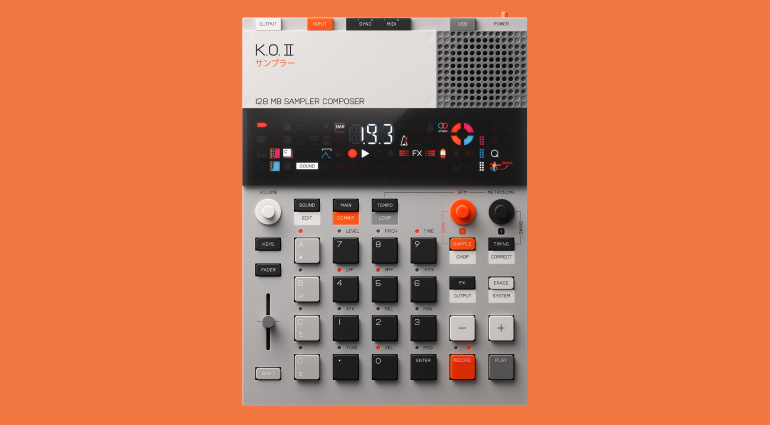
Let’s start with the update that makes you wonder why it took this long: the EP-133 K.O. II can now play samples in reverse. Yes, reverse. The feature every sampler had since the early ’90s. But we at Noxal aren’t here to mock — we’re here to celebrate that Teenage Engineering finally listened. Reverse is in. And honestly, for a device built around mangling sounds on the fly, its absence was a glaring omission. Now it’s there, and the glitch-loving community can finally sleep at night.
But the real headline is USB audio. You can now plug the K.O. II into a computer or smartphone via USB-C and send stereo audio both ways. Sampling over USB works too, which means you can grab sounds directly from your DAW or YouTube without fumbling with a 3.5 mm cable. This makes the K.O. II a much more viable studio tool — and a far better travel companion. New sample rate options (26.25 and 32 kHz) let you lean into lo-fi grit or save memory, and mono samples now stretch to 40 seconds. There’s also an arpeggiator that works in Keys mode with Oneshot and Legato samples — hold the Hold button, hit a few pads, and let the machine do the arpeggiating. It’s not a full-on synth arp, but it’s enough to add motion to your beats.
The Equal Length Autochop mode is a subtle but welcome addition. Previously, Autochop split samples by transients — great for drum breaks, less great for melodic loops. Now you can force equal-length slices, which makes chopping pads or ambient textures far more predictable. The timestretch algorithm has also been optimized. I’ll believe it when I hear it, but Teenage Engineering has a decent track record with these incremental polish updates.
128 MB Hardware Refresh: Twice the Memory, Still Tiny
If you’ve been holding out on buying a K.O. II, Teenage Engineering just gave you a reason to pull the trigger: a hardware revision with 128 MB of sample memory. That’s double the original 64 MB. Now, before you scoff and point at your Digitakt II or MPC One — yes, 128 MB is still laughably small by modern standards. But here’s the thing: the K.O. II was never about sample libraries. It’s about grabbing a sound, chopping it, and moving on. Too much memory breeds indecision. I have 50 GB of samples on my hard drive, and I still use the same three kick drums. The K.O. II forces you to commit. That’s a feature, not a bug.
Still, 128 MB is a meaningful upgrade. If you’re sampling on the fly at a live show or building a set from scratch in a coffee shop (we’ve all done it), having room for 40-second mono samples across more slots is genuinely useful. The new hardware version is available for pre-order now and should ship within a week. If you already own the original 64 MB version, there’s no upgrade path — you’ll have to buy a new unit. That stings, but Teenage Engineering has never been big on backwards compatibility when money is on the table.
CME WIDI K.O. II: Wireless MIDI for the Portable Sampler
CME, the company that made wireless MIDI almost respectable, has released a dedicated WIDI adapter for the K.O. II. It plugs directly into the sampler’s MIDI jacks, matches the orange-and-grey aesthetic, and is powered via MIDI. No batteries, no dongles dangling from the side — just a clean, flush adapter that turns the K.O. II into a Bluetooth MIDI device. Latency is rated at sub-3 ms, range is about 20 meters, and it supports Bluetooth 5. It works with macOS, Windows, Linux, iOS, and Android, and can connect to other WIDI-equipped devices or your DAW wirelessly.
This is the kind of accessory the K.O. II always deserved. The sampler’s portable nature is somewhat undermined by the need for a MIDI cable. Slap this on, pair it with an OP-XY or a laptop, and you’ve got a truly wireless sketchpad. The pre-order price is $39 (€39 / £34) until October 31, 2025, after which it jumps to $59. Shipping starts November 1. If you own a K.O. II and have ever tripped over a MIDI cable at a gig, this is a no-brainer.
Who Should Care — and Who Should Walk Away
The OS 2.5 update is free, so every K.O. II owner should download it immediately. USB audio alone is worth the price of admission — it transforms the sampler from a fun toy into a legit studio tool. The reverse function and arpeggiator are gravy. If you’ve been on the fence, the 128 MB hardware refresh makes the K.O. II a more compelling purchase, especially if you value immediacy over sample-count flexing. The CME WIDI adapter is a niche but excellent accessory for live performers or anyone who hates cables (which should be everyone).
Who should skip this? People who need deep sample manipulation, multi-track sequencing, or a screen larger than a postage stamp. The K.O. II is still a quirky, knob-heavy groovebox with a learning curve shaped like a cliff. It’s not for everyone. But for those who crave tactile, immediate sampling with a side of Swedish design, this is the best the K.O. II has ever been. And we haven’t even mentioned the Medieval update — yes, the EP-1320 Medieval gets USB audio too. Your lute samples are now USB-ready.
Frequently Asked Questions
Does the EP-133 K.O. II OS 2.5 update cost money?
No, the firmware update is free and available for download from the Teenage Engineering website. All existing K.O. II owners can update their units without paying a cent.
Can I upgrade my original 64 MB K.O. II to 128 MB?
No. The 128 MB version is a new hardware revision. You cannot upgrade the memory on an existing unit — you would need to purchase the new model. Teenage Engineering has not offered a paid upgrade path.
Is the CME WIDI K.O. II compatible with the EP-1320 Medieval?
Yes, CME states that the WIDI K.O. II adapter is compatible with both the EP-133 K.O. II and the EP-1320 Medieval. It plugs into the MIDI jacks of either device.
I’d write more, but my coffee’s gone cold and the K.O. II is now sampling the sound of me sighing through USB. Priorities.