
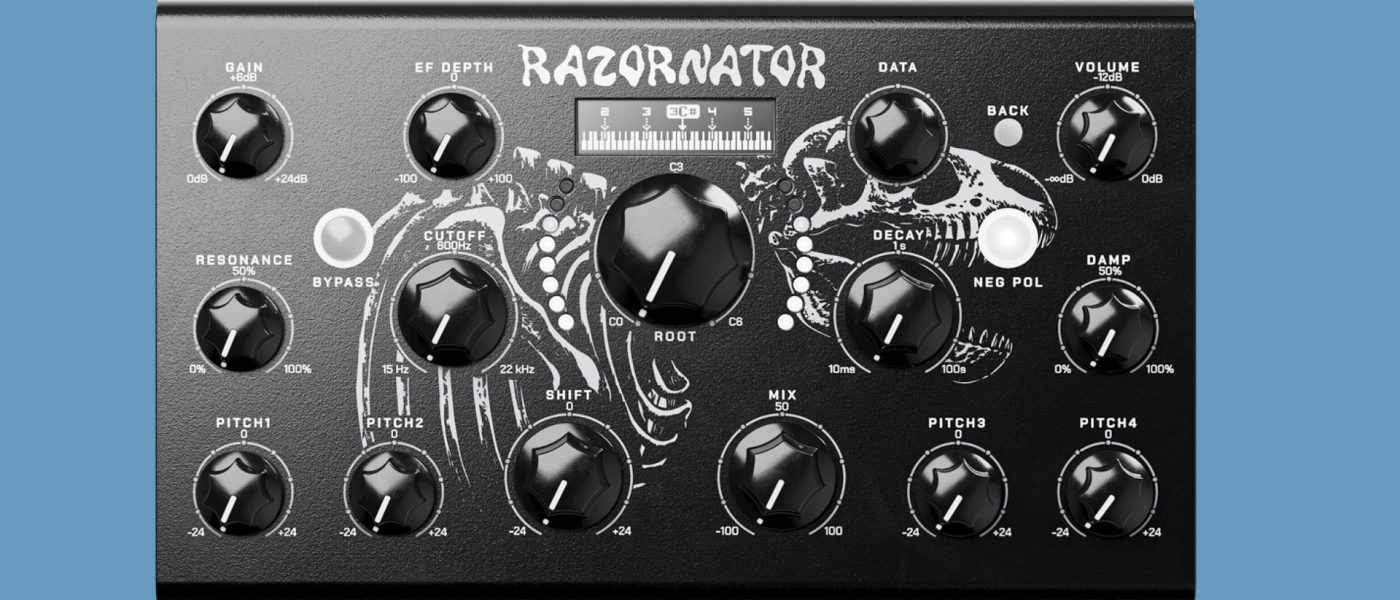
TL;DR: Erica Synths, in collaboration with Dutch software wizards 112dB, announces the Razornator – a desktop stereo resonator FX unit that packs five Karplus-Strong-based delay lines into a sleek aluminum chassis. It’s a rare standalone hardware resonator that promises to transform sterile signals into organic, acoustic-like textures, and it’s shipping as of July 3, 2026, for €490 + VAT.
- Features five chromatically tuned, Karplus-Strong-based stereo delay lines (10 resonators total) that emulate physical objects like instrument bodies and rooms.
- Signal path includes analog overdrive via a +24dB gain stage, a resonant low-pass filter, a compressor, an envelope follower, and a built-in equalizer.
- Full MIDI support (5-pin DIN and USB) with all parameters automatable, plus a footswitch input for expressive control.
- Compact, all-metal desktop design matching the Xenodrive and Nightverb series, with 12 hands-on parameters and onboard preset storage.
- Priced at €490 + VAT + shipping, available from July 3, 2026.
Reading time: 4 min
Want more synth news before your next coffee break? Join the Noxal newsletter — no spam, just gear worth knowing about.

What Is the Razornator?

The Razornator is the latest desktop FX box from the ongoing collaboration between Erica Synths and 112dB, the Dutch plug-in developers who previously gave us the Steampipe Synthesizer and the Xenodrive distortion. This time, the focus is on resonance — not the feedback-squeal kind, but the physical-modeling kind. Inside that familiar aluminum housing (same as the Xenodrive and Nightverb) lives an algorithm that uses five chromatically tuned stereo delay lines, each based on Karplus-Strong synthesis.
For those unfamiliar with the term: Karplus-Strong is a technique that uses a short delay line with a filter to simulate the sound of a plucked string or a resonating body. It’s been a staple of physical modeling synthesis for decades, but it’s rarely available in standalone hardware form outside of Eurorack modules. The Razornator gives you ten of these resonators (five per stereo channel), all tunable chromatically via a main shift control and four offset parameters.
Why Resonators Matter
Resonators are one of those effects that can instantly transform a lifeless signal into something that sounds like it was recorded in a cathedral made of piano strings. They add harmonic complexity and a sense of physical space that reverb alone can’t touch. The Razornator’s resonators are designed to emulate the resonance of instrument bodies, rooms, and structures — think of it as adding a ghost instrument to your sound.
What makes this particularly musical is the chromatic tuning. Unlike a fixed resonator bank (looking at you, certain Eurorack modules), you can dial in specific pitches on the fly. This means you can tune the resonators to the key of your track, making the effect feel less like a random wash and more like a deliberate harmonic layer. The built-in envelope follower can also drive the pitch offsets dynamically, so the resonators respond to the amplitude of your input signal. It’s subtle when you want it, and monstrous when you don’t.
Signal Path and Controls
The signal flow in the Razornator is worth unpacking. It starts with an analog gain stage that can boost signals up to +24dB, which the developers claim can act as an analog overdrive. Then, it passes through a resonant low-pass filter before hitting the five Karplus-Strong resonators. After the resonators, the signal is summed and compressed, then mixed with the dry signal, run through a built-in equalizer, and finally sent to the balanced outputs.
On the front panel, you get 12 parameters for direct control, plus save/recall for presets. The back panel is equally generous: stereo in/out via 3.5mm jacks, a footswitch input, 5-pin MIDI in/out, and USB. Full MIDI control over all parameters means you can automate the Razornator from your DAW or hardware sequencer. The power switch is also on the back, which is a small but appreciated detail for those of us who leave our gear patched.
Market Context and Alternatives
Standalone hardware resonators are rare. You’ll find them in Eurorack (e.g., the Mutable Instruments Rings and its clones, or the 4ms SMR), but as a dedicated desktop box, the Razornator is almost alone in its category. The closest competitor might be the Eventide H9 with a resonator algorithm, but that’s a multi-effects unit with a different philosophy. The Gotharman’s Zybraz is a resonator-based synthesizer, not an FX box. So the Razornator fills a genuine gap.
At €490 + VAT, it’s not cheap. But compare it to building a Eurorack resonator setup — a Rings clone, a case, power supply, and utilities — and the price starts to look reasonable. The build quality is excellent, the collaboration with 112dB ensures the algorithm is mature, and the compact form factor makes it easy to integrate into any studio or live rig.
Who Is This For?
The Razornator is for sound designers, experimental musicians, and anyone who feels that their current effects chain lacks soul. It’s for the person who wants to turn a simple monosynth line into a resonating alien artifact, or add subtle harmonic richness to a drum machine. It’s also for the Eurorack user who wants a dedicated resonator without sacrificing HP or dealing with patch cables.
Is it for everyone? No. If you’re happy with digital reverb and delay, you probably don’t need this. But if you’ve ever wished your sounds had more “body” — that intangible quality that makes a recording sound like it exists in a real space — the Razornator might be exactly what you didn’t know you were missing.
Frequently Asked Questions
What is Karplus-Strong synthesis?
Karplus-Strong is a physical modeling technique that uses a short delay line with a filter to simulate the sound of a plucked string or a resonating object. It creates natural, organic timbres that are distinct from standard subtractive synthesis. The Razornator uses five chromatically tuned Karplus-Strong delay lines per stereo channel.
Can I control the Razornator with MIDI?
Yes. The Razornator has full MIDI support via 5-pin DIN and USB, and all parameters can be automated from your DAW or hardware sequencer. It also has a footswitch input for hands-free control.
Is the Razornator stereo?
Yes, it’s a fully stereo processor. It has stereo input and output via 3.5mm jacks, and the five delay lines are arranged as stereo pairs, giving you ten resonators total.
I’m already imagining feeding a cheap drum machine through this thing and calling it “composition.” Now if you’ll excuse me, my coffee has gone cold and my studio smells like soldering flux and ambition.