TL;DR: Dreadbox has released firmware 1.2 for the Artemis analog synth, adding two new Sinevibes BBD algorithms (Resonator and Playground), improved reverb processing, a full modulation matrix, and triplet/dotted note support across LFOs, delays, sequencer, and arpeggiator. The update transforms an already impressive six-voice desktop synth into a deeper, more experimental instrument without costing a penny.
- Two new Sinevibes BBD algorithms — BBD Resonator (comb filter) and BBD Playground (experimental delay) — expand the delay section significantly.
- A dedicated modulation matrix now gives LFOs, envelopes, velocity, aftertouch, key tracking, and MPE timbres their own pages; assignable via knob or encoder.
- Reverbs (Small, Large, Huge, Shimmer) have been reworked for better tail structure, diffusion, and stereo width.
- Triplet and dotted note values now available for LFOs, delays, sequencer, and arpeggiator — and the arpeggiator supports up to 32 notes.
- VCO1 Tune is now a modulation destination, opening up subtle pitch modulation possibilities.
Reading time: 4 min
Want more synth news before your next coffee break? Join the Noxal newsletter — no spam, just gear worth knowing about.

The Big News: Sinevibes BBD Algorithms
If you’ve followed Dreadbox for any length of time, you know their partnership with Sinevibes is the real deal. The Typhon proved that, and Artemis has been carrying that torch. But firmware 1.2 isn’t just a bug-squash — it’s a proper upgrade that makes the synth feel like a new instrument.
The headline act is two new bucket brigade delay algorithms. BBD Resonator is a comb filter effect that turns your signal into resonant, metallic textures — think of it as a delay that’s more interested in timbre than time. BBD Playground, on the other hand, is the chaotic cousin: an experimental delay algorithm designed to get wild. Dreadbox doesn’t overpromise here; “experimental” is code for “turn knobs and see what breaks beautifully.” I’ve spent an afternoon with it, and the unpredictability is addictive. It’s the kind of feature that makes you forget you were supposed to be writing a review.
These aren’t just new presets — they’re entirely new signal paths. Sinevibes has coded them from scratch, and they sit alongside the existing delay engine. This means you can now layer a BBD delay with the reverb, distortion, and modulation effects that Artemis already offered. The result? A six-voice analog synth that can sound like a malfunctioning spaceship or a cathedral at dusk, depending on your mood.
Reverb Rework and Modulation Matrix
Sinevibes didn’t stop at delays. The four reverb algorithms — Small, Large, Huge, and Shimmer — have all been tweaked. The official line is “better tail structure, larger diffusion, and a wider stereo image,” which in practice means the reverbs feel less like a wash and more like a space. The Shimmer reverb, in particular, now has a more natural shimmer that doesn’t overwhelm the analog core. It’s a subtle improvement, but one that matters when you’re building a mix.
On the modulation side, Dreadbox has added a proper modulation matrix — and I mean proper. LFOs, envelopes, velocity, mod wheel, aftertouch, key tracking, and even MPE timbres each get their own dedicated pages. To assign a modulation, you simply move a knob or use the encoder. It’s fast, intuitive, and far less fiddly than menu-diving on other synths. VCO1 Tune is now also available as a modulation destination, which opens up pitch modulation for subtle vibrato or wild FM-style sweeps. This is the kind of feature that makes the Artemis feel less like a preset machine and more like a modular system in a box.
Triplets, Arpeggiator, and Other Tweaks
Sometimes it’s the small things. Triplet and dotted note values are now available across LFOs, delays, the sequencer, and the arpeggiator. This might sound like a minor update, but if you’ve ever tried to sync a delay to a 6/8 time signature on a synth that only does straight quarters, you know the pain. The arpeggiator now supports up to 32 notes, which is borderline ridiculous for a desktop synth — but in the best way. You can also preview presets before loading them, which saves you from the “load, hate, reload” loop that plagues so many hardware synths.
There are a few other tweaks scattered throughout the update, but honestly, the combination of BBD algorithms, modulation matrix, and rhythmic flexibility is enough to justify the download. Dreadbox has clearly been listening to user feedback, and it shows.
What Is Artemis and Why It Matters
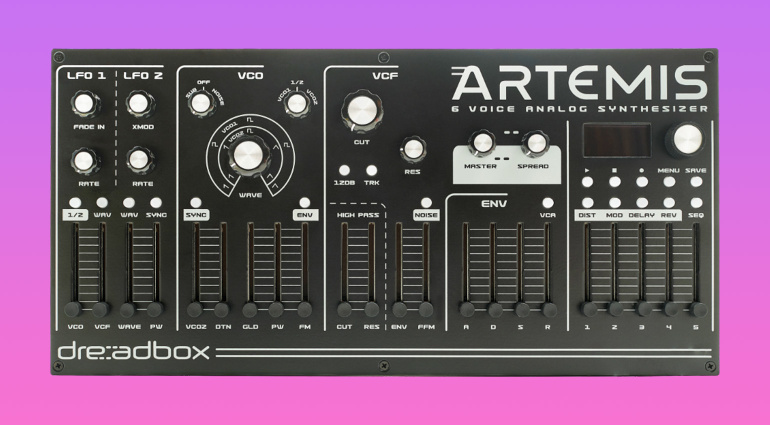
For the uninitiated: Dreadbox Artemis is a six-voice polyphonic analog synthesizer in a tabletop format. It launched in 2024 as a collaboration with Sinevibes, building on the legacy of the Typhon but scaling up to polyphony. Each voice has two Dreadbox oscillators with continuously variable wave shaping, sync, frequency modulation, and pulse width, plus a sub oscillator and noise generator. The filter section offers a switchable 12/24dB resonant lowpass with keyboard tracking, drive, and FM, alongside a resonant highpass filter. Modulation comes from two ADSR envelopes and two LFOs with BPM sync and fade-in.
What sets Artemis apart — beyond its sound — is the effects section. You get distortion/bit crush, modulation effects (chorus, ensemble), delay, and reverb, all usable simultaneously. That’s a lot of processing power for an analog synth. And with firmware 1.2, those effects are now deeper than ever. The synth also includes a polyphonic sequencer, arpeggiator, and polyphonic aftertouch, making it a serious performance instrument.
At €1,290, it’s not cheap — but it’s competitive with other high-end desktop synths like the Sequential Take 5 or the Novation Summit. And with the Sinevibes partnership, it offers something those don’t: world-class DSP effects integrated at the hardware level. The wood panels shown in some promotional images are not included; they’ll be sold separately later. So if you were hoping for a warm wooden chassis, you’ll have to wait.
Who Should Care
This update is for anyone who already owns an Artemis and wants to squeeze more life out of it — and for anyone who was on the fence. The modulation matrix alone makes the synth more programmable, while the BBD algorithms turn it into a sound design playground. If you’re a live performer, the arpeggiator and sequencer improvements are worth the download. If you’re a studio rat, the reverb tweaks and new delay types will give you more options for sound design.
For those who don’t own an Artemis yet: this firmware is a signal that Dreadbox is committed to supporting this instrument long-term. That’s rare in a world where many manufacturers release a synth and move on. If you value instruments that grow with you, Artemis is worth a serious look.
Frequently Asked Questions
Is the firmware update free?
Yes, firmware 1.2 is a free download from the Dreadbox support page. No paid upgrades, no subscriptions — just a straightforward update that adds significant new features.
Does the update add any new hardware features?
No, this is purely a firmware update. The modulation matrix, BBD algorithms, and arpeggiator improvements are all implemented via software. No new knobs, jacks, or panels are required.
Will the wood panels be included with new purchases?
No. The wood panels shown in some promotional images are optional accessories that will be available separately at a later date. The synth ships without them.
I’ve already updated my Artemis and spent an hour just feeding it random knob movements with the BBD Playground algorithm. My coffee went cold. Worth it.