
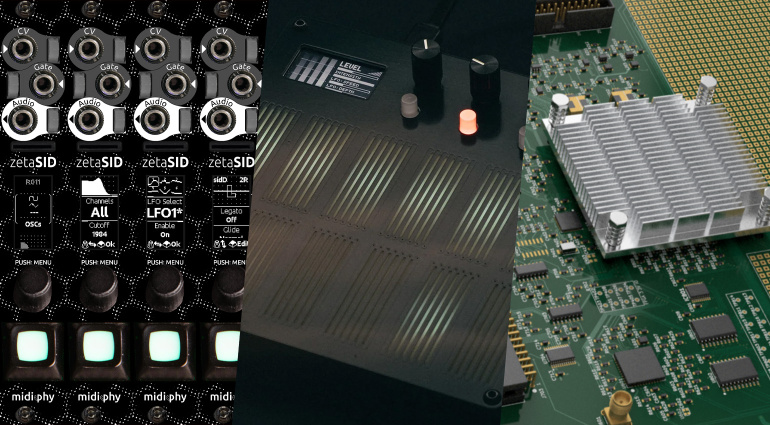
TL;DR: midiphy’s zetaSID Eurorack module gets a firmware update adding a 303-style bassline engine, Doboz releases the DVNA chord and texture synth with capacitive touch keys, and Freshwater Instruments offers a modern CPU upgrade card for the Fairlight CMI. All three prove that classic synthesis and clever engineering can still surprise us.
- midiphy zetaSID firmware 1.5 introduces a bassline sequencer with eight 16-step patterns, per-step note, octave, gate, slide, accent, and one freely assignable parameter.
- Doboz DVNA is a compact chord synth with a capacitive 12-pad keyboard, four oscillators, morphing systems, stereo multi-mode filter, overdrive, reverb, and delay.
- Freshwater Instruments FI50A CPU Card replaces the original computer section of the Fairlight CMI with a quad-core ARM CPU running Linux and RTOS, adding Wi-Fi, USB, Bluetooth, and 4K display output.
- zetaSID is back in stock at €199.98, Doboz DVNA costs €370, and the FI50A pricing is available on the developer’s site.
Reading time: 4 min
Want more synth news before your next coffee break? Join the Noxal newsletter — no spam, just gear worth knowing about.
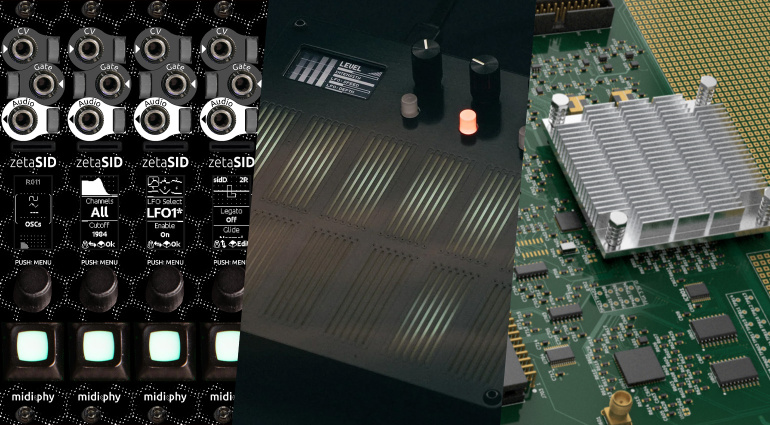
zetaSID Basslines: midiphy’s 303 Engine Gets Eurorack

We at Noxal have a soft spot for modules that pretend to be one thing and turn out to be ten. The zetaSID from midiphy, a 4 HP Eurorack module based on the MIDIbox SID synthesis engine, was already a formidable beast. Six LFOs, eight modulation paths, two envelopes, four wave sequencers, three independent arpeggiators, and a trigger matrix — that’s more modulation than most full-size synths dare to offer. And if you poly-chain up to twelve of them with a nexusMIDI expansion, you get a six-voice stereo instrument that can do everything from chiptune nostalgia to genuinely complex sound design.
But now, with firmware version 1.5, it gets a bassline engine. And not just any bassline engine — a proper 303-style step sequencer with eight patterns of sixteen steps each, per-step control over note, octave, gate, slide, and accent, plus one freely assignable parameter per step. This is the kind of update that makes you wonder why you ever bought a separate 303 clone. The new engine turns the zetaSID into a groovebox that fits in a few inches of rack space. And if you’re chaining multiple units, you can sequence them all from one master module. I’ve already started clearing space in my rack for a second one.
The module is back in stock at €199.98, and the firmware is a free download. If you’ve been on the fence, now is the time to jump off — preferably onto a pre-order button.
Doboz DVNA: Chord Synth Without the Cliches
Chord synths are having a moment. And while we’ve seen plenty of them lately — from the SOMA Lyra-8 to the Opsix’s chord mode — the Doboz DVNA takes a different approach. Instead of a traditional keyboard or grid of buttons, it uses a capacitive illuminated keyboard with twelve contact pads. Each pad triggers a full chord or interval, built from the synth’s four oscillators. And because the pads are touch-sensitive, you can use pressure as a modulation source. That’s expressive, immediate, and a little bit weird — exactly the kind of interface that makes you play things you wouldn’t normally play.
Under the hood, the DVNA offers a built-in quantizer locked to one of twenty-five scales, various tuning modes from fixed chord voicings to free microtonal tuning, and morphing systems for oscillator mix and panning. There’s a stereo multi-mode filter, overdrive, reverb, and delay. All of this is packed into a compact desktop unit that costs €370. That’s less than a high-end guitar pedal, and it gives you a full harmonic instrument with stereo effects. We’re not saying it’s the perfect travel companion, but we’re not not saying that either.
What I appreciate most about the DVNA is that it doesn’t try to be a complete workstation. It’s a tool for getting out of your harmonic ruts. You can spend an afternoon just exploring chord voicings and never touch a melody. That’s a rare luxury in a world where every synth wants to be everything to everyone.
Freshwater Instruments FI50A CPU Card: Fairlight CMI for the Modern Era
If you own a Fairlight CMI, you’re probably one of two things: a collector with a museum piece, or a working musician who’s tired of replacing capacitors. Either way, the FI50A CPU Card from Freshwater Instruments is the upgrade you didn’t know you needed. It fully replaces the original computer section of the CMI mainframe, using a 78-contact connector to interface with the CPU bus. The card runs a quad-core ARM CPU with Linux for general tasks and a separate RTOS for real-time effects, channel card handling, and MIDI/keyboard I/O.
The specs are, frankly, ridiculous for a machine that originally ran on a 68000. You get an SD card slot for loading sound libraries and updates, a display port that supports up to 4K resolution, and the ability to connect legacy CRT screens and light pens via a CMI-compatible 10-pin connector. But the real kicker is the connectivity: Wi-Fi for waveform upload, USB, and Bluetooth. Your Fairlight CMI can now talk to your laptop without a serial cable and a prayer.
The installation is straightforward and reversible, according to Freshwater Instruments. So if you ever want to go back to the original — perhaps to remind yourself how much better life is with a quad-core CPU — you can. Pricing is on the developer’s site, but we’ll say this: if you have a Fairlight CMI and you’re not at least looking at this card, you’re doing it wrong.
Market Context: Three Different Kinds of Newness
What ties these three announcements together isn’t just that they’re synth-related. It’s that they represent three different ways of being new in a hardware synth market that often feels saturated. The zetaSID update is a software-driven addition that extends the life and versatility of an existing module — a reminder that firmware updates can be as exciting as new hardware. The Doboz DVNA is a fresh take on an interface, using capacitive touch to rethink how we interact with harmony. And the FI50A CPU Card is an upgrade path for a legendary instrument that most people assumed was frozen in amber.
We at Noxal appreciate all three approaches. The market doesn’t need another generic subtractive synth with a 16-step sequencer and a reverb. But it does need tools that challenge us, that give us new ways to make mistakes and discoveries. The zetaSID bassline engine, the DVNA’s touch pads, and the FI50A’s modern guts all do exactly that. They’re not just products; they’re invitations to play differently.
And if you need an excuse to spend money on gear you don’t strictly need, these three are as good as any.
Frequently Asked Questions
Can the zetaSID bassline engine be used alongside the original synthesis engine?
Yes. The firmware update adds the bassline engine as an additional mode, so you can switch between the original polyphonic/chordal operation and the new 303-style sequencer. You don’t lose any existing functionality.
Is the Doboz DVNA suitable for live performance?
Absolutely. The capacitive touch pads are responsive and expressive, and the built-in quantizer and scale locking mean you can play harmonically complex chords without worrying about wrong notes. The stereo effects and morphing systems add plenty of movement for live sets.
Will the FI50A CPU Card work with any Fairlight CMI model?
The card is designed to be compatible with the CMI mainframe’s 78-contact CPU bus connector. Freshwater Instruments recommends checking your specific model’s compatibility on their website before purchase. The installation is reversible, so you can always revert to the original hardware.
I was going to make a joke about the Fairlight upgrade needing a separate coffee machine, but then I realised my own studio setup already has three espresso machines and zero functional patch cables. Priorities.