TL;DR: AKAI Professional has launched the MPC Live III Retro, a limited-edition variant of its flagship standalone sampler that swaps the standard black chassis for the iconic cream-and-grey colour scheme of the late ’80s and early ’90s MPCs. Under the hood, it’s identical to the current MPC Live III — meaning an 8-core processor, 8 GB of RAM, 128 GB of internal storage, and the expressive MPCe pads — but the retro aesthetic includes the original AKAI logo from the golden age of sampling. Available now for €1,599, it’s a nostalgia trip for beatmakers who want modern power in a classic wrapper.
- The MPC Live III Retro is a cosmetic-only special edition — no hardware or software changes versus the standard MPC Live III.
- It features the classic cream-and-grey colour scheme and the original AKAI Professional logo from the late ’80s/early ’90s.
- Under the hood: an 8-core processor, 8 GB of RAM, 128 GB of internal storage, support for up to 32 plugin instances, 16 audio tracks, and the high-quality zplane Stems Pro algorithm.
- The MPCe pads allow for up to four samples per pad and function as X/Y controllers, while the built-in battery (4 hours), stereo speakers, and microphone make it genuinely portable.
- Priced at €1,599 at Thomann — the standard black model remains available at the same price.
Reading time: 4 min
Want more synth news before your next coffee break? Join the Noxal newsletter — no spam, just gear worth knowing about.

The Retro Treatment: Cosmetic Nostalgia or More?
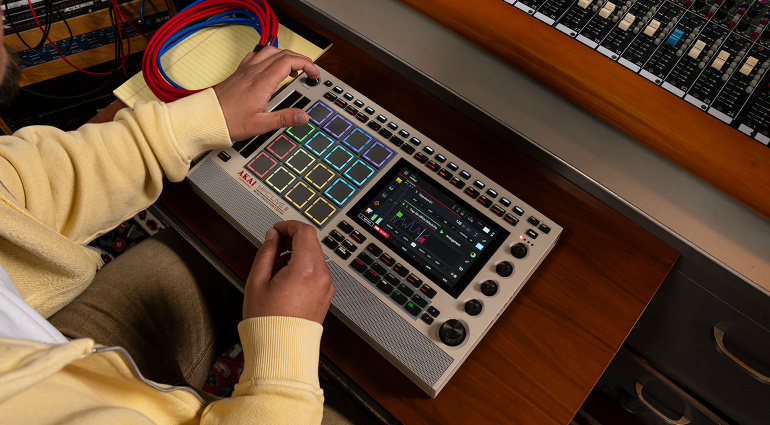
Let’s get the obvious out of the way: the AKAI MPC Live III Retro is, mechanically, the exact same machine as the standard black MPC Live III. There is no upgraded processor, no extra RAM, no secret firmware feature. What you get is a colour swap — the classic cream-and-grey palette that defined the MPC60, MPC3000, and those early SP-1200-adjacent workhorses — and a logo that says “AKAI Professional” in the same serif font your favourite producer from 1991 had tattooed on their forearm.
And you know what? I’m okay with that. In a world where every new groovebox is either matte black or brushed aluminium, AKAI is betting that a bit of retro warmth will resonate with the generation that grew up on grainy YouTube beat-making videos. It’s a bold move, but one that feels earned — the MPC Live III is, after all, a genuinely capable machine, and slapping a classic paint job on it doesn’t feel like a cash grab so much as a love letter to the brand’s heritage.
We at Noxal have seen this before with other gear — the Korg Minilogue XD in cream, the Roland TR-8S in silver — but AKAI’s execution here is particularly faithful. The retro logo alone will make anyone who used an MPC2000 in their dorm room feel a pang of something. Whether that something is worth €1,599 is a question only your bank account can answer.
Under the Hood: The Same Beast
For those who haven’t been following the MPC Live III since its October 2024 launch, here’s a quick refresher. The third-generation Live replaced the quad-core processor of the Live II with a second-generation 8-core CPU — four times the power, according to AKAI. This enables up to 32 plugin instances and 16 audio tracks simultaneously, which is frankly bonkers for a standalone device. The 8 GB of RAM and 128 GB of internal storage also put it ahead of the previous flagship, the MPC X SE, which offered less than half that storage out of the box.
The real star, though, is the zplane Stems Pro algorithm. Previously exclusive to the MPC desktop software, Stems Pro now runs natively on the Live III, allowing you to extract vocals, drums, bass, and other elements from audio with impressive fidelity. This is the kind of feature that turns a sampler into a production hub, and it’s a big reason why the MPC Live III — Retro or not — is a serious contender for the centrepiece of a DAWless setup.
Connectivity is equally generous: multichannel audio and MIDI over USB-C, WiFi and Bluetooth, plus the usual array of jacks and CV/gate outputs. The built-in rechargeable battery lasts up to four hours, and the integrated stereo speakers and microphone mean you can sketch ideas in a hotel room without hauling out a mixer. It’s a portable studio, not just a groovebox.
What the MPC Live III Brings to the Table
I spent a week with the standard MPC Live III before this Retro edition was announced, and I have to say: the MPCe pads are not a gimmick. Each pad can hold up to four samples simultaneously, which opens up expressive layering possibilities — think of them as mini X/Y controllers for timbre, pitch, or filter sweeps. The touch strip and four touch-sensitive knobs add further gestural control, making the Live III feel less like a step-sequencer and more like an instrument.
The step sequencer buttons and clip matrix are also welcome additions for anyone who came up on Ableton Live or Bitwig. You can trigger scenes, mute tracks, and arrange on the fly without diving into menus. It’s a workflow that bridges the gap between classic MPC finger-drumming and modern clip-launching, and it works surprisingly well in practice.
That said, the MPC Live III is not a beginner’s toy. The learning curve remains steep — AKAI’s OS is powerful but labyrinthine, and you will spend an evening or two squinting at the 10.1-inch touchscreen. But for those willing to invest the time, the payoff is enormous. This is a machine that can do everything from chopping vinyl to sequencing a Eurorack system to running a full mix through its internal effects.
Market Context: Who Is This For?
At €1,599, the MPC Live III Retro sits in a crowded but distinct niche. It’s competing with the Roland SP-404MKII (€599) for portability, the Elektron Octatrack (€1,499) for live sampling, and the Maschine+ (€1,199) for standalone beat-making. But the MPC Live III offers something neither of those do: a truly modern processor that can handle 32 plugin instances without breaking a sweat, plus the classic MPC ecosystem of expansions, synths, and effects.
We at Noxal think the Retro edition is primarily aimed at two groups: first, the nostalgia-driven producer who wants the vibe of an MPC3000 without the maintenance headaches and floppy disks; second, the collector who already owns a standard MPC Live III and wants a shelf piece that also happens to be a fully functional studio centrepiece. For everyone else, the standard black model is €1,599 and does the same thing — but if you’re going to stare at a box for hours, you might as well enjoy looking at it.
Is it worth the premium over a used MPC Live II? That depends on how much you value the extra power, the MPCe pads, and the clip matrix. The Live II is still a fantastic machine, but the III is a clear generational leap. If you’re buying new today, the Retro edition is a no-brainer for anyone who hates the industrial black aesthetic.
Frequently Asked Questions
Is the MPC Live III Retro limited edition?
Yes, AKAI has not announced a production run number, but the Retro colour scheme and logo are described as a special edition. Once they’re gone, they’re gone — so if you’re tempted, don’t wait for a Black Friday sale.
Does the Retro edition come with any exclusive software or expansions?
No. The MPC Live III Retro includes the same software bundle as the standard model: the MPC desktop software, a selection of plugin instruments (including the Hype synth and Fabric collection), and a few expansion packs. No extra “retro” sound banks are included, though you can, of course, load your own.
Can I upgrade the internal storage in the MPC Live III Retro?
Yes. The MPC Live III (both standard and Retro) supports adding a SATA SSD internally, in addition to the 128 GB of built-in storage. You can also expand via USB drives or SD cards. It’s a good idea to budget for an SSD if you plan on working with large sample libraries.
I’ll be honest: I spent ten minutes staring at the Retro colour scheme while my espresso went cold. It’s that kind of machine — the kind that makes you forget about time, coffee, and your next deadline. And honestly, that’s the whole point.