TL;DR: Behringer has finally released the JT-2, a paraphonic analog synthesizer that distills a single voice from the legendary Roland Jupiter-8 into a Eurorack module. Available now in the EU for €179, it offers two VCOs, a VCF, autotune, and an arpeggiator, but skips patch memory entirely. We at Noxal are cautiously intrigued, but we’re also wondering if this is the Jupiter-8 clone we’ve been waiting for or just another teaser that’s arrived before the coffee’s brewed.
- Behringer JT-2 is a paraphonic Eurorack module based on a single voice of the Roland Jupiter-8, now available in the EU at Musicstore.de for €179.
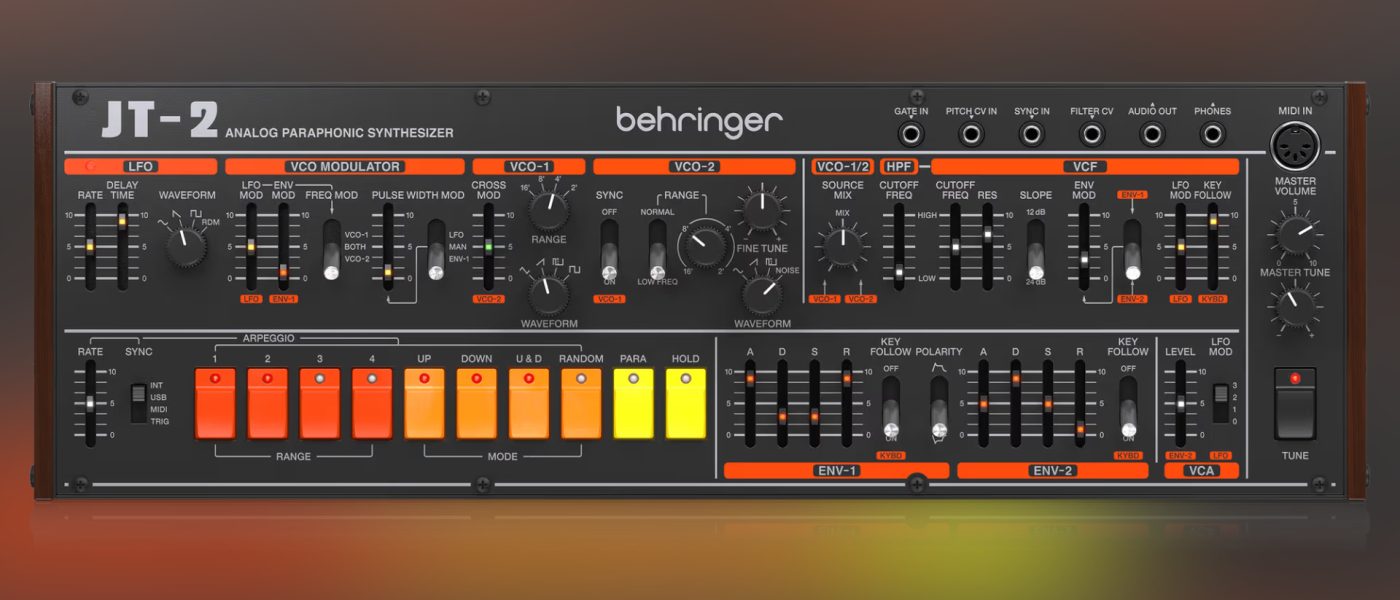
- Specs include two VCOs with cross-modulation and sync, a 24dB/oct low-pass/high-pass filter, two envelopes, an LFO, autotune, and a syncable arpeggiator with Jupiter-style buttons.
- Patch points are limited to gate in, pitch CV in, sync in, filter out, and a phone socket—no patch memory, which fits Eurorack norms but limits standalone appeal.
- First batch is limited and first-come, first-served, with a price of $189/€189/£159 for pre-orders elsewhere; earlier rumors of $299 may apply to future runs.
- Behringer is also working on a full-keyboard Jupiter-8 clone (Bupiter-8), so the JT-2 feels like a paraphonic appetizer before the main course.
Reading time: 4 min
Want more synth news before your next coffee break? Join the Noxal newsletter — no spam, just gear worth knowing about.

What Is the Behringer JT-2?
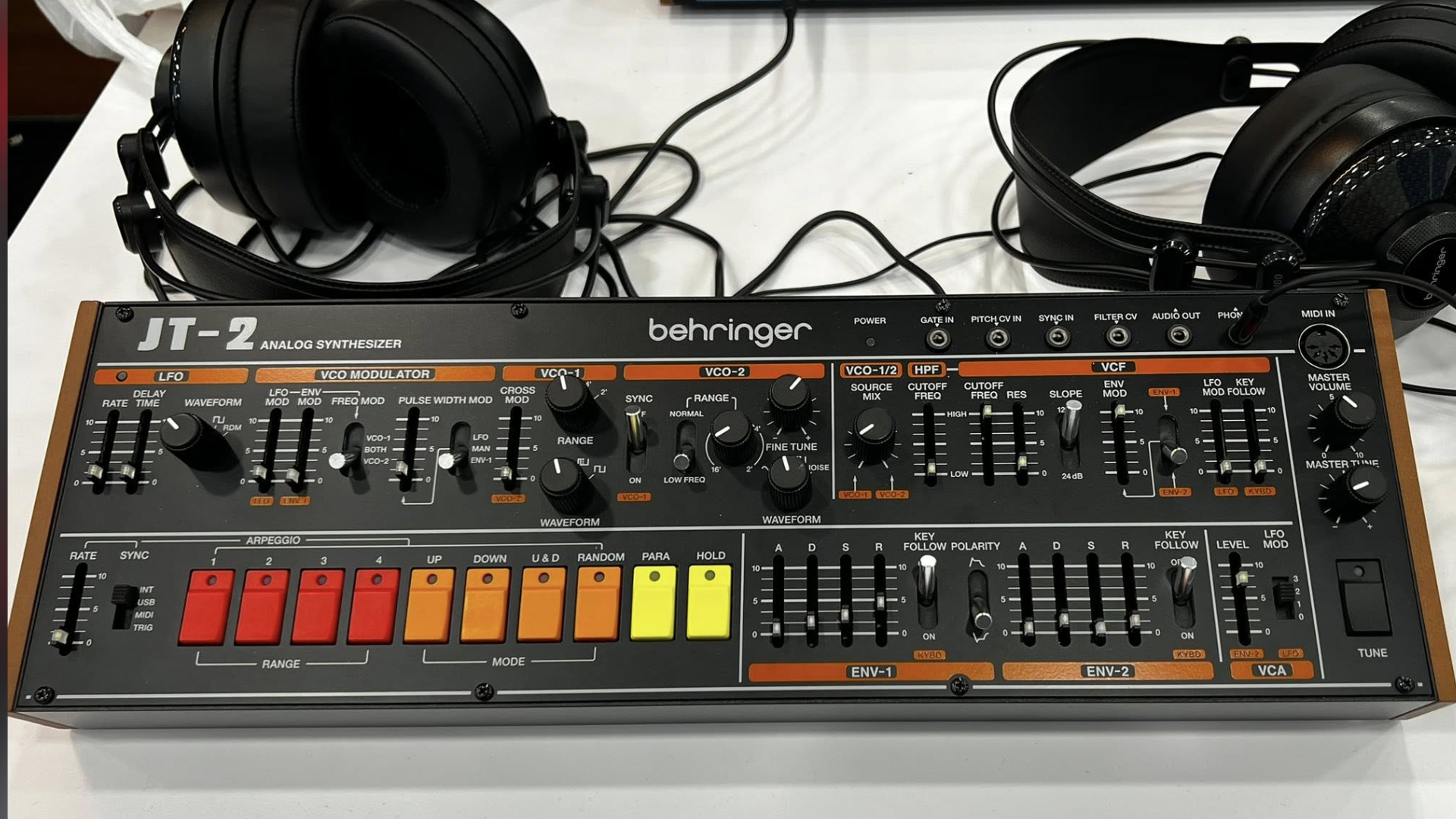
The Behringer JT-2 is, for lack of a better term, a Jupiter-8 voice in a Eurorack module—minus the polyphony and plus a dash of paraphonic charm. Unveiled in final form at NAMM 2026 and officially released in mid-April, it’s now available in the EU at Musicstore.de for a wallet-friendly €179. We at Noxal have been tracking this one since the teaser wave of early 2024, when Behringer’s endless promises of “coming soon” synths led to what we affectionately call “teaser saturation syndrome.” But the JT-2 is actually here, in the flesh, and it’s not just another vaporware Instagram post.
Essentially, Behringer took the single voice from their Eurorack Jupiter (itself a clone of the Roland Jupiter-8’s voice architecture) and stripped it down to a paraphonic, one-voice unit. This means you get two oscillators that can play together but share a single filter and envelope path—sacrificing true polyphony for a more affordable, compact package. As we like to say around the Noxal studio, it’s the Jupiter-8 minus seven voices, plus a price tag that won’t require selling a kidney.
What Makes It Tick?
At its core, the JT-2 replicates the Jupiter-8’s voice structure: two VCOs with cross-modulation and sync, a 24dB/oct low-pass filter that also switches to high-pass mode, two envelopes (one for amplitude, one for the filter), and an LFO. Behringer claims it uses “authentic” circuitry, which in translation means it likely uses the same chipset and topology as their other Jupiter clones, just in a smaller 20HP Eurorack format. What’s genuinely interesting is the inclusion of an autotune function—a feature borrowed from the original Jupiter-8’s automatic calibration system—and a syncable arpeggiator controlled by those colorful Jupiter-style buttons on the front panel.
But here’s the rub: there’s no patch memory. None. Zero. Zilch. This is standard for Eurorack modules, where patch cables define your sound, but if you were hoping to save your favorite Jupiter-8 pad and recall it later, you’re out of luck. The JT-2 is pure knob-twiddling, hands-on synthesis—which, as we at Noxal often argue, is either liberating or infuriating depending on your caffeine intake. The arpeggiator adds a nice rhythmic edge, but without memory, you’re locked into live performance or endless notetaking. It’s the synth equivalent of a jazz musician who refuses to read sheet music.
Key Specs and Features
Let’s get technical for a moment. The JT-2 features two VCOs with sawtooth, pulse, and triangle waveforms, plus cross-modulation and hard sync for those classic Jupiter-8 sweeps. The filter is a 24dB/oct low-pass with resonance that can self-oscillate, and it also offers a high-pass mode (via a switch) for more aggressive timbres. Two ADSR envelopes handle the amp and filter, while an LFO with multiple waveforms (triangle, saw, square, and random) modulates pitch, filter cutoff, or pulse width. The arpeggiator is syncable via MIDI or CV, with up, down, up/down, and random modes, all controlled by those tactile, color-coded buttons.
Connectivity is sparse but functional: you get gate in, pitch CV in, sync in, filter out, and a 3.5mm headphone jack on the front panel. On the back, there’s a 6.3mm audio output, MIDI thru, and a USB port for firmware updates and MIDI over USB. This is a far cry from the patch-bay-heavy modules we’ve seen from Make Noise or Doepfer, but for a single-voice Jupiter clone at this price, it’s acceptable. The dimensions are 20HP wide, making it a snug fit in any Eurorack case, and the build quality feels solid—plastic, but not cheap plastic. It’s the kind of module you’d trust to survive a late-night studio session fueled by espresso and bad decisions.
Market Context and Who Is It For
The JT-2 enters a crowded market of budget analog synths. At €179, it undercuts the Korg Monologue and even Behringer’s own Neutron, but it’s more expensive than the Crave. Its main competition is the Moog Minitaur (if you want bass) or the Arturia MicroBrute (if you want patchability), but neither offers that specific Jupiter-8 voice character. This module is clearly aimed at two groups: Eurorack enthusiasts who want a classic Jupiter sound without the polyphonic price tag, and keyboard players who are tired of waiting for Behringer’s promised full-keyboard Jupiter-8 clone (the Bupiter-8) and want a taste now.
But here’s the Noxal take: we’re not entirely sure who needs a paraphonic one-voice Jupiter. If you’re building a Eurorack system, you’re better off with a more flexible module like the Instruo Cs-L or the Mutable Instruments Plaits clone (the Behringer Grind, which just launched in the EU). If you’re a keyboard player, the lack of patch memory and keys is a dealbreaker. The JT-2 feels like a niche product—a novelty that sounds great but doesn’t quite fit into most workflows. It’s the synth equivalent of a single-origin espresso shot: beautiful and intense, but you’re not going to drink it all day.
Frequently Asked Questions
Is the Behringer JT-2 a polyphonic synthesizer?
No, it’s paraphonic, meaning it has two oscillators that can play together but share a single filter and envelope path. It cannot play chords like a true polyphonic synth. Think of it as a single voice from a Jupiter-8, not the whole orchestra.
Does the JT-2 have patch memory?
No, it does not. Like most Eurorack modules, the JT-2 relies on physical knob positions and patch cables for sound design. If you need to save presets, this synth will leave you frustrated. We recommend a notepad and a good pen.
When will the full-keyboard Jupiter-8 clone (Bupiter-8) be released?
Behringer has confirmed they are working on a full-keyboard Jupiter-8 clone, but no release date has been announced. Given their track record of teaser oversaturation, we at Noxal advise patience—and maybe a backup synth in the meantime.
The JT-2 is available now, but we at Noxal recommend you buy it, patch it, and then immediately start a new email chain to Uli Behringer demanding the Bupiter-8. Because nothing says “synth obsession” like refreshing a retailer page between coffee refills.