
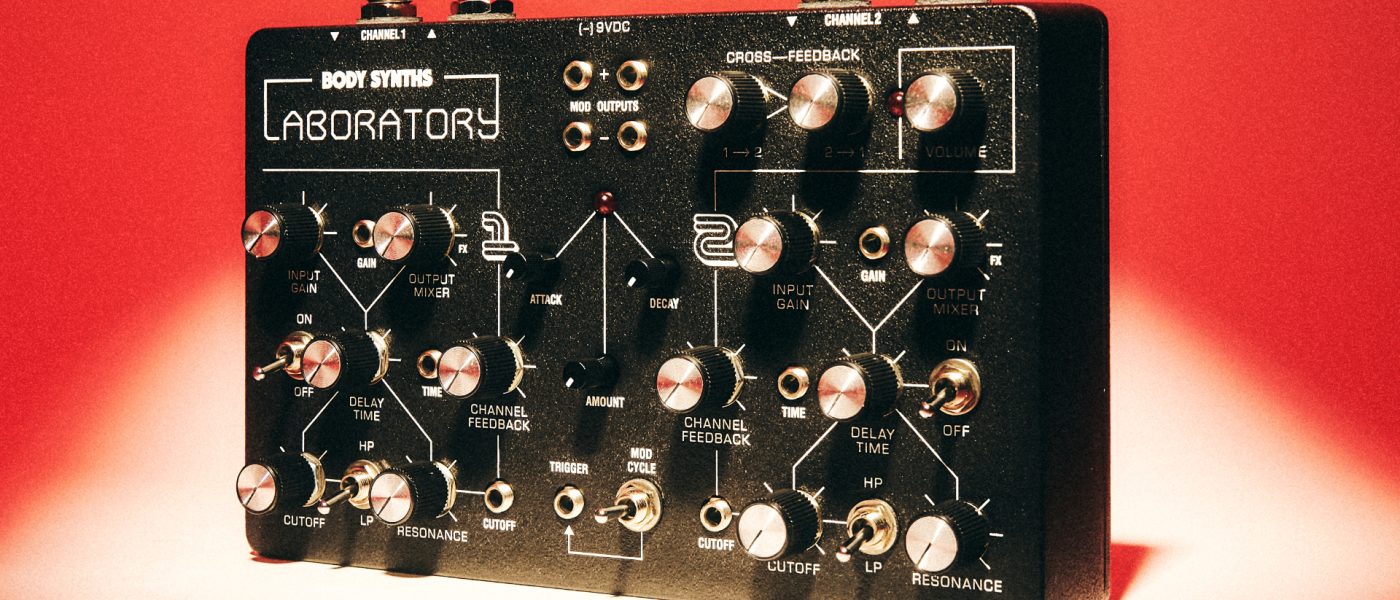
TL;DR: Body Synths Laboratory is a patchable dual FX processor with four feedback paths that can transform into a drone synth. It offers voltage-controlled gain, delay, resonant filters, and built-in modulation, making it a versatile tool for experimental sound design. Previewed at Superbooth 2026, it will be available later in the year.
- Dual-channel FX processor with voltage-controlled gain, delay, and resonant filter (lowpass/highpass) per channel.
- Four feedback paths enable self-oscillation, turning the unit into a feedback drone synthesizer.
- Built-in modulation (LFO or AD envelope) with two modulation channels (positive/negative) for patching to CV inputs.
- Channels can be chained in series for band-pass filter effects or multi-tap/ping-pong echoes.
- Clipping stage at each channel adds compression and distortion when driven hard.
Reading time: 4 min
Want more synth news before your next coffee break? Join the Noxal newsletter — no spam, just gear worth knowing about.

Dual FX Core

The Body Synths Laboratory is not your typical synthesizer. It lacks classic oscillators, which might sound like a downgrade, but trust me—it’s a feature, not a bug. At its core, this is a dual-channel effect processor. Each channel gives you voltage-controlled gain, delay, and a resonant filter that can toggle between lowpass and highpass modes. Think of it as a modular-grade FX unit that doesn’t need a Eurorack case to make noise.
You can feed external signals through the I/O on each side, or route the internal feedback for more chaotic results. The channels can be chained in series, which transforms the filter into a band-pass configuration and changes the delay behavior. This means you get multi-tap and ping-pong echoes when using both channels together. It’s like having a delay pedal that can also do your taxes—if your taxes were made of noise.
Feedback Synth Twist
Here’s where things get interesting: the Laboratory has four feedback paths. Yes, four. These paths let you route signals through the system to generate classic delay repeats with grid and texture. But the real magic happens when you push it into self-oscillation. The unit becomes a feedback drone synthesizer, capable of producing everything from subtle, evolving drones to harsh, aggressive noise.
According to Body Synths, having two independent channels for stereo feedback noise is a rarity among feedback and experimental noise instruments. I’d say that’s an understatement. Most feedback devices are monophonic or require external routing to achieve stereo. The Laboratory delivers this out of the box, which is a welcome change for those of us who like our noise with a side of spatial awareness.
Key Specs and Modulation
Each channel has dedicated controls for cutoff, resonance, delay time, and a clipping stage that adds compression and distortion when driven hard. The built-in modulator can act as either an LFO or an AD envelope generator, with two modulation channels (one positive, one negative) that can be patched to various CV inputs. This opens up a world of possibilities: stereo filter sweeps, modulated delays that sound like chorus, or amplitude modulation for tremolo and vibrato.
One thing that’s not yet clear from the press materials is whether the Laboratory is analog or digital. Given that the Metal Fetishist drum synthesizer was digital, I’d wager the Laboratory follows suit. But honestly, with feedback-based instruments, the distinction often blurs. What matters is how it sounds, and from the description, it sounds like a box of broken dreams you can control.
Market Context and Audience
We at Noxal have been watching the rise of feedback-driven synthesizers with great interest. In a market saturated with classic analog subtractive synths, it’s refreshing to see developers like Body Synths exploring resonator and feedback-based designs. The Laboratory fits neatly into this niche, offering a hands-on, patchable experience that rewards experimentation.
Who is this for? If you’re a fan of noise, drone, or experimental music, this is your jam. It’s also a solid choice for sound designers who want a unique FX processor that can double as a synth. The price is TBA, but it will be available in 2026 and previewed at Superbooth 2026 in Berlin on May 7–9. If you’re in Berlin, you can probably smell the solder fumes from here.
Frequently Asked Questions
Is the Body Synths Laboratory analog or digital?
Body Synths hasn’t confirmed this yet, but based on their previous Metal Fetishist drum synth, which was digital, it’s likely digital. The feedback paths and modulation suggest a digital core, but the exact architecture remains under wraps.
Can the Laboratory be used as a standalone synth?
Yes, but with a twist. It doesn’t have traditional oscillators, so it won’t produce standard synth tones. Instead, it generates sound through feedback and self-oscillation. Think of it as a drone synth or noise box rather than a melody machine.
What is the price and release date?
Price is TBA, but it will be available in 2026. The unit will be previewed at Superbooth 2026 in Berlin on May 7–9. We’ll update you as soon as we know more.
I’ll be patching mine into a cup of coffee and seeing if it brews feedback loops instead of espresso. Stay noisy, friends.