
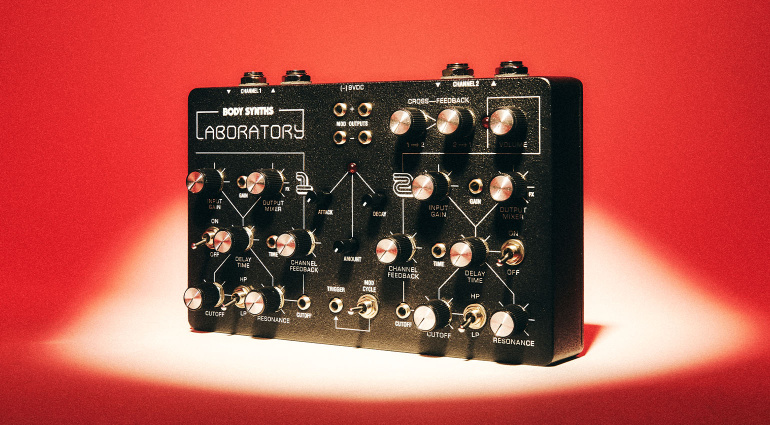
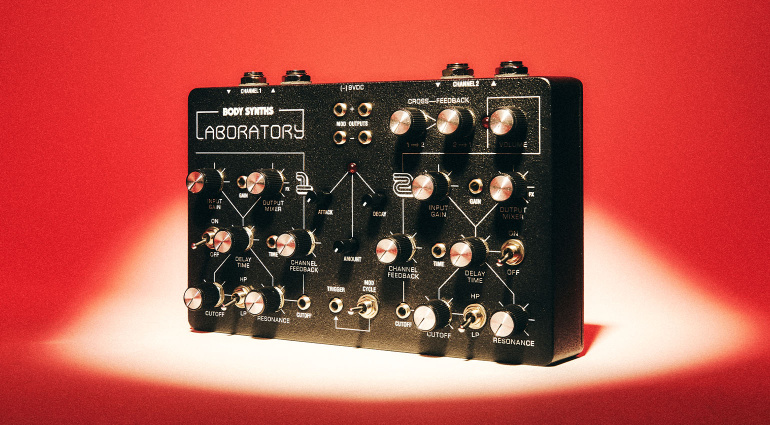
TL;DR: Body Synths returns with Laboratory, a dual-channel stereo delay/filter effects processor and feedback synthesizer built for noise, industrial, and experimental music. Designed with Berlin pedal builder akkusativ, it offers four feedback paths, CV control, and a modulator for LFO or envelope duties — capable of generating its own chaos without an input signal.
- Two identical channels with delay (time control) and switchable lowpass/highpass filter (cutoff/resonance) per channel, plus a clipping stage for compression and distortion.
- Four feedback paths per channel plus cross-feedback between channels for stereo feedback noise, self-oscillation, and no-input mixing board-style mayhem.
- Modulator section acts as LFO with trigger or AD envelope, enabling tremolo, vibrato, chorus, stereo filter sweeps, and modulated delays.
- CV inputs for delay time, filter cutoff/resonance, and input gain on each channel.
- Pricing TBA — expected around €380, similar to predecessor Metal Fetishist; debuts at Superbooth next month.
Reading time: 3 min
Want more synth news before your next coffee break? Join the Noxal newsletter — no spam, just gear worth knowing about.
What Is Body Synths Laboratory?

Two years ago, Body Synths emerged from the noise with Metal Fetishist, a digital drum machine that sounded like a factory collapsing in slow motion. Now they’re back with Laboratory — a stereo effects processor that also moonlights as a feedback synthesizer. The name is apt: this is a place you go to experiment, not to make polite ambient pads for your next coffee shop playlist.
Laboratory is a collaboration with Andrey of the Berlin-based pedal company akkusativ, and it shows. The unit is built for abuse. Each of its two identical channels packs a delay and a filter — lowpass or highpass, switchable per channel. The delay gives you time control, the filter gives you cutoff and resonance, and a clipping stage at the end of each channel adds compression and distortion when you push the gain. Run the two channels in parallel for stereo processing, or chain them in series for deeper manipulation. Set one filter to highpass and the other to lowpass, and you get bandpass filtering. Combine delays for multi-tap or ping-pong echoes.
But the real party trick? Laboratory can generate sound on its own. You don’t need an input signal to make it scream. That’s where the feedback paths come in.
Feedback as Instrument
We at Noxal have a soft spot for gear that treats feedback not as a problem to be solved but as a tool to be wielded. Laboratory has four feedback paths — two per channel — plus a cross-feedback section that lets you drive one channel into the other. This is the kind of architecture that rewards reckless knob-twiddling. Use the feedback with the delay for extra repeats, for grit, for texture, or to push the whole thing into self-oscillation. The result, according to Body Synths, is “stereo feedback noise” — a rarity in a world where most feedback instruments are monophonic scream machines.
I’ve spent more hours than I care to admit with no-input mixing boards, patching outputs back into inputs and watching meters dance into the red. Laboratory feels like that, but smaller, cheaper, and less likely to blow up your studio monitors. It’s a feedback synthesizer first and an effects processor second, and that’s exactly the right priority for the noise and industrial crowd.
There’s also a Modulator section that can act as an LFO with trigger or as an AD envelope. “This adds motion across the system, enabling effects such as tremolo, vibrato, chorus, stereo filter sweeps, modulated delays, and beyond,” says the manufacturer. In practice, that means you can turn a static drone into something that breathes, pulses, or lurches unpredictably.
Key Specs and Controls
Laboratory is not a menu-diving experience. Each channel gives you hands-on control over delay time, filter cutoff, filter resonance, and input gain — all with CV inputs for modular integration. The clipping stage is always ready to add saturation when you push the level. The Modulator’s LFO or envelope can be routed to modulate parameters across the system, giving you stereo sweeps, modulated delays, and other moving textures.
Pricing hasn’t been announced yet, but if Metal Fetishist is any guide, expect around €380. That puts it in the same ballpark as boutique pedals like the Dreadbox Dystopia or the Pladask Elektrisk Fabrikat, but with a feedback-focused architecture that neither of those offers. Laboratory will debut at Superbooth next month, so we’ll likely get a price and a deeper demo then.
For now, the only question is whether you want your feedback in stereo. If you do, Laboratory is one of the few dedicated boxes that delivers it without requiring a Eurorack case and a dozen cables.
Market Context and Who’s It For
Laboratory is not for everyone. If your idea of an effects processor is a pristine stereo reverb with 47 algorithms and a touchscreen, look elsewhere. This is for the person who wants to make their synthesizer sound like it’s arguing with itself. It’s for industrial producers, noise artists, hard techno heads, and anyone who’s ever thought, “This patch needs more feedback.”
Body Synths has carved out a niche in the digital noise instrument space — a space that’s small but fiercely loyal. Metal Fetishist proved they can make a drum machine that sounds like it’s been welded together in a foundry. Laboratory extends that philosophy into the effects domain, and the collaboration with akkusativ suggests a level of circuit design savvy that bodes well for the final product.
We at Noxal will be at Superbooth with a coffee in one hand and a notepad in the other, ready to put Laboratory through its paces. If it sounds half as aggressive as the specs suggest, we might need earplugs.
Frequently Asked Questions
Can Body Synths Laboratory be used as a standalone synthesizer without an input signal?
Yes. Laboratory is described as a “feedback synthesizer” capable of generating sound on its own using its four feedback paths. You can use it as a no-input instrument, producing noise, drones, and self-oscillation without any external audio source.
Does Laboratory support CV control?
Yes. Each channel has CV inputs for delay time, filter cutoff, filter resonance, and input gain. This makes it compatible with Eurorack modular systems for deeper modulation possibilities.
What is the expected price and availability?
The price has not been officially announced, but based on the predecessor Metal Fetishist (€380), a similar price point is expected. Laboratory will be shown at Superbooth next month, with availability likely following shortly after.
We’ll bring extra coffee to Superbooth — not for the caffeine, but to pour into the feedback loop and see what happens.