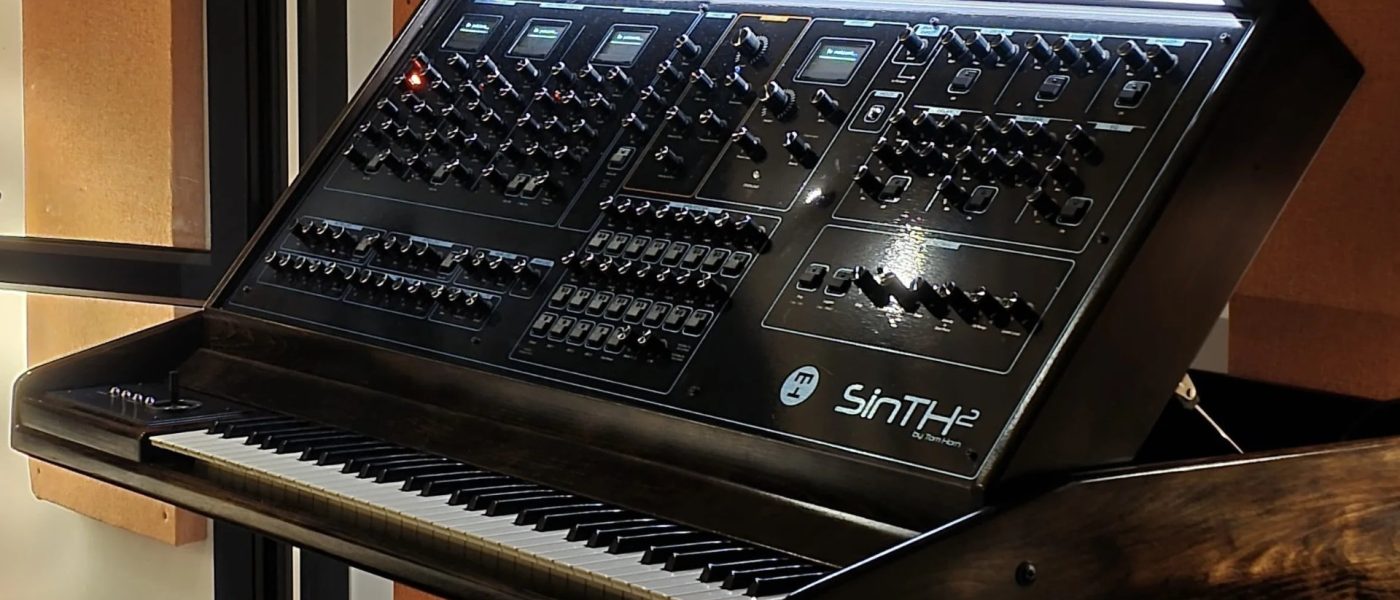
TL;DR: Polish developer Tomasz Rożka and his team have unveiled the SinTH2, a massive, customizable monster synthesizer that packs five sample-based oscillators, 60-voice polyphony, and a digital engine into a wooden chassis with a fold-out control panel. It’s a rare beast: a knobby, hands-on sample-based synth that could give workstation-style sound design a hardware home, priced and dated TBA.
- Five sample-based oscillators across three blocks, with 3GB of internal waveforms and 60-voice polyphony—a hybrid of sample playback and classic synthesis.
- Massive physical interface: 120 potentiometers, nine encoders, 36 buttons, and four OLED displays, plus a Fatar keyboard with joystick control.
- Customizable design: choose foldable or flat panel, desktop version in development, and even color schemes—each order discussed individually with the developer.
- Built-in 16-step polyphonic sequencer with motion recording, multi-FX section with drive, ensemble, phaser, delay, reverb, and EQ, plus stereo input for external processing.
- 1920 memory slots for presets, and back panel includes XLR audio outputs, 5-pin MIDI, and more—aimed at stage and studio use.
Reading time: 4 min
Want more synth news before your next coffee break? Join the Noxal newsletter — no spam, just gear worth knowing about.

Meet SinTH2: The Polish Behemoth

When a synth is described as a “monster,” you brace yourself for something that requires a forklift and a second mortgage. The SinTH2, from Polish developer Tomasz Rożka and his four-person team, delivers on both counts—though the price is still TBA, so maybe hold off on that home equity loan. The format alone evokes the Schmidt Synthesizer: a massive wooden housing with a fold-out panel that flips open like a medieval tome of sound design. It’s optional, mind you; you can order it flat or in a desktop version if your studio isn’t a cathedral.
The lower section houses a Fatar keyboard—likely with polyphonic aftertouch, though the developers haven’t confirmed—paired with a joystick for performance control. The top panel is where things get crowded: 120 potentiometers, nine encoders, 36 buttons, and four OLED displays. It’s the kind of interface that makes you feel like you’re piloting a submarine, and I mean that as a compliment. We at Noxal appreciate a synth that doesn’t hide its functions behind a menu tree, even if it does require a dedicated desk.
What’s genuinely unexpected is that this isn’t an analog beast. Given the wooden chassis and the knob count, you’d expect a thick analog sound. But no, the SinTH2 is digital—specifically, a sample-based engine with 60-voice polyphony. That’s a bold move in a world where “monster synth” usually means massive analog oscillators and a price tag that makes you weep. Rożka’s goal was “a modern, intuitive, and effective instrument with versatile stage and studio applications,” and he’s certainly taken a left turn to get there.
Digital Heart, Sample-Based Soul
The engine architecture is the real talking point here. Three oscillator blocks give you a total of five oscillators: blocks 1 and 2 each feature two independent stereo sound sources/layers, while block 3 offers a single stereo source designed for basses, leads, and reinforcement layers. Each oscillator can draw from classic synthesis or sample content, with 3GB of internal waveforms and sounds. Is it multi-sample capable? Can you load your own samples? The developers haven’t clarified, but if sampling is supported, this could blur the line between a workstation and a performance synth.
In the middle of the panel sits an 18dB filter with low-pass, band-pass, and high-pass modes, plus the usual cutoff and resonance controls. Modulation comes via four multi-wave voice LFOs (filter, pitch, amp, and pan), one global pitch LFO, and three ADSR envelopes (filter and amp). On the right, the FX section is refreshingly hands-on: drive, ensemble, phaser, delay, reverb, and EQ, each with dedicated controls. There’s even a stereo input to run external gear through the FX engine—a smart touch for live rigs.
The 16-step polyphonic sequencer with motion recording for all knobs adds a layer of generative potential, and 1920 memory slots mean you won’t run out of preset space anytime soon. It’s a workstation’s storage capacity in a monster synth’s body, and that’s a combination we haven’t seen before. Most sample-based monsters are either ROMplers with minimal knobs or touchscreen affairs. This one dares to be different.
Hands-On Horror or Bliss?
Let’s talk about the interface again, because it’s the defining feature of the SinTH2. 120 potentiometers is not a number you see on any synth outside of a modular wall or a vintage console. It’s almost absurd, and I love it. The fold-out panel design means you can angle the controls toward you like a mixing desk, which is ergonomically sound if physically imposing. The four OLED displays—one per oscillator block and one for the main parameters—mean you’re not completely blind, but you’ll still be spending a lot of time reaching.
Is this practical? For a live performer who wants to tweak everything in real time, absolutely. For a studio rat who prefers to program sounds from a chair without stretching, the desktop version might be a better bet. The ability to customize the layout—foldable, flat, or desktop—is a smart move, and Rożka discusses each order individually to finalize mechanical and color options. It’s boutique in the best sense: you get exactly what you want, provided you’re patient.
One caveat: the only detailed video so far is entirely in Polish. Automatic translation might not do it justice, but the sounds on display are undeniably powerful. We’re left waiting for more demos in a language we can understand, but the raw audio suggests a synth with serious presence.
Market Context and Who This Is For
The monster synth market is small. You’ve got the Schmidt Eightvoice, the Deckard’s Dream, the PolyBrute in a certain sense—all analog heavyweights. The SinTH2 is digital, sample-based, and that makes it an outlier. It’s closer in spirit to a workstation like the Korg Kronos or Yamaha Montage, but with a user interface that screams “hardware enthusiast” rather than “studio producer.”
Who is this for? The kind of person who wants the tactile immediacy of a massive synth but needs the flexibility of sample-based sounds. Maybe a live musician who layers pads, basses, and leads and wants to control everything at once. Or a collector who appreciates the craftsmanship of a custom-built instrument. It’s not for everyone—the price will likely be high, and the footprint is significant—but for those who fit the profile, it could be a dream machine.
We at Noxal admire the ambition. Rożka and his team are building something genuinely original in a market that often recycles the same analog circuits. The SinTH2 is a statement: monster synths don’t have to be analog, and sample-based synths don’t have to be boring. Now, if only we could get that price and a shipping date.
Frequently Asked Questions
Is the SinTH2 an analog synthesizer?
No, the SinTH2 is digital. Its engine uses sample-based oscillators and classic synthesis, offering 60-voice polyphony. The massive control surface and wooden housing might suggest analog, but inside it’s all digital—a deliberate choice for flexibility and polyphony.
Can I load my own samples into the SinTH2?
The developers haven’t confirmed sampling or user sample loading yet. The synth ships with 3GB of internal waveforms and sounds, but whether you can expand that library with your own content remains unclear. Keep an eye on the official website for updates.
How much will the SinTH2 cost, and when will it ship?
Price and availability are TBA. The developers discuss each order individually, allowing customization of color, panel layout (foldable, flat, or desktop), and software options. Expect a premium price given the build quality and customization—think boutique, not mass-market.
I’m going to need a bigger desk—and a stronger coffee—to do this beast justice. At least I can start clearing a corner now.