TL;DR: Jasmine & Olive Trees has unveiled Doppler, a Eurorack module that swaps its entire personality by simply placing a new overlay on top — no USB cables, no bootloader menus. It ships with four firmwares (percussion engine, lowpass gate, ADSR combo, and dual envelope) and promises more to come via a web tool. At $269, it’s a clever answer to anyone who loves multi-function modules but hates the constant cable tetris.
- Doppler changes firmware by swapping physical overlays — no USB connection or reflashing required.
- Base firmware is a delay-line pitch processor that turns any audio source into kicks, snares, hi-hats, and weird percussive sounds.
- Ships with three additional firmwares: Door (stereo lowpass gate), Rubin (ADSR VCA/VCF), and Lichen (dual AD envelope/VCA).
- All four engines run on J&OT’s own DSP platform; future firmwares will be loadable via a web tool.
- Priced at $269/€267,77 and shipping from Barcelona — available now.
Reading time: 4 min
Want more synth news before your next coffee break? Join the Noxal newsletter — no spam, just gear worth knowing about.

What Is Doppler?

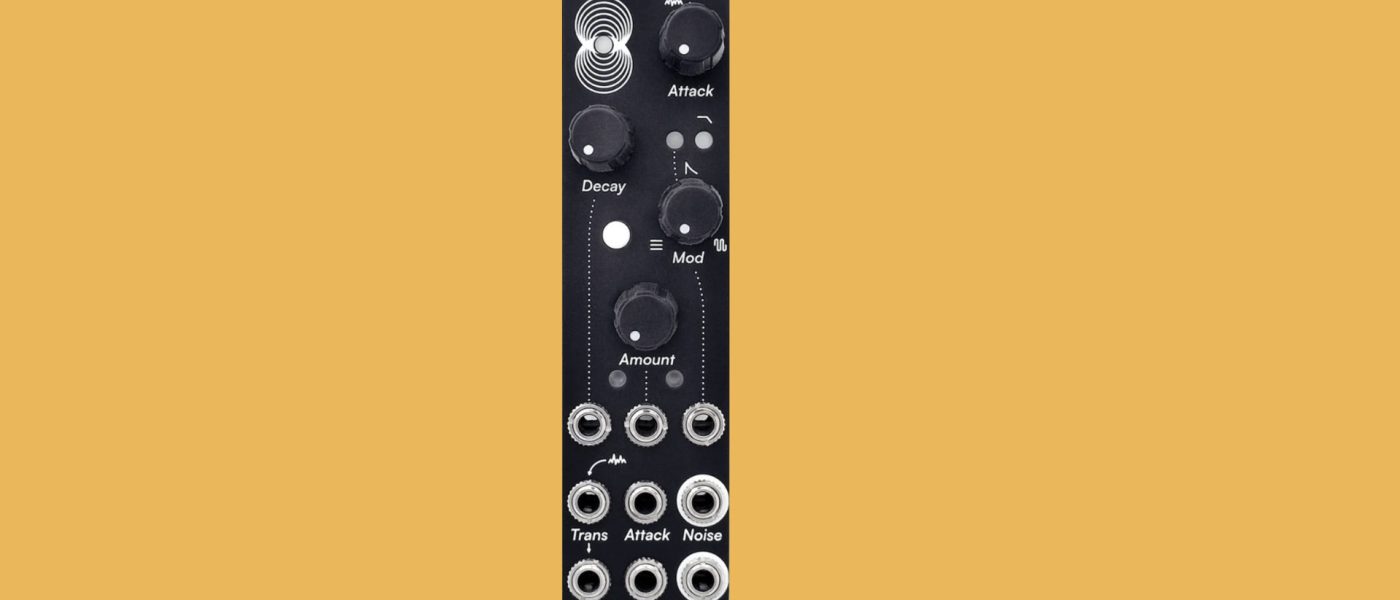
Jasmine & Olive Trees is a young developer from Barcelona, and they’ve just dropped a module that might make you rethink how you approach multi-function Eurorack. Doppler is a multi-functional module — yes, like Expert Sleepers Disting or Noise Engineering Versio — but it does something fundamentally different: changing firmware is as hands-on as turning a knob. No USB cable, no bootloader menu, no unscrewing anything. You just lay a different overlay on top of the module, and the firmware swaps instantly.
The base firmware, also called “Doppler,” is a percussion module that turns any audio source — oscillator, sample, synth voice, even your neighbour’s lawnmower if you patch it right — into percussive sounds. It’s a delay-line pitch processor: a trigger resets the read head, it sweeps down to a target depth, and out comes that falling-pitch kick. Four main controls — attack, decay, amount, and mod — let you morph through kicks, snares, hi-hats, and weirder territory. Every CV input takes audio-rate modulation, so you can push it into genuinely chaotic territory if that’s your thing.
The Overlay Trick: No USB, No Fuss
I’ve spent many evenings with the Noise Engineering Versio platform — fantastic modules, but swapping firmware means plugging in a USB cable, opening a browser, and waiting for the bootloader to do its thing. It works, but it breaks the flow. Doppler’s approach is smarter: the module detects which overlay you’ve placed on it and loads the corresponding firmware. No cables, no waiting, no “did I save the file correctly?” panic.
Domingo, the developer, calls this “unprecedented,” and I believe him. The module is built on their own J&OT DSP platform, and the overlays are essentially faceplates with embedded circuitry that tells the module what to do. It’s a tactile, almost retro way to change a digital module’s behaviour — and it feels refreshingly direct in an era where everything wants to be a screen.
Four Engines in One Box
Doppler ships with three additional overlays, giving you four personalities out of the box. First, Door is a stereo lowpass gate that listens and adapts its response depending on how fast you trigger it, what pitch you feed in, and how high your gate levels are. With its four controls, you can get percussive instruments that sound more organic and physical — think vactrol without the vactrol price tag.
Rubin turns the module into a stereo ADSR VCA and VCF combo module. It’s a workhorse for anyone who needs a compact voice with envelope and filter in one. Lichen, the fourth firmware, makes it a dual attack-decay envelope and VCA — great for percussion patches, modulation duties, or just filling a gap in a small system.
All four firmwares run on the same DSP platform, and the developer says more will be available in the future, loadable over USB via a web tool (so no extra hardware needed). It currently appears that custom firmware design isn’t possible, which is a small disappointment for the hacker crowd, but for most users, four engines (and counting) is plenty.
Market Context and Who It’s For
At $269/€267,77, Doppler sits in a sweet spot: cheaper than buying four separate modules, yet more tactile than a single multi-function module with a menu. It’s for the Eurorack user who wants flexibility without the friction of USB cables and bootloader rituals. It’s for the live performer who needs to switch between percussion, gating, and envelope duties mid-set without digging into a laptop. And it’s for the collector who appreciates a clever design solution — the overlays are also just nice faceplates, and I’d buy individual ones just for the aesthetic.
Shipping from Barcelona, it’s available now from Jasmine & Olive Trees’ official store and retailers. If you’re tired of the USB dance and want a module that changes its mind as fast as you do, Doppler is worth a serious look.
Frequently Asked Questions
How do I swap firmwares on the Doppler?
You simply place a different overlay on top of the module. The overlay contains embedded circuitry that tells the module which firmware to load. No USB cable, no computer, no bootloader — just swap the faceplate and go.
Can I create my own custom firmware?
Currently, custom firmware design is not supported. Jasmine & Olive Trees plans to release additional official firmwares in the future via a web tool, but user-created firmware is not on the roadmap.
What’s included in the box?
The module ships with four overlays: the base Doppler (percussion engine), Door (stereo lowpass gate), Rubin (ADSR VCA/VCF), and Lichen (dual AD envelope/VCA). All four firmwares are pre-loaded, so you can start patching immediately.
I’ll be swapping overlays on my coffee break tomorrow — the only thing I refuse to swap is my mug. Stay caffeinated, stay patched.