TL;DR: Analogue Solutions has announced Filtopia, a hand-built, fully analog monophonic synthesizer that replaces the traditional filter section with a five-filter parallel filterbank. Limited to 200 units and priced at £1799, it’s a niche instrument for those who crave vocal-like formant sweeps and modular-level filter modulation — no digital corners cut, and no USB in sight.
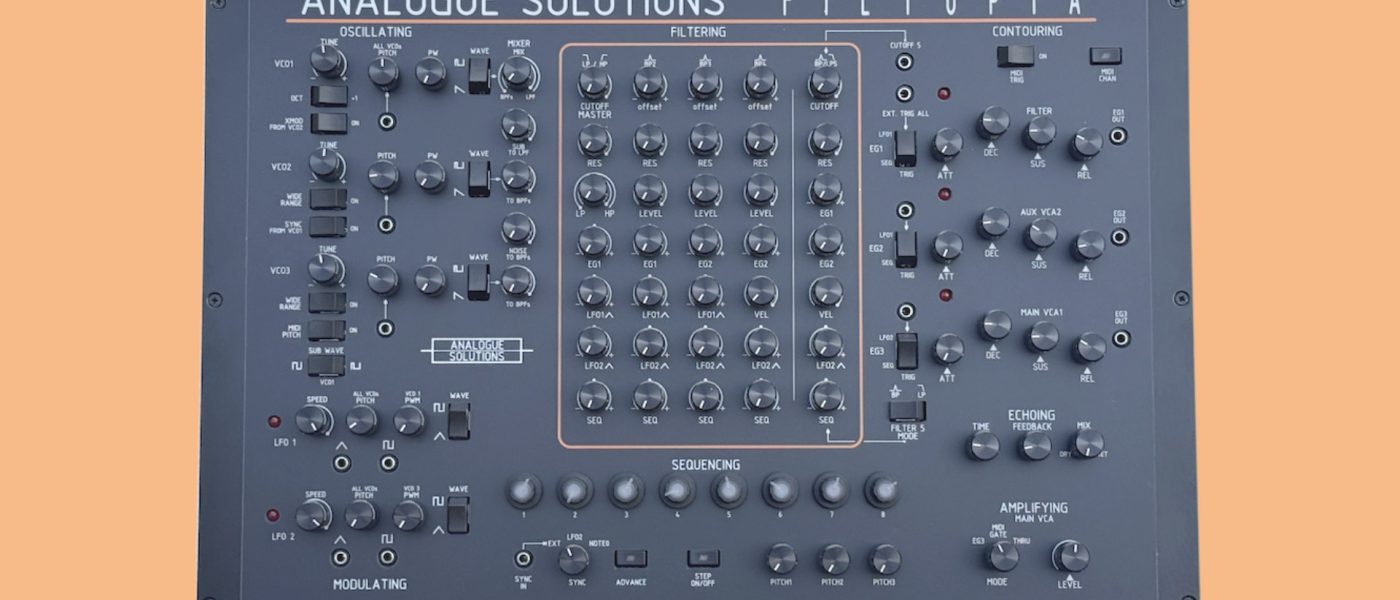
- Three multi-wave VCOs with PWM, sync, and cross-mod feed a five-filter parallel filterbank (LP/HP, three bandpass with offset, BP/LP).
- Each filter has dedicated resonance, level, and modulation routings from EG 1, LFO 1, LFO 2, and the built-in 8-step sequencer.
- Two VCAs on board: a main VCA with three modes (EG3, MIDI Gate, Thru) and a second VCA with a built-in echo effect.
- Hand-built in the UK by Tom Carpenter, limited to 200 units, priced at £1799.
- No demo yet, but the formant-filter architecture promises sounds you won’t get from a typical mono synth.
Reading time: 4 min
Want more synth news before your next coffee break? Join the Noxal newsletter — no spam, just gear worth knowing about.

What Is Filtopia?

Let’s be honest: the analog monosynth market is crowded enough to make you dizzy. Every month, another black box with knobs appears, promising “warmth” and “character.” So when Analogue Solutions — the UK-based workshop of Tom Carpenter — announces Filtopia, we at Noxal brace ourselves for something that actually earns a second look.
Filtopia is a three-oscillator analog monophonic synthesizer, but the name isn’t a marketing gimmick. It’s derived from “filter,” and that’s where the entire design philosophy pivots. Instead of the usual one or two filters in series, you get five analog filters wired in parallel. You read that right: five. This isn’t a synth you buy for its oscillator section alone — though that’s solid — you buy it for the filter architecture that promises formant-style sweeps, vocal-like textures, and evolving soundscapes that most mono synths can only dream of.
At the core, you have three multi-wave VCOs with pulse-width modulation, sync, and cross-modulation (XMOD). Two sub-oscillators add low-end heft, and a noise generator injects grit. A small mixer section lets you balance the oscillators before they hit the filterbank. It’s a classic front-end, but the real story begins when that signal reaches the middle of the panel.
The Filterbank at Its Heart
Picture five analog filters, each with its own resonance, level, and modulation routing (EG 1, LFO 1, LFO 2, or the sequencer). Filter 1 is a low-pass to high-pass sweep. Filters 2, 3, and 4 offer bandpass with an offset control — meaning you can tune their centre frequencies relative to each other. Filter 5 is a bandpass to low-pass. By dialling in different cutoff frequencies and cranking the resonance, you can create formant shapes that mimic human speech. It’s the kind of trick that usually requires a dedicated vocoder or a complex modular setup.
What makes this especially clever is the routing flexibility. You can send oscillator 1 to the LP/HP filter, oscillator 2 to a bandpass, and oscillator 3 to another bandpass. This isn’t just a fixed parallel bank — it’s a semi-modular playground where each filter becomes a distinct voice. The result is a synth that can sound like a choir of angry bees, a vowel-singing robot, or a slowly morphing ambient drone. It’s also a sound designer’s dream for soundtracks and experimental music.
The build quality is quintessentially Analogue Solutions. No USB, no digital effects, no menu-diving — just knobs, jacks, and a power switch. If you want to connect it to a computer, you’ll need a MIDI interface, and you’ll probably be happier for it. This is a synth for people who believe that analog circuits have a soul, and who aren’t afraid to spend time tweaking.
Modulation and Patching
Beyond the filterbank, Filtopia packs a modulation engine with three ADSR envelopes (dedicated to the filter, VCA, and an auxiliary source) and two multi-wave LFOs. That’s already more than most monosynths offer. But the real spice comes from the 8-step CV sequencer at the bottom of the panel. You can use it to animate filter cutoffs, modulate resonance, or control just about anything that accepts a CV input.
The VCA section is also split into two distinct channels. The main VCA has three modes: EG3, MIDI Gate, or Thru — allowing everything from sharp percussive envelopes to organ-like sustained sounds. The second VCA includes a built-in echo effect with controls for time, feedback, and level. It’s not a reverb, not a delay — it’s a warm, analog echo that adds depth without digital sheen. For those of us who prefer hardware echoes over plugins, this is a welcome addition.
Patch points on the interface let you break away from the internal routing. You can plug in external CV sources, route the sequencer to external gear, or even process external audio through the filterbank via the rear audio input. The stereo output (MAIN and AUX) means you can process the echo separately or run the filterbank into a stereo field. It’s a clever design that respects the modular mindset without requiring a wall of cables.
Market Context and Who It’s For
At £1799 and limited to 200 units, Filtopia isn’t for everyone. It’s not a beginner synth, nor is it a cheap workhorse. It’s a collector’s piece — a hand-built instrument from a boutique British manufacturer who has been doing this for decades. If you’re looking for a polyphonic workstation or a do-it-all groovebox, look elsewhere. But if you’re a sound designer, a film composer, or a synth obsessive who craves textures that no other mono synth can produce, Filtopia is worth every penny.
Competition in this price range includes the Moog Subsequent 37, the Dreadbox Erebus v3, and the Make Noise 0-Coast. But none of those offer a five-filter parallel bank. The closest analog is perhaps the Vermona PERfourMER or a small modular system, but even then, you’d struggle to achieve the same level of integrated control without a lot of patching. Filtopia is a unique proposition: a monosynth that’s all about the filter, and it’s unapologetic about it.
We haven’t heard a demo yet — and that’s frustrating — but given Tom Carpenter’s track record, the sound will likely be raw, aggressive, and deeply characterful. If you’re on the fence, wait for the first audio clips. But if you know you want it, act fast: 200 units will sell out quickly, and after that, you’ll be hunting on the second-hand market for a premium.
Frequently Asked Questions
What makes Filtopia different from other analog monosynths?
Its primary differentiator is the five-filter parallel filterbank. Instead of a single filter, you get five individually controllable filters with dedicated resonance, level, and modulation routings. This allows for formant-style and vocal-like filter sweeps that are rare in a standalone monosynth.
Can I use Filtopia with external audio?
Yes. The rear panel includes an audio input, so you can process external signals through the filterbank and echo effect. The main and aux outputs give you stereo routing options for the echo and dry signals.
Is Filtopia suitable for beginners?
No. It’s a semi-modular instrument with a deep modulation matrix, no presets, and a fully analog signal path. It’s best suited for experienced synthesists who enjoy hands-on sound design and aren’t afraid of a little creative patching.
We at Noxal will be brewing a fresh pot of Ethiopian Yirgacheffe while we wait for that demo — because if you’re going to obsess over five filters, you might as well do it with good coffee.