TL;DR: AtoVproject has released firmware 1.10 for the Faderpunk, a hackable 16-channel MIDI and CV controller that is the spiritual successor to the open-source 16n fader bank. The update adds three new apps (TB-3PO acid pattern generator, GenSeq generative sequencer, and Automator CV gesture looper), plus significant improvements to existing sequencer and LFO engines, Buchla 1.2V/oct support, and a unified mute system. This is a serious modulation hub that will cost 650€ when it ships on October 9, 2025.
- Firmware 1.10 introduces three new apps: TB-3PO (303-style acid pattern generator from Ornament & Crime), GenSeq (generative sequencer with two Turing Machines), and Automator (CV gesture looper for fader automation).
- Existing sequencer engines get substantial upgrades: seq8 now has slide, probability, and direction controls; built-in Turing machine gains a new gate output mode; LFO gets optional phase-lock-to-clock.
- Other additions include Buchla 1.2V/oct support, a per-app quantizer, and a unified mute refactor across all apps.
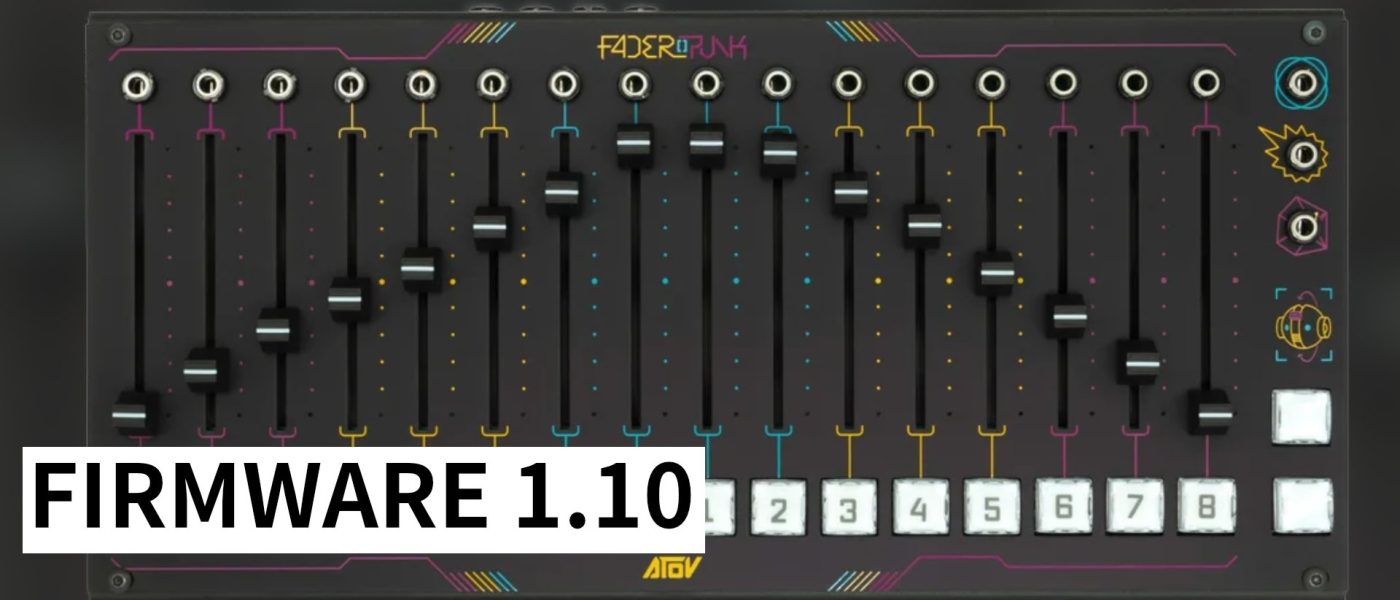
- The Faderpunk itself is a 16-channel controller with 60mm ALPS faders, mechanical RGB backlit buttons, and CV jacks configurable as input or output (0/5V, 0-10V, +/-5V range).
- Priced at 650€, available October 9, 2025 — and it runs open-source firmware that you can hack yourself using a developer-friendly API.
Reading time: 4 min
Want more synth news before your next coffee break? Join the Noxal newsletter — no spam, just gear worth knowing about.

What Is the Faderpunk?

Let’s get the origin story out of the way, because it matters. The Faderpunk is the evolution of the 16n, an open-source MIDI controller project by Tom Armitage that became a cult favourite among modular synth users. Berlin-based AtoVproject had been producing the 16n Rework for years, but now they’ve built a proper successor. And they’ve called it Faderpunk — a name that suggests both rebellion and a healthy disregard for closed ecosystems.
From the outside, it looks familiar: 16 faders, each paired with a mechanical RGB backlit button and a CV jack. But inside, it’s a different beast. The new open-source firmware architecture is built around so-called “apps” that can turn the Faderpunk into anything from a simple MIDI controller to a generative sequencer, an LFO bank, or a CV-to-MIDI converter. If you don’t like the factory apps, you can hack them. If you want something that doesn’t exist, you can write it yourself using the developer-friendly API. This is not a locked-down product. This is a Swiss Army knife with faders.
Firmware 1.10: What’s New
Firmware 1.10 is the latest update, and it’s not just a bug-fix release. It adds three new apps that significantly expand the Faderpunk’s capabilities. The TB-3PO is a 303-style acid pattern generator, ported directly from the Ornament & Crime module. If you’ve ever wanted to sequence squelchy basslines without dedicating a whole Eurorack case to the task, this is your app. It runs natively on the Faderpunk, meaning you get 16 faders to tweak parameters in real time.
Then there’s GenSeq, a generative sequencer based on Arthur’s live patch technique. It features two Turing Machines — one for pitch, one for spacing — which means you can create evolving, unpredictable sequences that never quite repeat. It’s the kind of thing that makes you feel like you’re collaborating with the machine rather than just programming it. And finally, the Automator is a CV gesture looper that records your fader movements and plays them back. Think of it as a modulation recorder for your hands — great for adding human feel to otherwise static patches.
But the update isn’t just about new apps. The existing sequencer engines have been given some love too. The core sequencer, seq8, now has slide, probability, and direction controls. The built-in Turing machine has a new gate output mode. And the LFO now features an optional phase-lock-to-clock, which recomputes each kick rather than free-running. This is a subtle but important detail: it means your LFO stays locked to your tempo, not drifting off into its own time zone. There’s also Buchla 1.2V/oct support, a per-app quantizer, and a unified mute refactor across all apps. It’s a lot for a firmware update, and it shows that AtoVproject is serious about keeping this platform alive.
The Hardware Under the Hood
Let’s talk about the physical bits, because hardware is what we care about at Noxal. The Faderpunk has 16 channels, each with a 60mm high-end ALPS fader. If you’ve ever used a cheap fader that gets scratchy after six months, you’ll appreciate this choice. Each channel also has a mechanical RGB backlit button — clickable, not squishy — and a CV jack that can be configured as either input or output. The voltage range is flexible: 0/5V, 0-10V, or +/-5V. That’s enough to handle most Eurorack and semi-modular gear.
On the back, you get a USB-C port for power and MIDI, a MIDI input and two MIDI outputs on 3.5mm TRS sockets, and an I2C socket. The unit is Eurorack-compatible at 56HP, but it ships as a standalone unit, so you can use it on a desktop without a rack. There are also three auxiliary CV jacks that can be freely configured as input or output. That’s a total of 19 CV-capable jacks on a device the size of a small lunchbox. The developer told Sonicstate that, as a modular synth user, “you really only need the sound generator modules; the Faderpunk can handle the rest.” That’s a bold claim, but looking at the specs, it’s not entirely unreasonable.
Market Context and Who It Is For
At 650€, the Faderpunk is not cheap. You could buy a used Expert Sleepers FH-2 and a MIDI controller for less. But the Faderpunk is more than a MIDI-to-CV interface — it’s a modulation hub that can replace several modules in your rack. If you’re the kind of person who owns a Eurorack system and spends more time patching modulation than actually making sound, this might be exactly what you need. It’s also useful for non-modular musicians: you can use it as a powerful MIDI controller for software, or to add CV modulation to synths that lack it.
The hackable nature of the firmware is the real selling point. AtoVproject has built this on an open-source architecture with a developer-friendly API. That means the community can extend it indefinitely. If you have programming skills, you can create apps that do exactly what you want. If you don’t, you can wait for someone else to do it. Either way, the Faderpunk is designed to evolve. It’s the opposite of a locked-down, firmware-as-a-service product. We at Noxal approve.
Final Thoughts
Firmware 1.10 is a substantial update that makes the Faderpunk even more versatile. The TB-3PO, GenSeq, and Automator apps are genuinely useful additions, and the improvements to existing features show that AtoVproject is listening to users. The Faderpunk itself is a well-built piece of hardware that can serve as the central modulation hub for a studio or live setup. It’s not for everyone — 650€ is a lot to spend on a controller — but if you need 16 faders, flexible CV routing, and the ability to customize everything, it’s hard to beat.
Frequently Asked Questions
What is the AtoVproject Faderpunk?
The Faderpunk is a hackable 16-channel MIDI and CV fader controller. It is the successor to the open-source 16n fader bank, featuring 60mm ALPS faders, mechanical RGB backlit buttons, and CV jacks that can be configured as input or output. It runs open-source firmware based on apps that can turn it into an LFO, sequencer, modulation recorder, and more.
What does firmware 1.10 add?
Firmware 1.10 adds three new apps: TB-3PO (303-style acid pattern generator), GenSeq (generative sequencer with two Turing Machines), and Automator (CV gesture looper). It also adds slide, probability, and direction controls to the seq8 sequencer, a new gate output mode for the Turing machine, phase-lock-to-clock for the LFO, Buchla 1.2V/oct support, a per-app quantizer, and a unified mute system.
How much does the Faderpunk cost and when is it available?
The AtoVproject Faderpunk costs 650€ and will be available starting October 9, 2025. It ships as a standalone unit that can also be mounted in a Eurorack case (56HP).
I’ll be honest: I spent more time reading the firmware changelog than I did drinking my morning espresso, and that’s saying something. The Faderpunk isn’t just a controller — it’s a conversation starter, and I’d happily let it interrupt my coffee ritual.