TL;DR: After more than three years of delays and teasers, Behringer has officially listed the AKS Mini on its website with a complete manual and feature set, suggesting an imminent release. This portable analog paraphonic synthesizer is a miniaturized clone of the legendary EMS Synthi AKS (VCS 3) from 1971, packing three oscillators, a unique envelope shaper, a joystick, and a 16-step sequencer into a $99 price point — if history is any guide, we’ll believe the price when we see it ship.
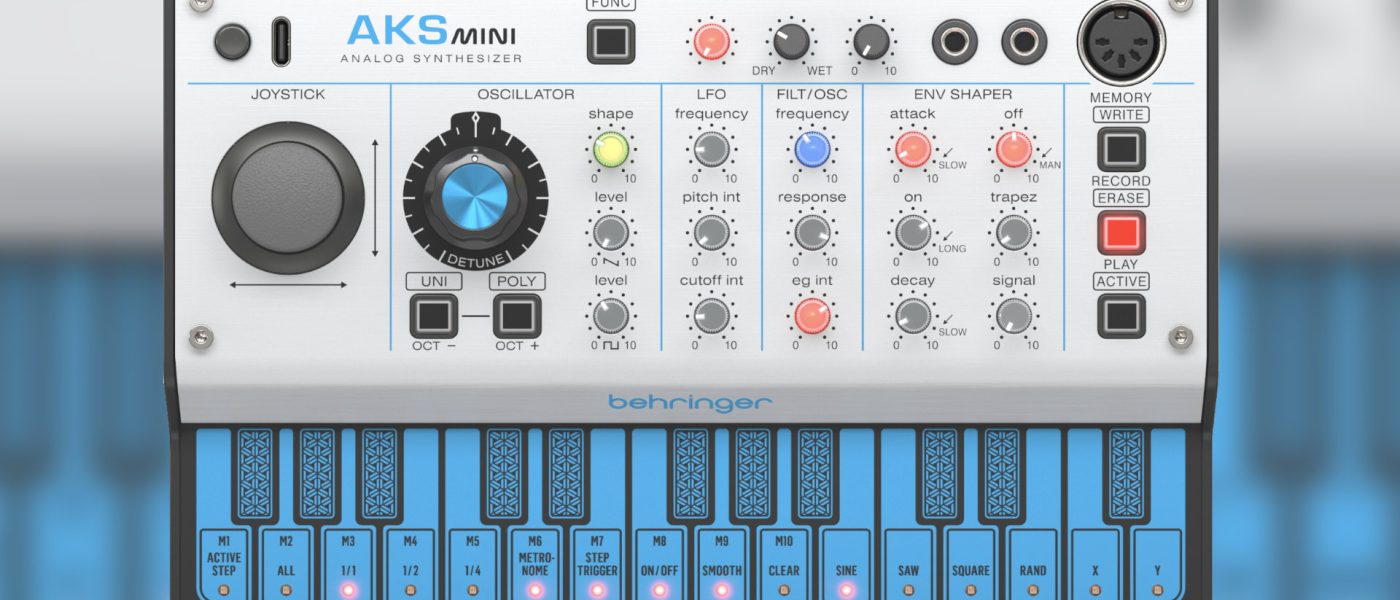
- The AKS Mini is a paraphonic analog synth based on EMS Synthi AKS/VCS 3 circuits, featuring three oscillators with variable saw and square waves in a shared-control topology.
- It includes a four-stage envelope shaper (attack, decay, on/sustain, off) with a looping mode that effectively turns it into an LFO — a direct nod to the original’s famously weird modulation system.
- A 2-axis joystick, digital spring reverb, 27 touch-sensitive keys, and a 16-step motion sequencer with 10 pattern slots round out the performance controls.
- Connectivity covers USB-C power, 5-pin MIDI input, sync socket, and a headphone/main output, with full MIDI implementation including NRPN/CC control for third-party editors.
- Behringer’s website listing suggests an imminent release, though the company’s track record of missed deadlines (originally promised for summer 2023) means we’ll keep our coffee hot and expectations cool.
Reading time: 4 min
Want more synth news before your next coffee break? Join the Noxal newsletter — no spam, just gear worth knowing about.

What Is the Behringer AKS Mini?

Three years. That’s how long we’ve been waiting for Behringer to deliver on their AKS Mini promise, first announced via Facebook in January 2023 with a “summer 2023” release window. As any synth veteran knows, Behringer’s timelines are about as reliable as a vintage VCO’s tuning after a bumpy flight. But here we are in 2026, and the AKS Mini has finally appeared on the company’s website with a full manual, complete feature list, and a new version of the Synth Tribe app. At Noxal, we’ve learned to temper our excitement with the knowledge that “imminent” in Behringer-speak can mean anywhere from next week to next decade. Still, the listing looks concrete enough to warrant a closer look.
The AKS Mini is a portable analog paraphonic synthesizer that cribs its soul from the EMS Synthi AKS — the same legendary synth used by Pink Floyd, Brian Eno, and Jean-Michel Jarre. That original instrument, released in 1971, was famous for its patchable matrix, bizarre envelope shaper, and the kind of unstable, characterful sound that no digital plugin has ever fully replicated. Behringer’s approach here is to shrink that circuit into their familiar mini-synth form factor, the same chassis used for the Crave, Model D, and Edge. It’s a logical move: take a classic, make it affordable, and package it for the modern Eurorack-adjacent crowd who want character without the vintage price tag or the risk of electrocution from a 50-year-old power supply.
What Makes It Interesting?
The AKS Mini’s most compelling feature is its envelope shaper — and no, that’s not a joke. Unlike the standard ADSR you find on 99% of synthesizers, the AKS Mini replicates the original Synthi’s four-stage envelope with parameters labeled attack, decay, on (sustain), and off. The “off” parameter is the secret sauce: it lets you loop the envelope, turning the entire thing into an LFO. This opens up rhythmic, evolving modulation that feels more like a living organism than a simple filter sweep. The trapezoid modulation level control adds further weirdness, allowing you to dial in exactly how much of that trapezoidal madness hits the VCA and VCF.
Then there’s the 2-axis joystick. In an era where most budget synths give you a mod wheel and maybe a pitch bend, the joystick feels like a proper performance tool. You can route it to pitch, filter cutoff, or both simultaneously, making it ideal for warbly leads, swooping pads, or the kind of drunken, unstable sounds that defined early electronic music. The digital spring reverb is a nice addition too — not a faithful recreation of the original’s spring tank, but a clean, serviceable effect that adds space without eating up DSP resources.
At Noxal, we’re particularly intrigued by the paraphony implementation. Three oscillators share tuning and waveform controls — no independent programming — which means you get three-voice paraphony or unison. This isn’t polyphony in the traditional sense, but it gives you enough harmonic heft for chords, drones, and layered leads. The variable saw and square waveforms on each oscillator offer more flexibility than the original, which was strictly sawtooth and pulse. It’s a sensible modernisation, even if purists will grumble.
Key Specs and Connectivity
Let’s get into the numbers, because at $99, the feature set is genuinely impressive. The AKS Mini packs three VCOs, a filter section with cutoff and resonance, the aforementioned envelope shaper, an LFO with four waveforms, a 16-step motion sequencer with 10 pattern slots, and 27 touch-sensitive keys. The sequencer supports motion recording, meaning you can record joystick movements and parameter changes directly into the sequence — a feature that, in our experience, turns a simple step sequencer into a powerful performance tool.
Connectivity is surprisingly generous for a mini synth. You get USB-C for power (works with a phone charger, power bank, or computer), a classic 5-pin MIDI input, a sync socket for integration with Volcas or Eurorack modules, and a headphone output that doubles as the main output. The full MIDI implementation includes NRPN and CC control of every parameter, plus bulk load/save. This is a big deal: it means third-party software editors are not just possible but actively encouraged, opening the door for preset management and remote control that the original Synthi never dreamed of.
The digital spring reverb is a curious choice — we suspect it’s a cost-saving measure rather than a sonic statement — but it’s functional and adds ambience without the mechanical fragility of a real spring. The touch-sensitive keys are responsive enough for basic playing, though we wouldn’t recommend them for virtuoso performances. They’re more useful for triggering notes and entering sequences than for expressive playing, which is exactly what you’d expect at this price point.
Market Context and Who Is It For
Behringer’s AKS Mini enters a crowded field of budget mini synths. Korg’s Volca series, Modal Electronics’ Craftsynth, and the various Pocket Operator offerings all compete for the same $100-ish space. What sets the AKS Mini apart is its specific sonic DNA — the VCS 3 circuit is genuinely unique, and no other budget synth offers that particular flavor of unstable, organic analog character. The joystick and looping envelope shaper give it performance capabilities that the Volcas lack, while the sequencer and MIDI implementation make it a viable studio tool rather than just a toy.
Who is this for? At Noxal, we see two primary audiences. First, the budget-conscious producer who wants analog character without spending thousands on a vintage Synthi or a modern clone like the Erica Synths Synth DIY. Second, the experimental musician who values the VCS 3’s idiosyncratic architecture — the envelope shaper, the joystick, the paraphonic voicing — and wants those tools in a portable, USB-powered format. It’s also a natural companion for Eurorack users who need a standalone voice for jamming or live performance. The sync socket and comprehensive MIDI make it easy to integrate into any setup.
The $99 price point is aggressive, even for Behringer. If they can deliver on that promise without cutting corners on build quality or sound, the AKS Mini could be the sleeper hit of 2026. But we’ve seen this movie before: the Crave and Model D were excellent, but the Edge had reliability issues, and the Pro-1 Mini was a mixed bag. We’ll reserve final judgment until we hear sound demos and get our hands on a production unit. For now, the AKS Mini is the most interesting Behringer mini synth we’ve seen in years — and that’s saying something, given how many mini synths they’ve churned out.
Frequently Asked Questions
What is the Behringer AKS Mini?
The Behringer AKS Mini is a portable analog paraphonic synthesizer based on the EMS Synthi AKS (VCS 3) circuits from 1971. It features three oscillators, a unique four-stage envelope shaper with looping capability, a 2-axis joystick, a 16-step motion sequencer, and digital spring reverb, all in a compact, USB-powered form factor.
How much does the Behringer AKS Mini cost?
Behringer has targeted a retail price of $99 USD for the AKS Mini. However, given the company’s history of delays and price fluctuations, we recommend treating this as an estimate until official pre-orders open. Pre-orders are expected to launch very soon, according to Behringer’s website.
When will the Behringer AKS Mini be released?
The AKS Mini was originally announced for summer 2023, but that deadline was missed. As of early 2026, the synth is listed on Behringer’s website with a manual and full feature set, suggesting an imminent release — possibly within days or weeks. We advise checking Behringer’s social media channels for the most current updates.
We’ll believe the AKS Mini is shipping when we see it in a studio, not a render. Until then, I’ll be here with my third espresso, refreshing Behringer’s website and muttering about “summer 2023” under my breath.