TL;DR: Arturia has unleashed “Ultra” editions of its KeyLab Mk.3 49 and 61 controllers, trading the usual black or white for a retina-searing orange chassis with wooden end cheeks. Functionally identical to the standard models, these are a purely cosmetic — but very welcome — splash of summer for those who want their keyboard stand to match their personality.
- Arturia KeyLab Mk.3 49 and 61 now available in “Ultra” orange with black wooden end cheeks and a new logo.
- Pricing remains identical to standard models: €449 for the 49-key, €549 for the 61-key.
- No functional changes — same great keybed, same DAW/V Collection integration, same built-in screen and controls.
- The 88-key version is notably absent from this colour treatment, much to the chagrin of weighted-action fans.
- White and black editions remain available for those who prefer their gear to blend in with the carpet.
Reading time: 4 min
Want more synth news before your next coffee break? Join the Noxal newsletter — no spam, just gear worth knowing about.

The Ultra Treatment
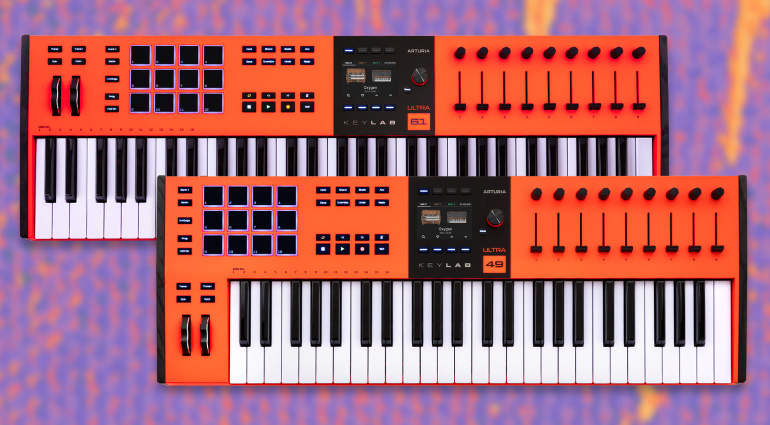
Arturia has decided that summer 2026 needs more orange. Not just any orange — the kind of orange that makes a traffic cone look subdued. The KeyLab Mk.3 Ultra editions for the 49 and 61-key models are here, and they are unapologetically loud. The chassis is now a bright, almost fluorescent orange, offset by black wooden end cheeks that look like they were borrowed from a PolyBrute’s darker cousin. A new logo sits proudly on the top panel, just in case anyone mistakes this for a plain black controller.
We at Noxal appreciate a good colourway. The synth world has been dominated by black, silver, and the occasional splash of red for far too long. Orange is a bold choice, and it works. These controllers will look fantastic on stage, especially under dim lighting where they’ll practically glow. For the studio, they’re a conversation starter — assuming your conversation isn’t about how you wish you’d bought the 88-key version.
What Hasn’t Changed
Functionally, the Ultra is identical to the standard Mk.3. You get the same slim, sleek form factor, the same beech wood end cheeks (now black, but still classy), and the same user interface. That means nine faders, nine 360-degree pots, and 16 velocity- and pressure-sensitive pads that can be bank-switched to give you 48 pads in total. The screen is still there, as is the deep integration with V Collection and a host of DAW templates.
The keybed is the same, too. And here, I must admit a personal bias. I was an early adopter of the original KeyLab Mk.1 back in 2013, and that experience was — how shall I put this? — educational. I had keys snapping off at odd angles, USB connection issues that made me question my life choices, and a MIDI Control Center that seemed to exist solely to test my patience. I repaired over a dozen keys with super glue before I learned Arturia had quietly fixed the mechanism. So when the Mk.3 arrived, I was relieved to find a solid, reliable keybed that doesn’t flex under pressure or spontaneously disassemble itself overnight. It’s good. Very good.
The Painful Memory of Mk.1
I feel I need to share my backstory with the KeyLab range to justify my initial scepticism. When the Mk.1 launched, I was excited — a dedicated controller for V Collection, what could go wrong? Quite a lot, as it turned out. The keyboard struggled to connect to my Mac over USB, the MIDI Control Center wouldn’t recognise it, and when it did connect, I’d see multiple ghost instances in the Mac’s MIDI Studio. Then the keys started breaking. One morning I walked into my studio to find a single key sitting at a jaunty angle, the key return stop snapped clean off. That was the first of many. I opened the unit, found the broken part, and applied super glue. It worked, but it wasn’t fun.
So when Arturia sent me the Mk.3, I was hopeful but cautious. I’m pleased to report that the Mk.3 is a different beast entirely. The keybed feels solid, the build quality is excellent, and the software integration is seamless. The removal of one row of pads (now you have 16 physical pads with four banks, giving you 48 virtual pads) was controversial, but it makes sense for most users — we’re not all finger-drumming MPC-style. The pads themselves are velocity- and pressure-sensitive, and they work beautifully with clip-based DAWs like Ableton Live.
Who Should Buy the Ultra?
If you already own a KeyLab Mk.3 in white or black, you don’t need the Ultra. It’s the same controller. But if you’re in the market for a new controller and you want something that stands out — literally — the Ultra is a no-brainer. The price is the same: €449 for the 49-key, €549 for the 61-key. That’s competitive for a controller with this level of integration and build quality. The only downside? The 88-key version didn’t get the Ultra treatment. If you need weighted keys, you’re stuck with black or white. Sorry, weighted-action fans.
For stage use, the Ultra is a visual statement. For the studio, it’s a cheerful splash of colour in a world of grey rackmounts. We at Noxal approve. Just make sure you have sunglasses handy.
Frequently Asked Questions
Is the KeyLab Mk.3 Ultra functionally different from the standard Mk.3?
No. The Ultra editions are purely cosmetic — orange chassis with black wooden end cheeks and a new logo. Everything else, from the keybed to the software integration, is identical.
Will the 88-key version get an Ultra colourway?
As of now, Arturia has not announced an Ultra version for the KeyLab Mk.3 88. We suspect the larger chassis would make orange a bit too overwhelming, but we’d love to be proven wrong.
How does the KeyLab Mk.3 compare to the original Mk.1 in terms of build quality?
The Mk.3 is a massive improvement. The keybed is solid, the pads are responsive, and the software integration is seamless. The Mk.1 had notorious key-breaking issues and USB connectivity problems — the Mk.3 has none of that.
We at Noxal will be reviewing the Ultra edition with a fresh cup of pour-over coffee and a pair of sunglasses. If you see us squinting, it’s either the orange or the caffeine — we can’t tell which.