TL;DR: Uwe from Rides In The Storm (formerly MFB) is developing the Rhythm Rides, an 8-track analog drum machine with dedicated synth engines, eight VCFs, and a modulation center called NEXUS. It’s a spiritual successor to classic MFB drum machines, with a compact design, individual outputs, and USB-C connectivity.
- Rhythm Rides features eight analog tracks: kick, snare, synbell, toms, claps, rides, dig 1, and dig 2—each with dedicated synthesis engines.
- It includes eight voltage-controlled filters (VCFs) and ten VCAs, plus a modulation center with eight assignable multi-wave LFOs for intercircuit modulation (ICM).
- The sequencer supports parameter locking, probability, and magic/random modes, operated via 16 white buttons.
- Connectivity includes individual outputs, a master VCF, MIDI over 3.5mm TRS, and two USB-C ports (one for USB MIDI host, one for audio/remote MIDI).
- Developed by Uwe, the mind behind MFB drum machines, this is a spiritual successor with a knob-per-function interface and a green color scheme (subject to change).
Reading time: 4 min
Want more synth news before your next coffee break? Join the Noxal newsletter — no spam, just gear worth knowing about.

The Return of a Drum Machine Visionary

If you’ve been in the hardware synth scene long enough, the name MFB likely triggers a nostalgic twitch—those compact, no-nonsense drum machines that punched far above their weight class. After Manfred Fricke’s passing in 2021, MFB folded, and many of us mourned the loss of that particular brand of German engineering. But Uwe, the man behind much of that magic, didn’t disappear. He resurfaced at Rides In The Storm, quietly building Eurorack modules with the same obsessive attention to analog circuitry.
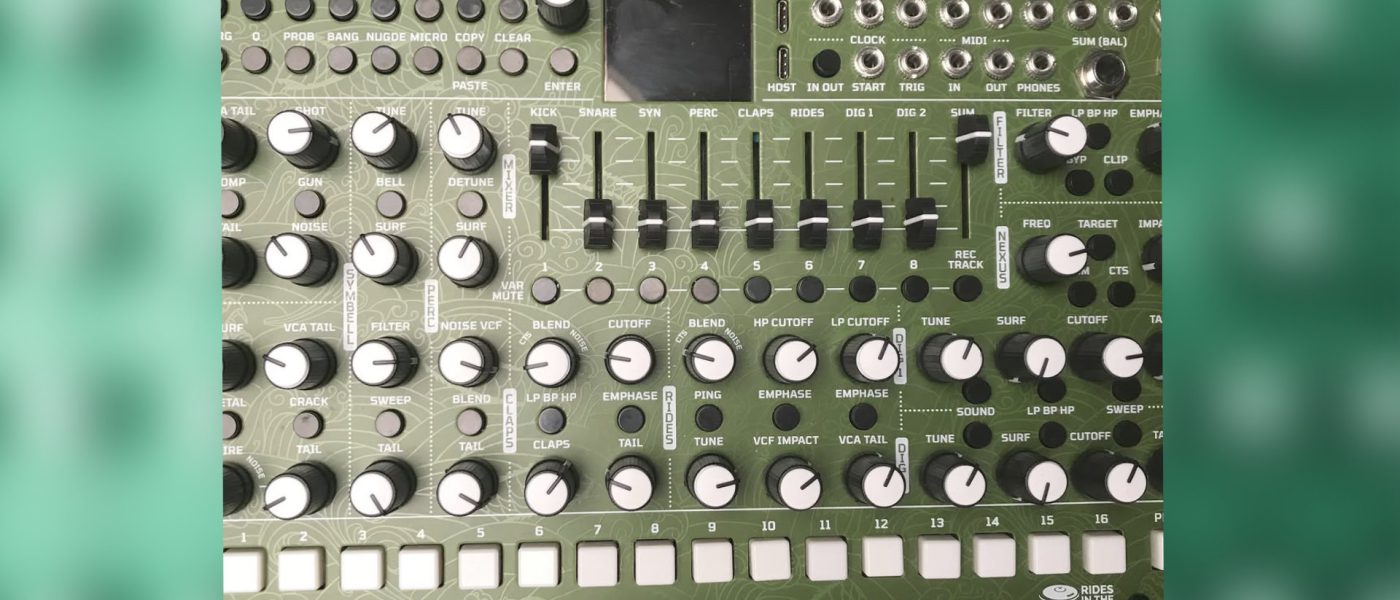
Now, at the Sofia Synth Symposium in June, he teased something that made my coffee go cold: the Rhythm Rides, an 8-track analog drum machine that looks and feels like a spiritual successor to the MFB line. The green interface (still a prototype color, so don’t get too attached) is a nod to the past, but the specs are pure 2025. This isn’t a reissue; it’s a reimagining.
At Noxal, we’ve been waiting for a standalone RITS instrument since we first heard about Uwe’s post-MFB work. The Eurorack modules were solid, but a drum machine? That’s where his heart has always been. And from what we’ve seen, this one’s got soul.
What Makes Rhythm Rides Tick
Let’s get down to the silicon and solder. The Rhythm Rides packs eight dedicated tracks: kick, snare, synbell, toms, claps, rides, dig 1, and dig 2. Each track has its own synthesis engine, not just a sample player with a filter slapped on. The synbell section, for example, offers square/saw waveforms, sub outs (2/3 and 3/4), a rectifier mix out, plus pitch, low-pass filter, and VCA envelopes. That’s a lot of tonal sculpting for a single voice in a drum machine.
The claps and rides are built around comparator transistor synthesis (CTS)—a fancy way of saying they blend analog noise with transistor-driven circuitry. There’s a blend knob to morph between CTS and pure noise, which should give those sounds a gritty, organic texture that digital emulations often miss. The last two tracks, dig 1 and dig 2, remain mysterious. Could be digital synthesis, could be samples. We’re betting on a hybrid approach, given Uwe’s history with both analog and digital in the MFB line.
What’s immediately striking is the knob-per-function interface. No menu diving here—just sliders and knobs for each sound, plus a classic mixer section with individual channel faders. There’s a display, but I suspect it’s for global settings and sequencer operations, not for micromanaging parameters. This is a machine that wants you to touch it, not stare at a screen.
Modulation and Sequencing: The Brain of the Beast
Under the hood, the Rhythm Rides boasts eight voltage-controlled filters (VCFs) and ten VCAs. That’s a ridiculous amount of analog processing for a drum machine—most units in this class barely scrape by with a single filter. Uwe calls this “intercircuit modulation” (ICM), which is essentially FM synthesis applied to drum voices. Think of it as cross-pollination between tracks: the kick can modulate the snare’s filter, or the synbell can frequency-modulate the toms. It’s the kind of patching flexibility that usually requires a modular setup.
The modulation center, dubbed NEXUS, houses eight assignable multi-wave LFOs. That’s eight modulation sources you can route to almost any parameter. Want your hi-hats to warp in pitch over time? Done. Need the snare’s decay to wobble in sync with the LFO? Easy. This is not your grandfather’s drum machine—this is a sound design playground.
The sequencer is equally ambitious. Controlled via 16 white buttons (reminiscent of the TR-808 layout), it supports parameter locking—confirmed on Instagram—plus probability and “drum” and “magic” modes that likely act as randomizers or generative pattern generators. Uwe calls it an “enhanced sequencer,” which suggests we’ll see features like ratcheting, swing per step, and pattern chaining. If it delivers on even half of that, it’ll be a performance powerhouse.
Connectivity and Market Context
On the back panel, you’ll find individual outputs for each track plus a master output with its own VCF. MIDI is handled via 3.5mm TRS jacks—standard for modern compact gear. But the real head-turner is the two USB-C ports on the top. One acts as a USB MIDI host, letting you connect a controller or sequencer directly. The other is labeled “VST”—and before you get excited, no, you can’t load plugins. Instead, it provides 4×2 channels of audio streaming and remote MIDI over USB-C. This effectively turns the Rhythm Rides into a multi-channel audio interface and control surface for your DAW.
In a market crowded with digital drum machines like the Elektron Analog Rytm and the Roland TR-8S, the Rhythm Rides stakes its claim on pure analog grunt. Where the Rytm offers digital samples with analog filtering, the Rhythm Rides is analog from oscillator to VCA on most tracks. That’s a different sonic fingerprint—one that’ll appeal to producers who crave the unpredictability and warmth of true analog circuits.
Pricing and availability are still TBA, but given RITS’s reputation for “quality yet affordable” modules, we’d expect it to land somewhere in the €800-€1200 range. That would put it in direct competition with the Behringer RD-8 and the MFB Tanzbär legacy, but with a more modern feature set.
Who Is This For?
The Rhythm Rides is for the producer who loves the immediacy of a hardware drum machine but wants the deep synthesis capabilities of a modular system. It’s for the MFB fan who’s been waiting for a worthy successor. It’s for the live performer who needs individual outputs and a robust sequencer. And it’s for the curious sound designer who wants to explore intercircuit modulation without patching a single cable.
We at Noxal are cautiously optimistic. Uwe has a track record of delivering on his promises, but the final product is still in development. If the Rhythm Rides ships with all the features teased—eight analog VCFs, NEXUS modulation, enhanced sequencing, and USB-C audio—it could be one of the most compelling drum machines of the decade. If it stumbles on execution or pricing, it’ll be a niche curiosity.
Either way, we’ll be watching. And probably brewing another pot of coffee while we wait.
Frequently Asked Questions
When will the Rhythm Rides be released and how much will it cost?
Availability and pricing are still TBA. Given the prototype stage, we’re likely looking at a late 2025 or early 2026 release. Based on RITS’s pricing history and the feature set, expect a range between €800 and €1200.
Is the Rhythm Rides a direct copy of the MFB Tanzbär?
No, it’s a spiritual successor, not a clone. While it shares the same developer and a knob-per-function philosophy, the Rhythm Rides introduces new features like intercircuit modulation (ICM), a NEXUS modulation center with eight LFOs, USB-C audio streaming, and an enhanced sequencer with parameter locking and probability.
Can I use the Rhythm Rides with my DAW without extra hardware?
Yes. The second USB-C port offers 4×2 channels of audio streaming and remote MIDI over USB-C, effectively turning the drum machine into a multi-channel audio interface. You can record individual tracks directly into your DAW without needing a separate mixer or interface.
I’m off to calibrate my caffeine-to-creativity ratio. If you need me, I’ll be in the studio, waiting for Uwe to drop more teaser videos and praying the green finish makes it to production.