
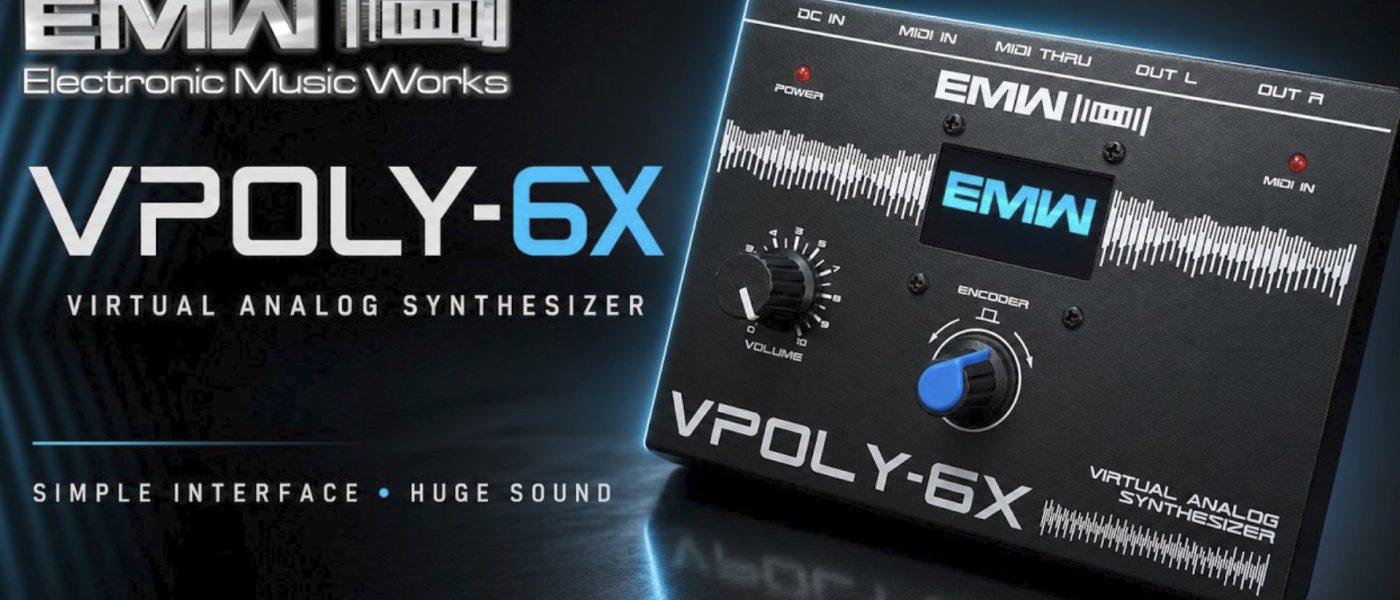
TL;DR: Brazilian synth builder EMW has announced the VPOLY-6X, a six-voice virtual analog desktop synth inspired by the Korg Polysix. It strips the interface down to just two knobs, promising intuitive programming via a minimal menu system, while adding a multimode filter, enhanced effects, and full MIDI CC control. No price or release date yet, but early demos suggest a warm, classic sound in a compact box.
- Six-voice virtual analog engine inspired by the Korg Polysix architecture, with a single oscillator, PWM, sub-oscillator, and multimode filter (LP/HP/BP).
- Radically minimalist interface: just one main encoder and a volume knob — all other parameters accessed via menus or MIDI CC.
- Enhanced modulation engine compared to the original, plus additional voice modes and onboard effects (chorus, phaser, ensemble suspected).
- Full 5-pin MIDI in/thru, stereo 6.3mm outputs, and CC control for every parameter — designed for DAW integration and MIDI controller pairing.
- Made in Brazil; pricing and availability still TBA — expect a niche product for Polysix fans who value compact size over knob-per-function.
Reading time: 4 min
Want more synth news before your next coffee break? Join the Noxal newsletter — no spam, just gear worth knowing about.

Introducing the VPOLY-6X

We at Noxal have a soft spot for companies that swim against the current. In a market drowning in knob-per-function behemoths and endless menu-diving workstations, EMW — the Brazilian outfit behind the recent WCS-X hybrid — has dropped the VPOLY-6X. It’s a six-voice virtual analog desktop synth that openly cribs from the Korg Polysix, arguably one of the most beloved budget polysynths of the early ’80s. And they’ve done it with only two knobs.
Yes, two. The main encoder and a volume knob. That’s it. Before you close the tab in horror, let me pour myself another coffee and explain. EMW’s philosophy here is not to clone the Polysix — they explicitly state this is not a digital clone — but to capture its musical character and simplicity while adding modern flexibility. The result is a tiny box that sounds promising, if early demos are any indication, but demands a certain leap of faith from anyone who loves touching physical controls.
The Two-Knob Conundrum
Let’s address the elephant in the room. The original Korg Polysix had a front panel covered in sliders, switches, and buttons. It was tactile, immediate, and gloriously simple. EMW’s VPOLY-6X throws that out the window in favor of a single encoder and a volume knob. Their claim: “simple-to-use, fast-to-program interface that doesn’t require complex menu navigation.” I’ve heard that before, and it usually means one of two things: either the menus are genuinely clever, or you’ll spend more time scrolling than playing.
We haven’t had hands-on time yet, but the early video footage suggests a well-organized layout with a clear OLED display. Still, I’ll confess a personal bias here: I need knobs. I need sliders. I need something to grab when inspiration strikes. The VPOLY-6X seems designed for the studio producer who wants to dial in sounds via a MIDI controller or automate everything from a DAW. For live tweakers, it may feel like a compromise. But EMW is betting that the sheer compactness and the sound quality will win people over.
Sound Engine and Key Specs
Under the hood, the VPOLY-6X follows the Polysix blueprint but adds modern twists. You get a single oscillator per voice with saw and pulse width (with PWM), plus a sub-oscillator. The original’s simple 24dB/oct low-pass filter is replaced by a multimode affair: 12/24 dB low-pass, high-pass, and band-pass. That alone opens up sonic territory the Polysix could only dream of.
The modulation engine is described as “modern and advanced,” though EMW is light on specifics. We suspect multiple LFOs and envelopes, plus additional voice modes beyond the original’s single unison/poly options. Effects are onboard — likely chorus, phaser, and ensemble, given the Polysix’s legacy. Full MIDI implementation means every parameter is controllable via CC, making the VPOLY-6X a flexible module for a larger setup. Connectivity is minimal but adequate: 5-pin MIDI in and thru, stereo 6.3mm outputs, and power via an external supply.
Market Context and Who It’s For
At Noxal, we’ve seen a resurgence of interest in virtual analog polysynths — from the Modal Electronics Cobalt8 to the recent Hansy Synth OPLA. The VPOLY-6X enters a crowded field, but it carves a distinct niche by targeting Polysix nostalgia without the vintage price tag or maintenance nightmares. It’s also refreshingly small: a desktop unit that won’t dominate your workspace.
Who is this for? The producer who already owns a MIDI controller and wants a dedicated polysynth voice module. The Polysix fan who craves that sound but wants modern filter options and effects. The traveler who needs a serious synth in a backpack. It is not for the knob-twiddling purist who wants to shape every parameter in real time. EMW seems to know their audience — this is a tool for getting sounds fast, not for sculpting every nuance by hand.
Pricing and availability remain TBA, but given EMW’s boutique Brazilian manufacturing, expect a reasonable price point that undercuts vintage Polysix units. We’ll be watching closely — and maybe we’ll get a review unit in time for a proper knob-counting session.
Frequently Asked Questions
Is the VPOLY-6X a direct clone of the Korg Polysix?
No. EMW explicitly states it is inspired by the Polysix’s architecture and character, but it is a modern virtual analog design. It includes a multimode filter, enhanced modulation, and additional voice modes not found on the original.
Can I control the VPOLY-6X with external hardware?
Yes. It has full MIDI CC implementation for every parameter, so you can pair it with a MIDI controller or automate it from a DAW. The synth itself has only two physical controls, so external control is practically required for hands-on tweaking.
When will it be available and how much will it cost?
EMW has not yet announced pricing or a release date. The synth is made in Brazil, so availability may be limited initially. We recommend checking EMW’s official channels for updates.
I’ll be honest — I’m not sure I could live with two knobs. But then again, I said the same about instant coffee once, and now I have a cabinet full of the stuff. Maybe EMW is onto something.