TL;DR: Brazilian hardware outfit EMW has unleashed the DX7000, a 16-voice desktop FM synthesizer that plays over 1100 presets and accepts DX-7 SysEx patches. It’s a sound player, not a sound programmer — no FM menu-diving, just knob-twiddling for instant gratification. At $365, it’s a niche but affordable ticket to Yamaha’s classic FM palette.
- 16-voice digital FM engine with DX-7 SysEx patch compatibility — drag and drop your favourite sounds from Dexed or vintage libraries.
- 1110 built-in sounds organised by category (pianos, bells, basses, pads, etc.) plus 256 user slots for imported patches.
- Two-knob interface (encoder + menu navigation) — no patch programming, pure preset playback with pitch-bend, mod wheel, and sustain support.
- Desktop form factor with MIDI In, MIDI Thru, and a single audio output; no USB or CV connectivity.
- Priced at $365, competing with software like KQ Dixie (iOS) and hardware like Dtronics DT-DX for the same money.
Reading time: 4 min
Want more synth news before your next coffee break? Join the Noxal newsletter — no spam, just gear worth knowing about.

What Is the EMW DX7000?

Let’s be honest: the Yamaha DX-7 is 43 years old, and we’re still not done talking about it. It’s the synth that launched a thousand glassy EPs, the sound of the 80s that refuses to die. And now, Brazilian company EMW — the same folks who gave us the VPOLY-6X — have released the DX7000, a desktop FM sound player that strips away everything except the presets.
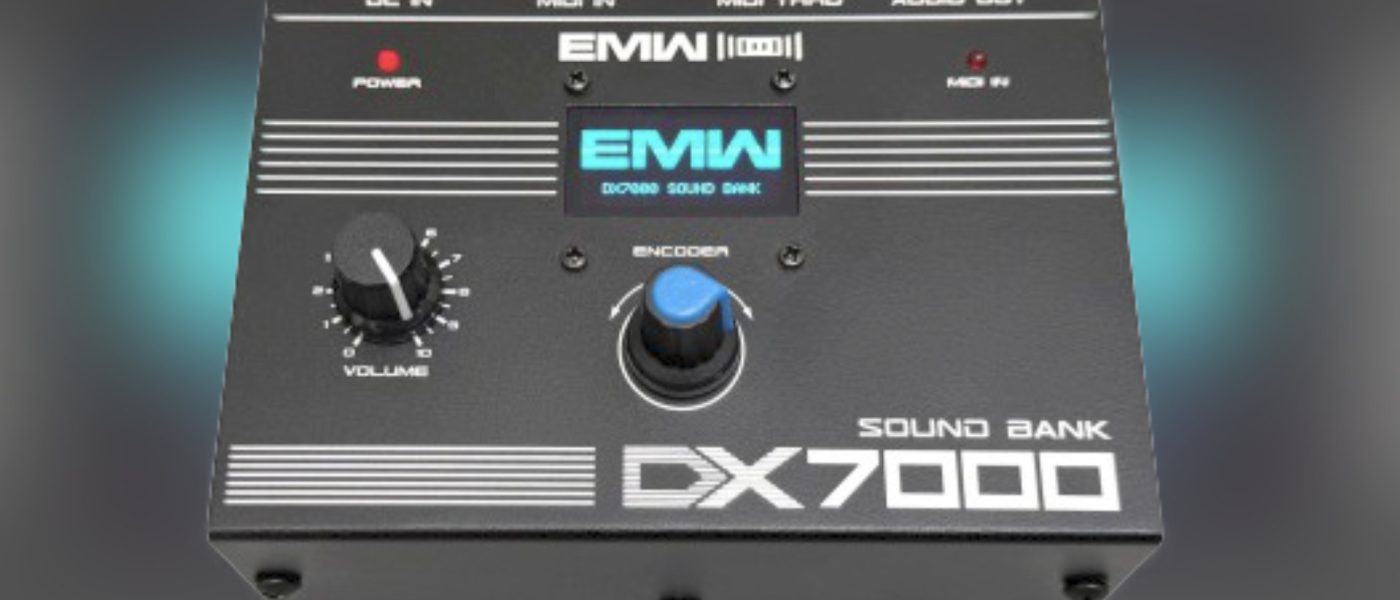
The DX7000 is a 16-voice, single-timbral FM synth that lives in the same compact, grey plastic housing as the VPOLY-6X. It has two knobs: one for navigating categories, one for selecting patches. That’s it. No operator matrix, no envelope tweaking, no algorithm madness. You turn it on, scroll through 1110 built-in sounds, and play. It’s FM synthesis for people who want to make music, not debug a spreadsheet.
The engine is clearly DX-7 inspired — EMW doesn’t explicitly say “emulation,” but the SysEx patch compatibility is a dead giveaway. You can load DX-7 patches from libraries, editors, or software like Dexed directly into 256 user slots. The DX7000 will respond to pitch-bend, mod wheel, and sustain pedal, plus MIDI Program Change for remote patch selection. It’s a glorified sound module, and that’s exactly the point.
What Makes It Interesting?
At Noxal, we’ve seen a lot of FM reissues and clones. There’s the Korg opsix (a brilliant but deep FM/X/analog hybrid), the Elektron Digitone (a performance FM sequencer), and the Dtronics DT-DX (a rack-mount DX-7 emulator). But the DX7000 occupies a weird, specific niche: it’s a preset-only FM machine. No editing. No synthesis. Just sound.
For some, that’s a limitation. For others, it’s liberation. I’ve spent hours in FM synthesis menus that feel like tax software — the DX7000 says, “Here are 1100 sounds, pick one, move on.” That’s refreshing, especially for live players or producers who want the DX-7’s iconic tones without the learning curve. The soundset is broad: crystal-clear EPs, metallic bells, punchy basses, expressive brass, lush pads, and digital textures. The categories (piano, organ, strings, etc.) are straightforward, and the encoder lets you zip through them quickly.
The real kicker is the price: $365. That’s cheaper than a used DX-7 and significantly less than a new opsix (even on sale). For the same money, you could buy an iPad and KQ Dixie (an excellent FM app), or a Dtronics DT-DX which can load 8 instances of DX-7 patches simultaneously. But neither of those feels like a dedicated hardware box with a knob. The DX7000 is a physical, tactile object that says “I am an FM synth” without requiring a computer or a tablet.
Key Specs and Connectivity
Let’s get technical — briefly, because the DX7000 isn’t about specs. Its digital engine is 16-voice polyphonic, which is enough for chords and layering. It accepts DX-7 SysEx patches via MIDI — you can send them from a computer, a librarian app, or even an old Atari ST if you’re feeling retro. The 256 user slots are generous for a preset player; you’ll never run out of space for your favourite patches.
On the back panel, you’ll find a power supply socket, MIDI In, MIDI Thru, and a single stereo audio output. That’s it. No USB, no audio over USB, no CV/gate, no expander ports. It’s spartan, but that’s consistent with the “sound player” philosophy. It’s also worth noting that the DX7000 does not have multi-timbrality — it’s a single patch at a time. You’ll need to layer externally if you want two sounds simultaneously.
The housing is the same as the VPOLY-6X, which means it’s a small, desk-friendly box that won’t take up much space. The two-knob UI is minimal, but it works for browsing presets. If you want deeper control, you’ll need to patch via MIDI and use an external editor — which kind of defeats the purpose, but it’s an option.
Market Context and Who It’s For
Let’s be real: the DX7000 isn’t for everyone. At Noxal, we love programming synths, but we also understand the appeal of a well-curated soundset in a dedicated box. This is for the musician who wants DX-7 tones without the headache of FM programming. It’s for the live performer who needs reliable, instant access to 1100 patches. It’s for the collector who wants a compact, affordable way to play classic DX-7 sounds without dragging a 1983 behemoth to a gig.
Compared to its competition, the DX7000 is a niche product. The Korg opsix is deeper, more flexible, and often on sale for $329 (though that deal is sold out, per the source). The Elektron Digitone is more performance-oriented and has a sequencer. The Dtronics DT-DX is a rack unit that can load 8 patches simultaneously for the same price. But none of those are as simple as the DX7000. It’s the FM equivalent of a preset-only analog synth — a tool for sound selection, not sound design.
Is $365 a fair price? For a dedicated hardware player with 1110 sounds and DX-7 compatibility, yes. But you could also get a used DX-7 for a bit more, or a software solution for less. The DX7000 is for those who value physical hardware and simplicity above all else. It’s a statement: “I don’t want to program FM. I just want to play it.” And that’s okay.
Frequently Asked Questions
Can I edit sounds on the DX7000?
No. The DX7000 is a sound player, not a sound editor. You cannot alter operators, algorithms, envelopes, or parameters on the unit. If you want to modify patches, you’ll need to edit them in a software librarian (like Dexed) and then load the modified SysEx data into the DX7000’s user slots.
Does the DX7000 work with classic DX-7 cartridges?
No. There is no cartridge slot. The DX7000 accepts DX-7 SysEx patch data via MIDI. You can send patches from a computer, tablet, or hardware librarian. It does not read physical cartridges or ROMs.
Is the DX7000 multi-timbral?
No. It is a single-timbral, 16-voice synth. You can only play one patch at a time. For multi-timbral operation, you would need to use external MIDI splitting or a separate hardware mixer. It does not support layering multiple patches internally.
I’ll take my DX-7 with a side of coffee, thanks — though I suspect the DX7000’s idea of a “programming break” is just choosing a different preset. Stay caffeinated, friends.