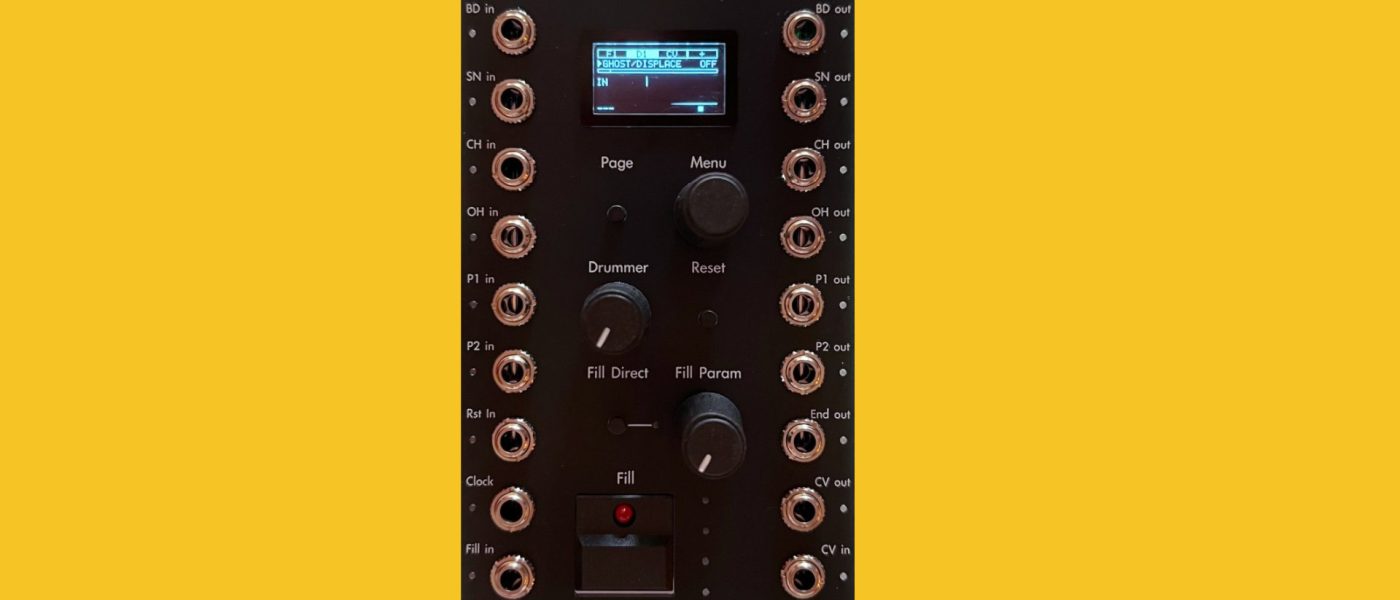
TL;DR: Timo Rozendal’s Filler is a 14HP Eurorack module that breathes life into repetitive drum patterns by injecting fills, variations, and humanization on the fly. It listens to six trigger inputs, learns your groove, and serves up 333 curated fill patterns, all while offering CV control and a dedicated fill button for instant performance spice. Available now as an assembled module for €250 or as a DIY kit for €160.
- Six trigger inputs and seven trigger outputs (BD, SN, CH, OH, P1, P2, plus an automatic crash/accent output).
- On-the-fly fills triggered via a dedicated button, bar-synced, or CV-controlled.
- Built-in library of 333 curated fill patterns across 41 banks (classic, rock, metal, jazz, etc.).
- Always-on drummer layer adds ghost hits, probability, stutters, slicing, and Markov-based variations.
- CV output for a fill-synced envelope to modulate filters, VCAs, or effects.
Reading time: 4 min
Want more synth news before your next coffee break? Join the Noxal newsletter — no spam, just gear worth knowing about.

What Is Filler?
Let’s be honest: Eurorack drum patterns can get stale faster than a bag of chips left open on a mixer. You’ve got your kick, snare, hats, and maybe a rimshot or two, but after a few bars, it’s all a bit… predictable. Enter Timo Rozendal’s Filler — a 14HP module that promises to inject variations and fills into your modular rhythms without requiring a degree in patchology. We at Noxal have seen plenty of “drum enhancers” come and go, but this one actually listens to what you’re playing and responds in real time.
Filler debuted at this year’s DIY Kit Day in Berlin, right after Superbooth, where Rozendal showed off his growing lineup. The module is performance-optimized, meaning it’s built for live tweaking rather than studio tinkering. It ships with a massive library of 333 curated fill patterns organized into 41 banks — everything from classic rock and metal to jazz and country rolls. That’s enough variety to keep even the most jaded drummer happy for a few sets.
The Brain Behind the Beats
At its core, Filler is a smart listener. It takes up to six incoming trigger inputs — think kick, snare, closed hat, open hat, and two percussion channels — and learns the pattern you’re playing. Then it generates synced fills, variation mutes, Euclidean rhythms, and automatic transitions on demand. But here’s where it gets interesting: there’s an always-on “powerful drummer layer” that adds ghost hits, humanization, probability, stutters, slicing, phase shifts, negative-space patterns, and Markov-based variations. Yes, Markov chains — the same statistical models that predict your next word on a phone keyboard, now predicting your next drum hit. It’s weird, and it works.
I’ve spent a few evenings with a pre-production unit, and the first thing I noticed is how Filler doesn’t just slap random fills onto your pattern. It learns the groove — the swing, the accents, the off-beat hi-hats — and then offers variations that feel organic rather than algorithmic. The Markov engine is especially good at creating “mistakes” that sound intentional, like a drummer who’s had one too many coffees but still nails the downbeat.
Performance Tools and Specs
Filler’s front panel is deceptively simple: three buttons (one clicky), three knobs, and a small display. The dedicated Fill button is the star — press it, and the module inserts a fill at the next bar boundary, then returns to the original rhythm. You can also trigger fills bar-synced or via CV. There’s a CV input for the fill parameter or drummer amount, and a CV output that generates a fill-synced envelope. That envelope is a godsend for modulating filters, VCAs, or effects in time with the fill — no more manually patching a separate envelope generator.
The trigger outputs cover BD, SN, CH, OH, P1, P2, and an automatic crash/accent output that fires at the end of fills. That last one is a nice touch — it adds a cymbal crash exactly when you’d expect one, like a bandleader cueing the finale. The module also features a “drummer amount” knob that controls how much of the always-on layer bleeds into the pattern, from subtle ghost notes to full-on rhythmic chaos.
Market Context and Who It’s For
At €250 assembled (€160 as a DIY kit), Filler positions itself as a mid-range performance module. It’s not cheap, but it’s cheaper than buying a separate trigger sequencer, fill generator, and probability module. Compared to something like the ALM Busy Circuits Pamela’s NEW Workout or the Intellijel Steppy, Filler is more specialized — it’s built for drum fills, not general-purpose sequencing. That focus is both its strength and its limitation.
Who should buy this? Live performers who want to break out of four-on-the-floor monotony. Studio producers who crave immediate variation without menu-diving. And anyone who’s ever wished their drum machine had a “just make it sound more human” button. If you’re the type who spends hours micro-editing velocity and timing in a DAW, Filler might feel like cheating. But if you’re the type who wants to twist a knob and hear magic, this module will make you grin.
Frequently Asked Questions
How does Filler learn my drum pattern?
It listens to up to six trigger inputs over a few bars, analyzing timing and dynamics. It then generates fills and variations that are synced to the original pattern’s tempo and feel.
Can I use Filler with non-drum modules?
Yes, technically. The trigger inputs can accept any gate or trigger signal, so you could feed it a melodic sequence and get rhythmic fills. But it’s optimized for drum voices — kick, snare, hats, etc.
Is the DIY kit difficult to build?
Timo Rozendal’s kits are known for clear instructions and through-hole components. If you’ve built a few modules before, it’s straightforward. If you’re new to soldering, start with something simpler — or buy the assembled version.
I’m writing this with a cold pour-over at my elbow, watching a kick drum pattern cycle through seventeen different fills before settling back into its original groove. Filler doesn’t just make patterns less boring — it makes you wonder why you ever programmed drums manually. Now if only it could also make my coffee.