TL;DR: Torso Electronics’ S-4 Sculpting Sampler gets a firmware 2.2 update that reworks the Mosaic engine, letting you freeze time and scan through audio in real time. The update is free for existing owners, and the S-4 is also now available in a limited White Edition with matching UI themes. This is the kind of thoughtful, creative update that reminds us why we love hardware that evolves.
- Firmware 2.2 introduces a new Mosaic mode that freezes audio and allows real-time scanning, ideal for sound design and live performance.
- White Edition of the S-4 ships now with a white chassis and dual display themes (white/black), also available to original model users via firmware.
- Price for the White Edition is $839 / £764 / €859 at Thomann; standard black version remains available at the same price point.
- Previous OS 2.0 update (June 2025) already added global macros, envelope follower, and unlimited sample length playback, setting the stage for this latest feature.
- Adopted by artists like Surgeon and Nadia Struiwigh, the S-4 is carving out a niche among experimental and ambient musicians.
Reading time: 5 min
Want more synth news before your next coffee break? Join the Noxal newsletter — no spam, just gear worth knowing about.

Freeze Time with the New Mosaic Engine
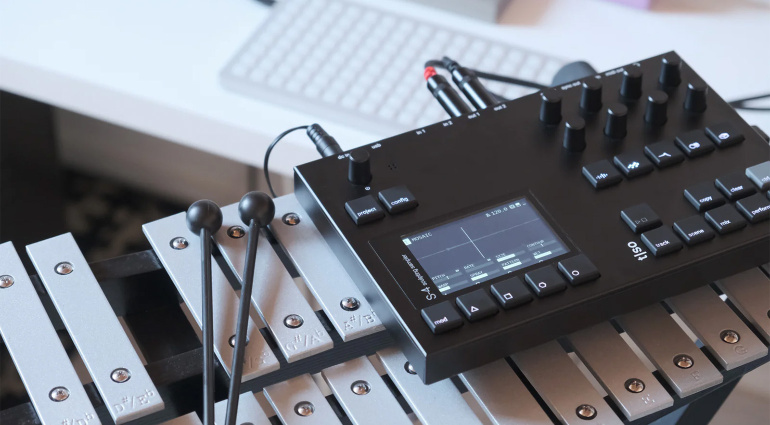
There’s a particular thrill when a piece of hardware you already love suddenly learns a new trick. The Torso Electronics S-4 has been doing that since it landed in 2023, and firmware 2.2 is the latest example. The headline feature is a reworked Mosaic engine that lets you freeze incoming audio and scan through it in real time. If you’ve ever wanted to grab a moment of sound and stretch it like taffy, this is your update.
The freeze function is deceptively simple: hit the button, and the S-4 captures a buffer of audio — from a live mic, line input, or internal track — and holds it. Then you can move through that frozen slice with a dedicated control, creating glitchy, granular textures or smooth, evolving pads. It’s the kind of feature that feels like it was always meant to be there, which is the highest compliment we can pay to a firmware update. For live performers, this could be a game-changer: freeze a loop, twist it into something unrecognizable, then release it back into the mix.
This isn’t just a gimmick either. The implementation is deep enough to satisfy sound designers, with the frozen audio responding to modulation sources and effects chains. You can map an LFO to the scan position and get automatic, cyclical timbral shifts. Or use an envelope follower to trigger freeze and release based on input dynamics. It’s the kind of thoughtful integration that makes the S-4 feel less like a sampler and more like an instrument with a personality.
White Edition and UI Refresh
Alongside the firmware news, Torso Electronics has released a White Edition of the S-4. It’s exactly what it sounds like: the same sculpting sampler in a white aluminum chassis instead of the standard matte black. But Torso didn’t stop at a paint job. The display now supports both white and black themes, and this UI update is also rolling out to original model owners via the firmware. So even if you’re not tempted by the white version, you get the visual refresh for free.
The White Edition is available now at Thomann for $839 / £764 / €859. That’s the same price as the black model, which remains in production. It’s a smart move — offering a limited colorway without a premium markup feels like a nod to the community that’s been supporting this instrument. And let’s be honest, a white synth on a dark desk is a nice aesthetic change of pace. We at Noxal appreciate a bit of visual variety in the studio, especially when it doesn’t cost extra.
For those of us who’ve been using the S-4 since the beginning, the white theme is a welcome quality-of-life improvement. The original dark UI was functional but occasionally hard to read in low light. The new white theme is crisp and legible, and switching between them is just a menu dive away. It’s a small thing, but small things matter when you’re hunched over a gear rack at 2 a.m. with a cup of cold coffee.
Key Specs and Workflow
For anyone new to the S-4, here’s the quick rundown. It’s a four-track stereo sampler running at 24-bit/48kHz, with a tape-machine-inspired workflow that eschews grids and step sequencers. Each track has a chain of five audio devices: Material (sampling/recording/looping), Granular (time-warping and pitch-shifting), Filter (a 48-band morphing resonator), Color (distortion, bit crushing, compression), and Space (reverb, delay, pitch-shifting shimmer). Yes, that filter bank is as good as it sounds — I’ve spent entire sessions just feeding it drum loops and watching them dissolve into harmonic clouds.
Modulation is where the S-4 really shines. Each audio device has four configurable modulators, giving you 20 total, and they can be mapped to any parameter with unlimited destinations. Modulation sources include complex LFOs, envelopes, and generative sequencers. This turns the S-4 into something closer to a synthesizer than a traditional sampler. Hook up a MIDI keyboard, and you can play it like an instrument, with the four tracks acting as voices. It’s a flexible, inspiring system that rewards experimentation.
The original OS 2.0 update from June 2025 already added global macros, an envelope follower, and unlimited sample length playback. That update was a full rewrite of the core engine, and it set the stage for the Mosaic freeze feature we’re getting now. Torso Electronics has been consistent about supporting the S-4 with meaningful updates, which is rare in a world where many companies release a product and move on. We respect that kind of commitment.
Market Context and Who It’s For
The S-4 exists in a crowded space. Elektron’s Octatrack and Digitakt, Polyend’s Tracker and Play, and the ubiquitous SP-404 all compete for the same mental real estate. But the S-4 carves out its own niche with the tape-machine workflow and granular focus. It’s less about precise beat slicing and more about fluid, experimental sound design. Artists like Surgeon and Nadia Struiwigh have adopted it, and that tells you something about its intended audience: people who think in textures, not grids.
This update reinforces that identity. The freeze function is not something you’d use to trigger a clean one-shot sample — it’s for grabbing a moment of chaos and turning it into something beautiful. If you’re an ambient, experimental, or generative musician, the S-4 is probably already on your radar. If you’re a more traditional beatmaker, it might feel alien. That’s fine. Not every instrument needs to be everything to everyone.
At its price point, the S-4 competes directly with the Octatrack and higher-end samplers. It’s not cheap, but it offers a unique workflow that you can’t get elsewhere. The firmware updates have only made it more compelling. For anyone on the fence, the White Edition and the 2.2 update might be the push you need. Just be prepared to lose an afternoon to frozen audio and morphing filters.
Frequently Asked Questions
Is the firmware 2.2 update free for existing S-4 owners?
Yes, the update is free and available for download from the Torso Electronics support page. It includes the new Mosaic freeze feature and the white/black display themes.
What is the difference between the White Edition and the original S-4?
Cosmetically, the White Edition has a white aluminum chassis and matching white display theme. Internally, they are identical. The white theme is also available to original model owners via the firmware update.
Can the S-4 be used as a live performance instrument?
Absolutely. The four-track workflow, real-time sampling, and now the freeze function make it well-suited for live improvisation. It responds to MIDI controllers and can be integrated into a larger setup with ease.
Now if you’ll excuse me, I have a frozen slice of a coffee grinder recording to scan through — it sounds like a dying robot in love, and I can’t stop listening. Time to brew another pot and see where this goes.