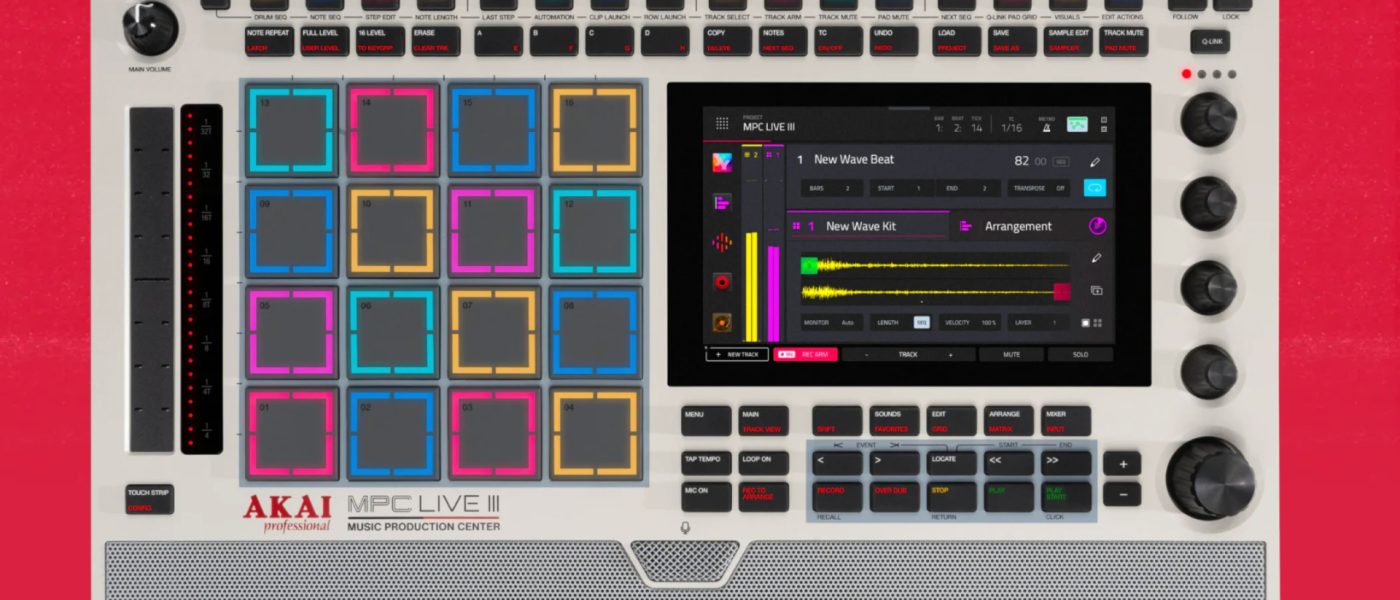
TL;DR: Akai has released a retro-styled version of the MPC Live III, swapping the standard silver/black for a classic MPC grey/red color scheme that nods to the MPC60 and MPC3000. Inside, it’s identical to the standard Live III — same 8-core processor, 8GB RAM, 128GB storage, and the expressive MPCe touch pads with 3D-sensing technology. Available now for 1599€, it’s a nostalgia play for purists who want modern power in a vintage-looking box.
- Retro design inspired by the MPC60 and MPC3000 era — grey chassis with red accents and classic Akai logo
- Internal specs unchanged: 8-core CPU, 8GB RAM, 128GB internal memory, and the 3D-sensing MPCe touch pads
- Priced at 1599€, same as the standard MPC Live III — a pure cosmetic variant
- All MPC OS 3.0 features included, including the step sequencer, performance clip matrix, and Pro Stems separation
- Targets producers who value the MPC’s visual heritage but want the latest standalone workflow
Reading time: 4 min
Want more synth news before your next coffee break? Join the Noxal newsletter — no spam, just gear worth knowing about.

Retro Aesthetic Meets Modern Hardware

We at Noxal have a soft spot for colorways that pay homage to the golden era of hardware, and Akai’s MPC Live III Retro is exactly that. The standard MPC Live III, released late last year, already pushed the standalone groovebox concept forward with its 3D-sensing pads and beefy internals. But let’s be honest — the silver and black industrial look, while functional, never quite screamed “classic MPC.” The Retro version fixes that with a grey chassis, red accents, and the old-school Akai logo that looks like it was pulled straight off a 1990s MPC3000.
It’s a smart move from Akai. The MPC brand has always carried an almost mythological weight in hip-hop and electronic music, and the visual identity of those early machines is part of that. The MPC60, the MPC3000, the MPC2000 — they all had a certain no-nonsense, studio-tool aesthetic that the Live III Retro channels convincingly. If you’re the type of producer who feels a little more inspired when your gear looks like it could have been used on a classic J Dilla beat, this is likely the version for you.
That said, I do wonder if Akai is leaning a little too hard on nostalgia. The retro treatment worked well for the MPC Live II, but the market has changed. The Live III already had a somewhat polarizing design — the step sequencer and extra buttons were welcome additions, but the unchanged touchscreen and Q-Link controls felt like missed opportunities. The retro skin doesn’t fix that, but it does make the whole package feel more cohesive, as if Akai finally decided what it wanted the MPC to look like in 2024.
What’s Inside the Retro Shell
Under that grey coat, the MPC Live III Retro is identical to the standard version — and that’s a very good thing. The 8-core processor, 8GB of RAM, and 128GB of internal storage provide four times the power of the MPC Live II. This translates to up to 32 simultaneous plugin instances and 16 audio tracks, which is genuinely impressive for a standalone machine. The SSD bay remains, so you can expand storage without relying on external drives.
The headline feature, of course, is the MPCe touch pads. These are not your grandfather’s MPC pads. Each pad functions as an expressive X/Y controller, letting you map up to four samples per pad — one in each corner — and blend between them with your fingers. It’s a radical departure from the classic MPC workflow, and it opens up possibilities for sound design that were previously the domain of expensive Eurorack modules or software. The 3D-sensing technology adds a layer of expression that goes beyond aftertouch, and I’ve found it genuinely useful for creating evolving textures and dynamic note repeats.
Also new is the 16-step sequencer, now with dedicated hardware controls. This is a first for the MPC line, and it’s a massive quality-of-life improvement. Instead of tapping on the touchscreen to program steps, you can now jab at physical buttons, which is faster and more satisfying. The secondary functions — track select, clip launching — are smartly integrated, and the performance touch-strip adds real-time control for effects, pitch-bending, and Q-Link parameters. It’s clear Akai listened to the community’s complaints about the Live II’s reliance on the screen.
The Retro Effect on Workflow
Let’s talk about workflow, because that’s where the MPC Live III — retro or not — really shines or stumbles. The MPC 3 OS update, which arrived earlier this year, was a significant overhaul. It introduced a performance clip matrix, clip edit mode, and the ability to launch loops of different lengths in real-time. Combined with the new hardware, the Live III feels like a proper instrument rather than a computer in a box. The retro version doesn’t change the OS, but it does change how you feel while using it.
I’ll be honest: I’m a sucker for gear that looks like it belongs in a studio from 1995. When I sit down with the MPC Live III Retro, I’m not just making beats — I’m making beats that feel like they could have been made on an MPC3000, even if the actual workflow is miles apart. There’s a psychological component to gear aesthetics that we at Noxal don’t dismiss lightly. If the grey and red makes you want to spend more time with the machine, that’s a valid upgrade.
However, I also have to point out that the retro treatment doesn’t address the Live III’s few shortcomings. The touchscreen is still 7 inches and unchanged from the Live II, and the Q-Link controls remain the same four knobs. I would have loved to see more dedicated hardware for mixing and effects — a few more knobs or faders would have made the retro version feel like a true “pro” tool. Instead, it’s a cosmetic refresh that relies on the same touchscreen-heavy interaction. It’s good, but it’s not perfect.
Market Context and Final Thoughts
At 1599€, the MPC Live III Retro is priced identically to the standard version, so there’s no financial penalty for choosing style over substance. That’s the right call. However, it’s worth noting that the standard MPC Live III has been out since late last year, and the retro version arrives at a time when the standalone groovebox market is increasingly crowded. The Elektron Digitakt II, the Roland SP-404MKII, and the Pioneer Toraiz SP-16 are all vying for your attention, each with their own aesthetic and workflow quirks.
Who should buy this? If you’re a producer who already owns an MPC Live II and feels the upgrade itch, the Live III — retro or not — is a significant leap forward in terms of power and expressiveness. The 3D-sensing pads alone are a compelling reason to upgrade if you do any amount of sound design. If you’re new to the MPC ecosystem, the retro version is a fine entry point, especially if the classic MPC look speaks to you. But if you’re purely about performance and don’t care about the color of your gear, save yourself the aesthetic premium and grab the standard version.
We at Noxal can’t help but appreciate the retro wave that’s sweeping hardware right now. From the Korg Minilogue XD’s special editions to the Moog Minitaur’s limited runs, manufacturers are realizing that people want gear that looks as good as it sounds. The MPC Live III Retro is a loving nod to the past, wrapped around a genuinely powerful modern machine. It’s not revolutionary, but it’s charming — and sometimes that’s exactly what you need in a studio.
Frequently Asked Questions
Is the MPC Live III Retro any different from the standard MPC Live III?
No, the Retro version is a purely cosmetic variant. The internal hardware, software, and feature set are identical to the standard MPC Live III. The only differences are the grey/red color scheme and the classic Akai logo.
Can I upgrade my MPC Live II or MPC One to the Live III Retro’s specs?
No, the Live III’s hardware — including the 8-core processor, 8GB RAM, and 3D-sensing pads — is only available in the Live III itself. There is no upgrade path for older models, though they do receive OS updates.
Does the MPC Live III Retro work with all MPC plugins and expansions?
Yes, it’s fully compatible with all MPC plugins and expansions designed for the MPC 3 OS. It also ships with the MPC3 Pro Pack, which includes effects from AIR like Reverb Pro and Visual EQ4.
I’ll take my MPC Live III Retro with a double espresso, please — preferably brewed while looking at the grey chassis and pretending I’m in a 1990s New York studio. The nostalgia is strong, but so is the caffeine.