TL;DR: 4ms has announced two new Eurorack modules at Superbooth 2026: MESA, a hardware version of the Valley Plateau reverb from VCV Rack (due August 2026, $399), and LEQA, a vintage-style leveling amplifier and 3-band EQ for master bus processing (due June 30, 2026, $345). Both modules bring sophisticated studio processing to the modular world.
- MESA is a stereo plate reverb based on the Dattorro algorithm, with 10 CV inputs for deep modulation control — ideal for ambient and experimental patches.
- LEQA combines an LA-2A-style compressor/limiter with a 1073-style 3-band EQ and CV-controllable stereo width, all in 14 HP.
- MESA costs $399 and arrives in August 2026; LEQA is $345 and lands on June 30, 2026.
- Both modules are pre-order ready, but 4ms has not yet confirmed exact retailers.
Reading time: 4 min
Want more synth news before your next coffee break? Join the Noxal newsletter — no spam, just gear worth knowing about.

MESA: Valley Plateau in Hardware
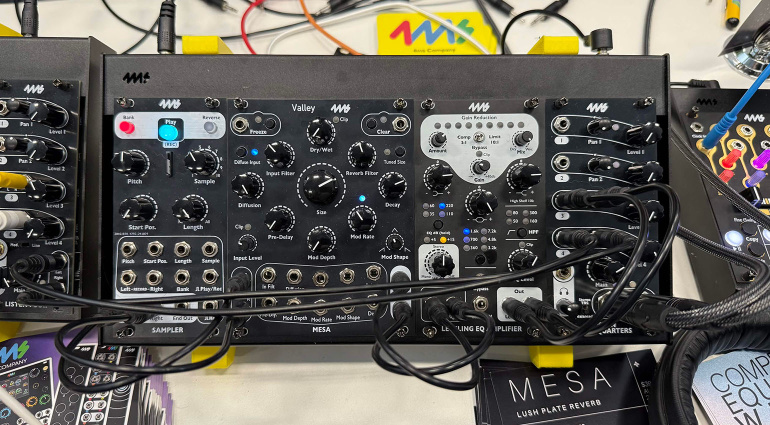
We at Noxal have a soft spot for the reverse workflow: when a software module gets the hardware treatment. Usually, it’s the other way around — a Eurorack module gets ported to VCV Rack, and everyone cheers. But 4ms has flipped the script with MESA, a faithful hardware incarnation of the popular Valley Plateau reverb from VCV Rack.
Valley Plateau, for the uninitiated, is a stereo plate reverb built on the legendary Dattorro algorithm from 1997 — the same architecture that powers some of the most beloved digital reverbs in history. Its claim to fame is endless, shimmering tails with heaps of modulation, though it can also do shorter, tighter reverbs when you dial it back. MESA brings all of that into a physical module, with knobs and patch sockets rearranged for ergonomic rack use.
The real selling point here is CV control. MESA offers ten CV inputs covering Input Filter, Pre-Delay, Diffusion, Size, Mod Depth, Mod Rate, Mod Shape, Decay, Reverb Filter, and Dry/Wet. That’s a ridiculous amount of modulation potential for a reverb module. You can create everything from subtle spatial movement to chaotic, self-oscillating soundscapes. If you’ve ever wanted to automate reverb tails with an LFO or sequence the dry/wet mix, MESA is your new best friend. It’s due in August 2026 for $399.
LEQA: Vintage-Style Leveling EQ
LEQA is a different beast entirely. While MESA is about space and ambience, LEQA is about control and polish. It’s a 14 HP module that combines a compressor/limiter inspired by the legendary LA-2A with a 1073-style 3-band EQ. If that sounds like a mastering chain in a single module, that’s because it is — plus a CV-controllable stereo width processor.
The compressor offers two ratios — 3:1 and 10:1 — and includes a gain reduction meter, so you can actually see what you’re doing. The EQ section gives you four switchable frequencies for the low and high shelving bands, plus six frequency ranges for the mid band. There’s also a high-pass filter to clean up low-end rumble. The stereo width processor is a nice touch, letting you expand or narrow the stereo field via CV.
At $345, LEQA is priced competitively for what it offers. It’s not a cheap module, but considering you’re getting a compressor, EQ, and stereo width tool in one package, it’s a solid value for anyone looking to master or process a final mix inside the rack. It’s scheduled for release on June 30, 2026 — just in time for summer studio sessions.
Key Specs and Market Context
Let’s get specific. MESA is a stereo plate reverb with 10 CV inputs, based on the Dattorro algorithm. It excels at long, modulated tails but can do shorter reverbs as well. It’s 16 HP (estimated) and costs $399. LEQA is a 14 HP module with an LA-2A-style compressor (two ratios), a 1073-style 3-band EQ (with switchable frequencies), a high-pass filter, and a CV-controllable stereo width processor. It costs $345.
In the current market, there are plenty of reverb modules — from Mutable Instruments’ Clouds clones to Strymon’s Magneto — but few offer this level of CV control over so many parameters. Similarly, mastering-grade modules are rare in Eurorack; most compressors and EQs are standalone. LEQA’s combination of both, plus stereo width, is genuinely novel. 4ms is known for quirky, high-quality modules like the Ensemble Oscillator and the Meta Module, and these two fit right into that lineage.
One note: 4ms has not yet confirmed exact retailers for pre-orders. Keep an eye on their website and major dealers like Perfect Circuit, Schneidersladen, and Signal Sounds.
Who Are These For?
MESA is for anyone who loves deep, textural reverb and wants to modulate it in real time. If you’re into ambient, drone, or experimental music, this is a no-brainer. It’s also for VCV Rack users who’ve been dreaming of a hardware version of Valley Plateau — your dream is now real.
LEQA is for the modular producer who wants a cohesive master bus in their rack. If you’ve been patching together a compressor and EQ from different manufacturers, this simplifies your chain and adds stereo width control. It’s also for those who appreciate vintage-inspired tone but want modern CV control. Both modules are for serious users who understand that good processing can make or break a track.
We at Noxal are particularly excited about MESA. The Dattorro algorithm is a classic for a reason, and having it with full CV control is a game-changer for sound design. LEQA, meanwhile, feels like a tool for the finish line — something you patch in when the track is almost done and needs that final polish. Both are welcome additions to the 4ms lineup.
Frequently Asked Questions
When will MESA and LEQA be released?
MESA is scheduled for August 2026, and LEQA for June 30, 2026. Pre-orders are expected to open soon through major retailers.
How much do they cost?
MESA is $399, and LEQA is $345. Both prices are USD and may vary by region.
Can I use LEQA as a standalone mastering processor?
Yes, LEQA is designed for master bus processing. It combines compression, EQ, high-pass filtering, and stereo width control in a single module, making it ideal for final mix polish inside a Eurorack system.
I’ll be honest — I’m already planning a patch where MESA’s reverb tail lasts longer than my attention span during a boring meeting. Coffee helps. The reverb helps more.