TL;DR: Suonobuono has released firmware v0.35 for its Polyvera hybrid wavetable synth and sampler, adding a bunch of new synthesis features just in time for Superbooth. The six-voice desktop unit combines digital oscillators and sampling with an analog filter, eight filter types, and a binaural mode — and now it’s even more capable. If you’ve been eyeing this Italian/Swedish hybrid for €1,199, the update might be the nudge you need.
- Firmware v0.35 adds new synthesis features to the Polyvera, including enhancements to the wavetable and sampling engines.
- The synth features six voices with two oscillators each: oscillator one is wavetable with a sub oscillator; oscillator two can be wavetable or a sampler with 60 seconds of sample time.
- Analog filter section includes eight filter types (original and classic chip), resonance, drive, post-filter distortion, and FM.
- Modulation includes an eight-slot mod matrix, three LFOs, and one loopable multimode envelope; effects cover chorus, delay, phaser, and multiple reverbs.
- The update is free for existing owners; the Polyvera is priced at €1,199 and available now.
Reading time: 4 min
Want more synth news before your next coffee break? Join the Noxal newsletter — no spam, just gear worth knowing about.

What Is the Suonobuono Polyvera?
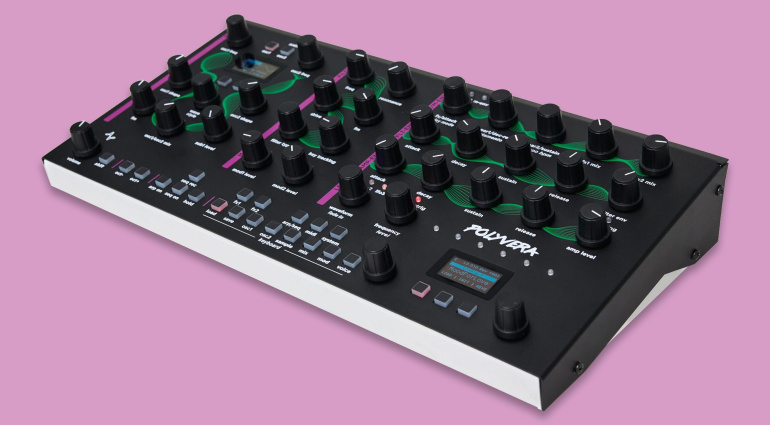
We at Noxal have a soft spot for synths that refuse to pick a lane. The Suonobuono Polyvera is exactly that — a six-voice desktop hybrid that blends digital wavetable oscillators with analog filtering and sampling. Developed by an Italian-born maker based in Sweden (the same person behind the nABC sidechain compressor and the Lazer gesture controller), the Polyvera first appeared on our radar in September 2024, teased for Roma Modulare. Now, with firmware v0.35 out, it’s evolved from intriguing to genuinely formidable.
The design is straightforward: two oscillators per voice, one wavetable with a sub oscillator, the other either wavetable or sampler. You can load your own wavetables via SD card, sample through the audio inputs (up to 60 seconds), and then route everything through an analog filter. It’s the kind of architecture that makes you want to stop reading and start patching — even if there are no patch cables involved.
Firmware v0.35: What’s New?
The update, released just before Superbooth, adds a “slew of exciting synthesis features,” according to the company. While the exact changelog details are still trickling in, early reports point to expanded modulation options, improved sample handling, and tweaks to the binaural mode — a feature that lets you create spatial audio effects without leaving the synth’s architecture.
I’ll be honest: firmware updates are usually about bug fixes and minor QoL improvements. But Suonobuono seems to treat them as opportunities to add whole new dimensions. The v0.35 release isn’t just a polish — it’s a substantive expansion. For a synth that already packed eight filter types, three LFOs, and a loopable envelope, that’s saying something. And because it’s free for existing owners, the only cost is the time to download and install it.
Key Specs and Sound Engine
Let’s get into the numbers, because that’s what we do at Noxal (between coffee refills). The Polyvera offers six voices, each with two oscillators. Oscillator 1 is wavetable with a sub oscillator; oscillator 2 can be wavetable or a sampler. The oscillator section includes FM, sync, ring modulation, and a noise generator. You can load your own wavetables via SD card, and the sampler offers 60 seconds of sample time via the audio inputs.
The analog filter is where things get interesting. It has eight filter types, including original designs and “classic chip” models. It’s resonant, self-oscillating, and features drive, post-filter distortion, and filter FM. Modulation comes from an eight-slot mod matrix, three LFOs, and one loopable multimode envelope. Effects are split into two sections: one with chorus, delay, and phaser, the other with multiple reverb types. There’s also a classic arpeggiator, a 32-step polyphonic sequencer with panel control automation, MPE support, and that binaural mode we mentioned earlier.
At €1,199, it competes with things like the Sequential Take 5 or the Waldorf Iridium — but the Polyvera’s hybrid nature and sampling capabilities give it a unique edge. It’s not trying to be everything; it’s trying to be a specific kind of everything.
Market Context and Who It’s For
We at Noxal have seen a lot of hybrid synths come and go. Some are too digital, some too analog, and some just confuse everyone. The Polyvera strikes a balance that feels intentional. It’s for the producer who wants wavetable flexibility without giving up the warmth of an analog filter. It’s for the sound designer who needs sampling capability in a hardware box. It’s for the live performer who wants MPE and a sequencer that can handle polyphonic steps.
That said, it’s not for everyone. At €1,199, it’s an investment. The interface is desktop-only, so you’ll need a mixer or audio interface. And while the binaural mode is cool, it’s a niche feature that won’t matter if you’re mixing in mono. But if you’re the type who reads firmware changelogs for fun (and I am that type, unashamedly), the Polyvera is worth a serious look.
Frequently Asked Questions
What does the firmware v0.35 update add to the Polyvera?
The update introduces new synthesis features, including expanded modulation options, improved sample handling, and tweaks to the binaural mode. It’s a free download for existing owners from the Suonobuono website.
Can I load my own wavetables and samples into the Polyvera?
Yes. You can load your own wavetables via SD card. The synth also offers 60 seconds of sample time through the audio inputs, with an internal library included.
How does the Polyvera compare to other hybrid synths in its price range?
At €1,199, the Polyvera sits between the Sequential Take 5 and the Waldorf Iridium. Its hybrid architecture — digital oscillators and sampling with an analog filter — is its main differentiator. The binaural mode and MPE support add further value for experimental producers.
I’ll be honest: I downloaded the firmware while my espresso machine was heating up, and by the time my cup was full, the Polyvera was already sounding better. That’s efficiency I can get behind — even if my caffeine intake is anything but.