
TL;DR: This Is Not Rocket Science and Error Instruments have teamed up again to create SmartLab, a standalone six-voice granular string synthesizer controlled by touch-sensitive faders and a central looper/granular engine. It’s a weird, beautiful, and experimental instrument that borrows from their previous modules but stands on its own — shipping in June for around €600. Meanwhile, TINRS is leaving Eurorack behind with a final 20-unit run of their Flourish system.
- SmartLab is a standalone (not Eurorack) six-voice string synth using Karplus-Strong algorithms, played via six vertical touch faders.
- Central glowing ring houses a looper and granular engine that can capture and mangle audio from the instrument or onboard microphone — then play it back with the faders.
- Includes effects, per-fader sequencers, and CV outputs for controlling external gear.
- Price around €600, expected to ship in June 2025.
- This Is Not Rocket Science is leaving Eurorack to focus on keyboard instruments; their final Eurorack system, Flourish (limited to 20 units, €3200), is a “greatest hits” collection of their modules.
Reading time: 4 min
Want more synth news before your next coffee break? Join the Noxal newsletter — no spam, just gear worth knowing about.

What is SmartLab?
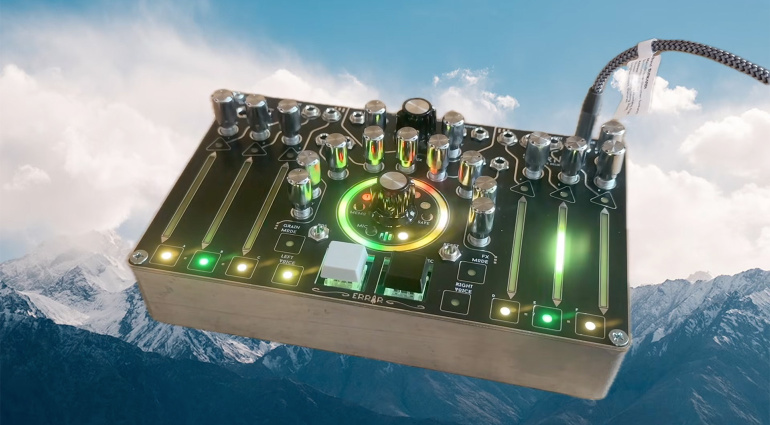
Superbooth has grown up — it’s now a sprawling trade show with flashy booths and corporate logos, a far cry from the scrappy DIY affair it was a decade ago. But every year, a few gems remind us that weird still has a home. SmartLab, the latest collaboration between This Is Not Rocket Science and Error Instruments, is one of those gems. It’s a standalone instrument that looks like a prop from a 1980s sci-fi film about a sentient synthesizer, and it sounds like the fever dream of a granular enthusiast who’s been locked in a room with a string section and a blender.
At its core, SmartLab is a six-voice string synthesizer. But this isn’t your grandmother’s Crumar. It uses Karplus-Strong algorithms — a physical modeling technique that simulates plucked strings — to generate its sound. You play it by touching six vertical fader strips on the front panel. Each strip controls one voice, and the response is capacitive, meaning you can slide, tap, or press to shape the sound in real-time. It’s tactile, immediate, and refreshingly unconventional.
You can tune each voice individually, and the sound ranges from smooth, almost glassy tones to abrasive, grating textures. There are effects onboard, as well as per-fader sequencers. Each fader also has a corresponding CV output, so you can use SmartLab to control external Eurorack modules or other gear. Because of course you can — these two companies don’t believe in isolation.
The Granular Looper (and Why It Matters)
The centerpiece of SmartLab — literally and figuratively — is the large glowing ring in the middle of the panel. This is a looper and granular engine. It captures whatever you play on the faders, or audio recorded through the onboard microphone, and then obliterates it. We mean that in the best possible way: it chops, scatters, and reassembles the audio into granular clouds. You can then play these grains back using the same faders, turning the instrument into a kind of tactile granular sampler.
This is where SmartLab stops being a string synth and becomes something else entirely. The combination of Karplus-Strong synthesis with a granular looper creates a feedback loop that can produce everything from lush, evolving pads to chaotic, glitchy noise. The onboard microphone adds another layer of unpredictability — you can capture ambient sounds, vocal snippets, or the sound of your cat walking across the desk, and then turn them into playable textures. It’s the kind of instrument that rewards experimentation and punishes predictability.
Specs and Practicalities
SmartLab is not a Eurorack module, though it can interface with Eurorack systems via CV. It’s a fully standalone instrument with its own power supply and enclosure. The design borrows ideas from previous TINRS and Error Instruments modules — like the White Rabbit — but repackages them into a self-contained unit. The exact specifications are still trickling out, but here’s what we know:
- Voices: 6, each controlled by a vertical capacitive fader
- Sound engine: Karplus-Strong physical modeling
- Looper/Granular: Central ring interface, captures audio from instrument or onboard microphone
- Effects: Onboard, type TBD
- Sequencing: Per-fader sequencers, plus CV output sequencers
- CV I/O: 6 CV outputs for controlling external gear
- Price: Around €600
- Availability: Expected to ship June 2025
At €600, SmartLab is priced competitively for what it offers — especially considering the build quality and the sheer weirdness factor. It’s not cheap, but it’s not prohibitively expensive either. For context, a single high-end Eurorack module can cost €400, and this is a complete instrument.
TINRS Bows Out of Eurorack with Flourish
In somewhat related news, This Is Not Rocket Science has announced they are leaving the Eurorack world. Their focus will shift entirely to keyboard instruments, like the BigFish we reported on recently. Their final Eurorack product is Flourish, a system that represents the greatest hits of 10 years of TINRS modules. They’re only making 20 units, and you can order one directly from the company for €3200.
Flourish is essentially a pre-configured Eurorack system that collects the most beloved modules from TINRS’s catalog. It’s a farewell tour in module form. For €3200, you’re getting a curated system that has been designed to work together, which is a nice alternative to the usual “buy 20 modules and hope they play nice” approach. But with only 20 units available, it’s more of a collector’s item than a mass-market product.
We at Noxal are a little sad to see TINRS leave Eurorack — their modules were always interesting, if occasionally baffling. But if it means more instruments like SmartLab and BigFish, we’re willing to forgive the departure. The world needs more weird keyboards.
Who Is This For?
SmartLab is not for everyone. If you want a straightforward polysynth with a familiar interface and predictable results, this is not it. If you’re the kind of person who finds joy in patching cables at random and discovering happy accidents, you’ll feel right at home. It’s for experimental musicians, sound designers, and anyone who’s ever felt that “normal” synthesizers are a bit too… normal.
The touch faders make it highly gestural — you can play it like a theremin, a ribbon controller, or a drum pad, depending on your mood. The granular looper adds a layer of unpredictability that can turn a simple melody into a cloud of sonic debris. It’s the kind of instrument that rewards deep exploration, but also offers immediate gratification for those willing to embrace chaos.
At Noxal, we believe that the best instruments are the ones that make you want to play them, even if you have no idea what you’re doing. SmartLab fits that description perfectly. It’s weird, beautiful, and unapologetically experimental — exactly what Superbooth needs more of.
Frequently Asked Questions
Is SmartLab a Eurorack module?
No, SmartLab is a standalone instrument. It can interface with Eurorack via its CV outputs, but it has its own power supply and enclosure.
How does the granular looper work?
The central glowing ring captures audio from the instrument or the onboard microphone. It then processes this audio through a granular engine, chopping it into grains that can be played back using the six touch faders. It’s essentially a looper that lets you mangle and re-play captured sounds.
When will SmartLab be available and how much does it cost?
SmartLab is expected to ship in June 2025, with a price of around €600. You can pre-order directly from This Is Not Rocket Science or Error Instruments.
We at Noxal will be ordering two SmartLabs — one to play, and one to use as a very expensive coffee coaster. Priorities.