TL;DR: Waldorf has officially announced the Iridium mk2 desktop synth, bringing increased RAM, flash memory, multi-timbral support up to four layers, a new Seeds vector-synthesis engine, and per-note parameter locks co-developed with Aphex Twin. Existing Iridium mk1 owners can upgrade their hardware starting mid-August 2026 for €598, while Quantum users will also be eligible later.
- Iridium mk2 desktop adds a new CPU board with 6 GB of user sample storage and support for four-layer multi-timbral operation (up from two).
- New Seeds engine offers vector-synthesis-inspired timbral journeys with dynamic sub-oscillator waypoints; each of three oscillators can use it.
- Per-Note Parameter Locks, developed with Aphex Twin, assign up to 16 unique parameter variations to each of 128 notes – including synthesis mode changes.
- Hardware upgrade for existing Iridium mk1 owners (desktop, keyboard, Core) costs €598 incl. installation and return shipping within the EU.
- Quantum users will get the same upgrade path, though official details have not yet been announced.
- Firmware v4.0 for all Quantum and Iridium users adds a mutator patch randomizer, polyphonic arpeggiator, and microtonal patch saving.
Reading time: 5 min
Want more synth news before your next coffee break? Join the Noxal newsletter — no spam, just gear worth knowing about.

What is the Iridium mk2 Desktop?

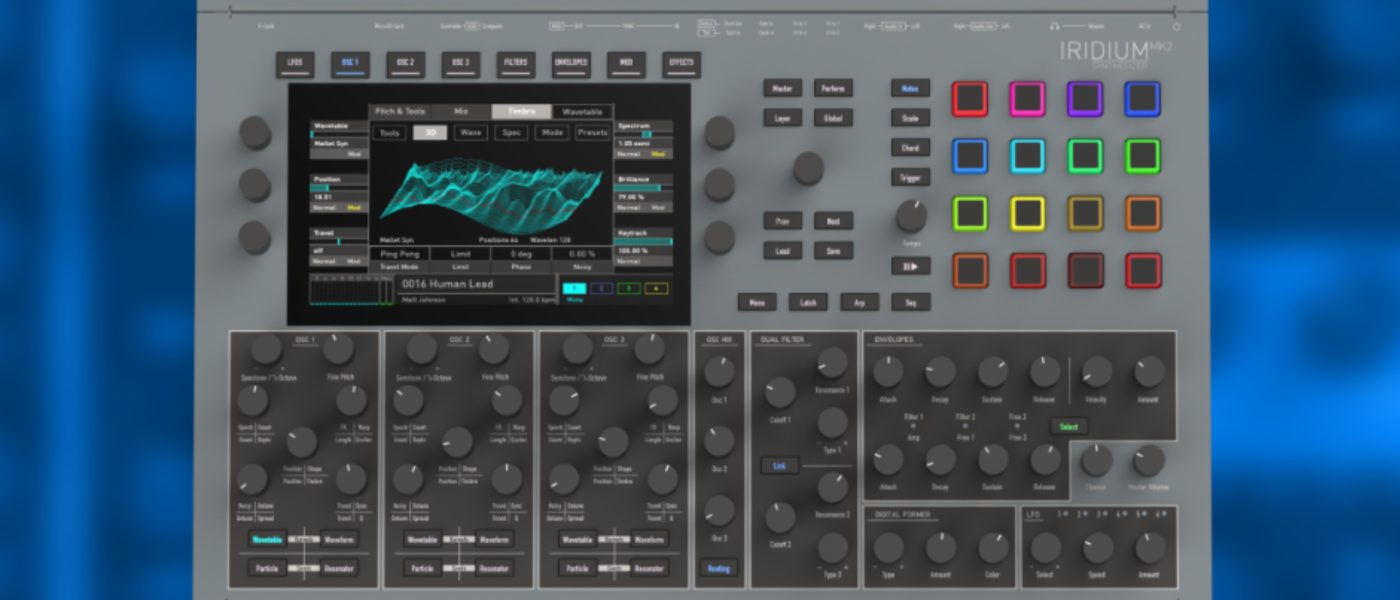
At Superbooth 2026, Waldorf did what every sensible synth company should do when faced with a beloved six-year-old product: they made it better without breaking the bank or alienating early adopters. The Iridium mk2 desktop is the official successor to the original Iridium, and while it looks mostly the same — 98% of the controls are identical, though the color is now a rather fetching gray — the real changes live under the hood.
The biggest news is internal. The mk2 features an upgraded CPU board (not a new CPU, mind you, but more RAM and flash memory). User sample storage jumps to 6 GB total, which means you can load gargantuan multi-sampled instruments without hitting the dreaded “memory full” wall mid-patch. Multi-timbral support goes from two layers to four, and Waldorf has ported over the round-robin and random-robin modes from its Protein synth. These aren’t just buzzwords: they bring genuine timbral variety, allowing you to build patches that evolve differently every time you press a key.
At €598 for the hardware upgrade — which includes installation and return shipping within the EU — this is a serious investment. But for anyone who has spent the last half-decade wrestling with the original Iridium’s memory limits, it may well be worth every euro.
The Seeds Engine and Flavour Knob
The highlight of the mk2’s new synthesis capabilities is the Seeds engine, available on each of the three oscillators. Think of it as vector synthesis for the modern age. Waldorf describes it as a “timbral journey” where each wavetable point is not a static waveform but is dynamically synthesized from sub-oscillators called Seeds. These Seeds can be combined using ring modulation, FM, wavetable, or partials synthesis, and can also be enriched with noise and non-pitched material.
Here’s the practical bit: you can twist a single knob and travel through 12 different waypoints, each using a different synthesis technique. The unit ships with a set of predefined timbral journeys, but you can edit and create your own. If you’ve ever wished your wavetable synth could do FM on one frame and additive on the next, this is your machine.
Then there’s the Flavour knob — a physical control that introduces micro-variations in timing, timbre, pitch, and other parameters. It’s Waldorf’s answer to the “liveliness” problem that plagues sterile digital synths. A small twist adds unpredictable, organic movement without diving into menus. It’s the kind of feature that makes you want to record everything and sort it out later.
Aphex Twin and Per-Note Parameter Locks
Let’s address the elephant in the Waldorf booth: Aphex Twin is a heavy user of the Iridium, and Waldorf has collaborated with him on a feature called Per-Note Parameter Locks. The concept is simple but devastatingly powerful: each of the 128 notes in a patch can be assigned up to 16 individual parameter variations. Hold a note, turn a knob, and that note remembers the setting. You can change the synthesis mode of oscillators per note, or tweak effect parameters on a per-note basis.
This is not a gimmick. It allows for sequences where every single note has a different timbre, filter envelope, or even oscillator type. Imagine a bass line where every other note switches from wavetable to FM — that’s the kind of rhythmic, glitchy unpredictability that Aphex Twin has been famous for since the ’90s, now baked into a hardware synth interface. The locks are saved with each patch and can be edited on a dedicated page, so you’re never flying blind.
I will admit: I spent a good ten minutes staring at the press images and imagining the possibilities. Then I made another coffee. This is the kind of feature that rewards obsessive tweaking, and I mean that as the highest compliment.
Upgrade Path and Market Context
Waldorf’s decision to offer a hardware upgrade for existing Iridium mk1 owners is both generous and strategically sound. The upgrade costs €598 and includes the new SOM board with increased RAM and flash memory but the same CPU. Waldorf’s service team will begin performing installations from mid-August 2026. If you’re outside the EU, you’ll need to contact your local distributor.
Quantum users are also in line for the upgrade, though Waldorf hasn’t officially announced those details yet. In a conversation with developer Rolf Wöhrmann, he confirmed that Waldorf is actively exploring ways to make this work. The company has also announced firmware v4.0 for all Quantum and Iridium users, which adds a mutator patch randomizer (originally from the Microwave plugin), a polyphonic arpeggiator, and microtonal features saved in patches.
This is a smart move. The Iridium mk2 isn’t a complete overhaul — it’s an evolution that respects the original hardware while pushing the platform forward. For mk1 owners, the upgrade path means you don’t have to sell your synth at a loss and buy a new one. For Waldorf, it means keeping a loyal user base happy and generating revenue from existing hardware. Everyone wins, except perhaps rival synth makers.
Who Is It For?
The Iridium mk2 is for the synth enthusiast who wants deep, multi-engine digital synthesis without staring at a computer screen. It’s for the producer who needs four layers of timbral complexity and the memory to hold huge sample libraries. It’s for the experimental musician who wants per-note parameter locks to build evolving, glitchy sequences that would take hours to program in a DAW.
It is not for beginners. The Iridium line has always had a steep learning curve, and the mk2 adds more depth without dumbing anything down. If you’re still figuring out what an envelope generator does, this synth will eat you alive. But if you crave sonic architecture — building sounds from the ground up with wavetable, FM, granular, and now Seeds synthesis — this is one of the most powerful digital synths in a desktop form factor.
The upgrade is also a solid deal for existing Iridium owners who have hit the memory ceiling or want the new synthesis modes. For new buyers, the mk2 desktop is a clear choice over the original, provided your wallet can handle the premium. And for Quantum users: be patient. The upgrade is coming, and it will be worth the wait.
Frequently Asked Questions
Can I upgrade my Iridium mk1 to mk2 hardware?
Yes. Starting mid-August 2026, Waldorf will offer a hardware upgrade for all Iridium models (desktop, keyboard, and Core). The upgrade costs €598 incl. VAT, installation, and return shipping within the EU. It includes a new SOM board with increased RAM and flash memory, unlocking Seeds synthesis, per-note parameter locks, four-layer multi modes, and the Flavour knob.
What is the Seeds engine and how is it different from wavetable synthesis?
Seeds is a vector-synthesis-inspired engine where each waypoint in a timbral journey is dynamically synthesized from sub-oscillators (Seeds) using techniques like ring modulation, FM, wavetable, or partials. Unlike static wavetables, each point can use a different synthesis method, and you can edit or create your own journeys. A single knob lets you travel through 12 different points.
Will the hardware upgrade be available for Quantum users?
Waldorf has confirmed that Quantum users will benefit from the same upgrade, but official details have not been announced yet. The company is actively working on making this available, so owners should watch for updates from their distributor.
At Noxal, we believe a synth upgrade should feel like finding an extra shot of espresso in your morning cappuccino — unexpected, welcome, and slightly dangerous. Now if you’ll excuse me, I have 128 notes to lock and a coffee to finish before the kettle boils again.