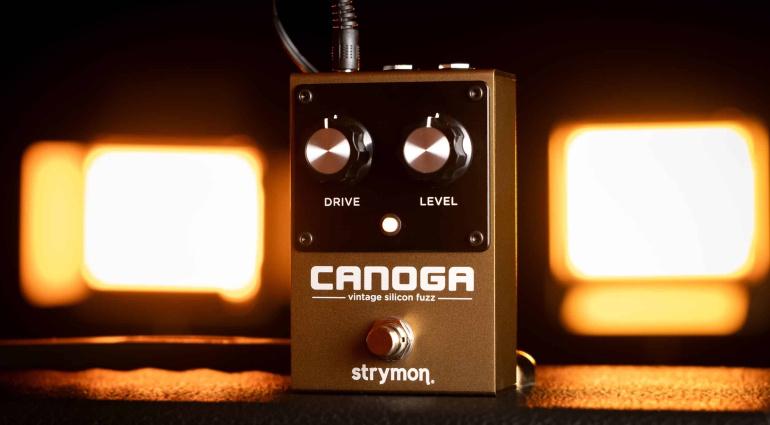
TL;DR: Strymon has released the Canoga, an all-analog silicon fuzz pedal with zero digital processing — no MIDI, no USB, no firmware updates. It’s based on a prototype from seven years ago and features a bare-bones Drive/Level control set, true bypass, and an internal power-state jumper. At $227, it’s a stripped-back offering for purists who want vintage fuzz tones without the modern bells and whistles.
- The Canoga is a silicon Fuzz Face-style pedal with only two controls: Drive and Level.
- It features zero digital components — no MIDI, USB, or firmware — and is part of Strymon’s all-analog A Series.
- An internal jumper lets you set the pedal’s initial power-up state to bypass or engage.
- Priced at $227/£199/€229, it’s available now at retailers like Thomann.
- It’s based on a prototype by Strymon founder Gregg Stock that sat untouched for seven years.
Reading time: 4 min
Want more synth news before your next coffee break? Join the Noxal newsletter — no spam, just gear worth knowing about.

What Is the Strymon Canoga?
We at Noxal have a soft spot for companies that occasionally throw a curveball. Strymon, known for their DSP-laden reverbs and delays, has done exactly that with the Canoga — a vintage-voiced silicon fuzz pedal that’s about as analog as it gets. No MIDI, no USB, no firmware updates, and zero digital processing. It’s a fuzz pedal, plain and simple, and that’s refreshing in an era where every stompbox seems to need a companion app.
The Canoga is based on an analog fuzz circuit built by Strymon founder Gregg Stock. The story goes that a set of prototypes sat untouched for seven years before the company decided to release it as part of their A Series of all-analog effects. That series already includes the Fairfax, a drive pedal, and the Canoga fits neatly alongside it as a no-nonsense fuzz option. It’s a back-to-basics move from a company that usually makes us reach for our reading glasses and a USB cable.
I’ll admit, when I first saw the announcement, I raised an eyebrow. Strymon making a fuzz pedal? But then I remembered that their A Series is all about analog purity, and fuzz is arguably the most analog effect in existence. It makes sense, even if it feels like they’re arriving late to a party that’s been going since the 1960s.
Silicon Fuzz Simplicity Meets Modern Utility
The control layout is spartan: Drive and Level. That’s it. No tone stack, no bias knob, no blend control. This is a pedal that trusts you to shape your sound with your guitar’s volume knob and your amp’s settings. As a silicon fuzz, it works best as the first pedal in your chain, and I can confirm from years of fuzz abuse that this is the way to go. Silicon fuzzes love a clean, unbuffered signal, and the Canoga delivers that in spades.
But here’s where Strymon’s modern sensibilities creep in: the Canoga includes true bypass and a status LED — two things that vintage fuzz pedals often lacked. There’s also an internal jumper that lets you set the pedal’s initial power-up state to bypass or engage. It’s a small touch, but one that touring musicians will appreciate. No more tap-dancing to remember which pedal is on when the power comes back after a set break.
I own a lot of silicon fuzz pedals — too many, according to my bank account — and I’m not sure the Canoga would convince me to buy another. It sounds good, sure, but it’s not doing anything revolutionary. It’s a fuzz pedal. It does fuzz things. And sometimes that’s exactly what you need, especially when you’re staring at a pedalboard full of menu-diving behemoths.
Key Specs and Design Choices
Let’s get into the nitty-gritty. The Canoga is housed in Strymon’s standard compact enclosure, which means it’ll fit on any pedalboard without fuss. It’s powered by an external power brick (9V DC, center negative), and there’s no battery option — a nod to modern convenience over vintage authenticity. The internal jumper for power-up state is a nice touch, and it’s easy to access by removing the backplate.
The circuit is entirely analog, which means no digital artifacts, no latency, and no need for firmware updates. It’s a silicon fuzz, so it’s more articulate and less prone to gating than germanium fuzzes, but it still delivers that classic, aggressive sustain that makes fuzz so addictive. The Drive control goes from a mild overdrive-like crunch to full-on sputtering mayhem, while the Level control gives you plenty of output to push your amp into natural breakup.
At $227/£199/€229, it’s priced competitively for a boutique fuzz pedal. That’s less than many Strymon offerings, which tend to hover in the $300+ range. But it’s also more than a standard Fuzz Face clone, which you can find for under $100. You’re paying for the Strymon name, the build quality, and the modern touches like true bypass and the power-state jumper. Whether that’s worth it depends on how much you value those extras.
Market Context and Who It’s For
The fuzz pedal market is saturated. You’ve got classics like the Fuzz Face and Big Muff, boutique options from companies like EarthQuaker Devices and ZVex, and budget-friendly clones from Behringer and Donner. So why should you care about the Strymon Canoga? Because it’s from Strymon, and that alone generates buzz (pun intended). But also because it represents a deliberate step away from the company’s DSP-heavy identity.
We at Noxal think the Canoga is for two types of people: Strymon fans who want to complete their A Series collection, and guitarists who want a reliable, no-fuss fuzz pedal that doesn’t require a manual. If you’re a vintage fuzz purist, you might scoff at the lack of germanium or the modern power requirements. But if you’ve ever had a vintage fuzz pedal fail on you mid-gig, you’ll appreciate the reliability of a well-built silicon circuit.
Personally, I’m torn. I love the concept, but I’m not sure the execution justifies the price. It’s a fuzz pedal — it does what it’s supposed to do, and it does it well. But in a world where you can get a JHS, a Walrus Audio, or even a Boss fuzz for less money, the Canoga feels like a niche product for a very specific audience. That said, if you’re a Strymon loyalist or a collector, you’ve probably already ordered one.
Frequently Asked Questions
What’s the difference between the Canoga and the Strymon Fairfax?
The Fairfax is an analog overdrive pedal with a more complex control set (Volume, Drive, Tone, and a three-way switch). The Canoga is a simpler silicon fuzz with only Drive and Level. Both are part of the A Series, but they serve different purposes: the Fairfax for overdrive, the Canoga for fuzz.
Does the Canoga work with bass guitar?
Silicon fuzz pedals can work with bass, but the Canoga isn’t specifically designed for it. The lack of a blend control means you’ll lose some low-end definition. If you’re a bassist, you’re better off with a dedicated bass fuzz like the MXR M85 or the Darkglass Duality.
Can I use the Canoga with a battery?
No. The Canoga requires an external 9V DC power supply with center-negative polarity. There’s no battery compartment, which is a modern design choice that keeps the enclosure compact but limits portability.
I’ll be honest — I’ll probably end up buying one anyway, because that’s what happens when you write about gear for a living. But I’ll make sure to have a fresh pot of coffee ready when it arrives, because nothing pairs with a new fuzz pedal like caffeine and questionable life choices.