TL;DR: Beetronics has slimmed down its Seabee Harmochorus into the new Seabee Lite, a compact analog chorus and vibe pedal with digital control. It packs three distinct modulation modes, onboard filtering, stereo outputs, and MIDI into a stompbox friendly to synths and basses. It’s available now for $256.
- Analog bucket-brigade (BBD) chorus/vibe core with digital control for tap tempo, presets, and MIDI.
- Three modulation modes: Classic (chorus), Flangee (flanger-like), and Wobblee (unstable tape modulation).
- Three-way filter switch (Flat, Band Pass, High Pass) for tonal shaping of the wet signal.
- Studio-friendly features: selectable input levels, stereo outputs (Dry/Wet or phase-inverted), and 16 presets.
- Compact format with expression input and a “hold to ramp” speed-up function on the tap tempo footswitch.
Reading time: 4 min
Want more synth news before your next coffee break? Join the Noxal newsletter — no spam, just gear worth knowing about.

The Lite Touch
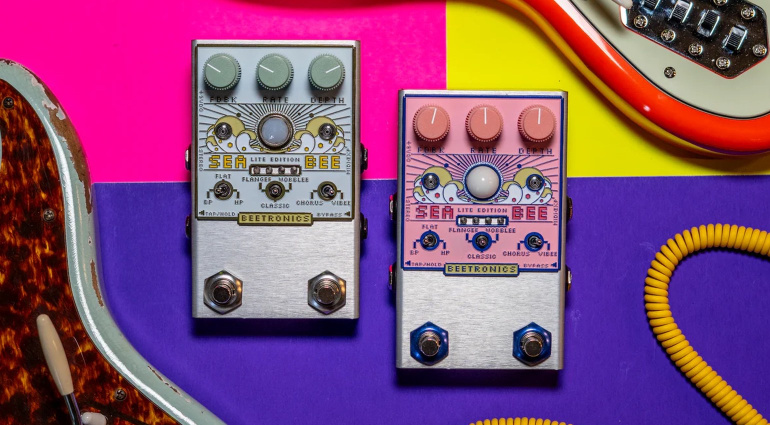
Beetronics, a brand known for its artisanal, bee-themed aesthetics and circuit-bending ethos, has decided to go on a diet. The result is the Seabee Lite, a streamlined version of their earlier, more complex Seabee Harmochorus. We at Noxal have a soft spot for companies that refine rather than just reinvent; it suggests a confidence in the original circuit. This isn’t a downgrade but a distillation. They’ve taken the core analog bucket-brigade (BBD) magic of the Seabee, kept the crucial digital control elements, and packaged it in a more pedalboard-friendly, synth-rack-adjacent format. The “Lite” moniker, therefore, refers to its physical footprint and perhaps its interface, not its capabilities.
The visual departure is notable. Gone are the wild graphics and honeycomb enclosures of some Beetronics pedals. In their place is a clean, almost minimalist pink or cream chassis. I find this refreshing. In a world of pedalboards that look like a sticker bomb exploded, a simple, bold color can be a statement of its own. More importantly, it signals a shift in intent. This feels less like a boutique collectible and more like a serious tool designed to be used, not just admired on a shelf. It’s a pedal that wants to earn its keep through functionality, which is a philosophy we can always get behind.
Analog Heart, Digital Brain
Let’s cut to the chase: the soul of the Seabee Lite is analog. At its core is a bucket-brigade device (BBD), the classic, slightly noisy, wonderfully organic chip responsible for the lush choruses and warbly vibes of the ’70s and ’80s. This is the good stuff—the same foundational technology that makes a Roland Juno chorus or an old Boss CE-2 sound so alive. You’re getting that authentic, voltage-controlled delay line modulation, with all its inherent character and slight imperfections. This is the “heart” we’re talking about.
The “brain,” however, is thoroughly modern. Digital control manages the clock for the BBD, and this is where the Seabee Lite gets clever. This hybrid approach unlocks features pure analog circuits struggle with: precise tap tempo (with an external input for expression pedal control), a whopping 16 onboard presets, and full MIDI implementation. The tap tempo footswitch even has a neat “hold to ramp” function, temporarily speeding up the modulation for a dramatic swell. This marriage is the pedal’s superpower. You get the warm, unpredictable texture of analog with the recallability and tight integration of a digital device. For the synth user drowning in cables and presets, that MIDI capability isn’t a luxury; it’s a necessity.
Three Faces of Modulation
Where many chorus pedals offer one flavor, the Seabee Lite serves a tasting menu via a central three-way toggle. The “Classic” mode is your bread-and-butter, wide triangle-wave LFO chorus with a 10ms delay time. It’s the safe, beautiful setting. “Flangee” shortens the delay time to 5ms and uses a unique LFO wave shape to veer into flanger territory—think jet whoosh and metallic sweeps rather than oceanic thickening. It’s a clever way to pack two classic modulation effects into one box.
The star of the show for me, however, is “Wobblee.” With a longer 25ms delay time and an irregular LFO, this mode aims for the sound of unstable tape, aging vinyl, or a slightly failing Leslie speaker. This is the secret sauce for anyone making lo-fi hip-hop, ambient, or anything that benefits from a dose of organic instability. Paired with the three-way filter switch (Flat, Band Pass, High Pass), you can sculpt this wobble to perfection. Need a chorus that doesn’t muddy your bass? Engage the High Pass filter. Want a focused, mid-range vibrato? The Band Pass is your friend. This level of post-modulation EQ is a studio-grade feature rarely seen on compact pedals.
For the Synth Desk
Beetronics explicitly mentions compatibility with bass, keys, and synths, and the Seabee Lite is built to prove it. The selectable input level is the first clue; it can handle the hot output of a modern synth without clipping, something many guitar-centric pedals fail at. Then there’s the stereo output implementation. A mono input can be routed to two stereo output options: a standard Dry/Wet split or a phase-inverted version for wider, more immersive stereo imaging. This turns a mono synth signal into a stereo field, a fantastic trick for pads and leads.
Combined with the MIDI and preset functionality, this positions the Seabee Lite as a potent studio and live tool for electronic musicians. Imagine having a preset for a subtle Juno-style chorus on your polysynth, a deep vibrato for your Mellotron strings, and a wobbly tape effect for a vocal sample, all recallable via a MIDI controller. It transitions seamlessly from a guitar pedalboard to a synth effects send, which is the hallmark of truly versatile modern gear. In an era where the line between guitar pedals and Eurorack modules is deliciously blurry, the Seabee Lite sits comfortably in the middle.
Verdict: A Swiss Army Chorus?
So, who is this for? It’s for the modulation-curious guitarist who wants vintage sound with modern convenience. It’s for the bassist seeking a chorus that won’t vanish in the mix. And crucially, it’s for the synth enthusiast who’s tired of sifting through one-trick-pony pedals that can’t interface with their MIDI-driven world. At around $256, it’s positioned in the upper-mid range—not an impulse buy, but a serious investment in a modulation workhorse.
The Seabee Lite succeeds by doing a few things exceptionally well rather than everything passably. It honors the analog BBD tradition while embracing the control modern musicians demand. It offers distinct, usable flavors of modulation instead of a sea of indistinguishable options. In a market saturated with choruses, from cheap clones to $500 boutique wonders, the Seabee Lite carves out a smart niche: the intelligent, studio-ready, hybrid modulator. It’s a compelling argument that sometimes, “Lite” can mean “more focused,” and that’s a trade we’ll make any day.
Frequently Asked Questions
Is the Seabee Lite a true stereo pedal?
It has a stereo output, but a mono input. It creates stereo width by processing the mono signal in two different ways (Dry/Wet or phase-inverted) and sending them to the left and right outputs. It’s a mono-in, stereo-out pedal, perfect for widening a mono synth or guitar signal.
Can I use it with line-level synth outputs?
Yes. The selectable input level is specifically designed for this. You can switch it to accommodate the hotter signals from synths, drum machines, or interfaces without introducing unwanted distortion, making it far more studio-friendly than many pedals.
What’s the practical use of the filter switch?
The filter shapes the wet (effected) signal only. The High Pass filter cuts low-end rumble from the modulation, keeping your bass frequencies clean. The Band Pass focuses the effect into a specific mid-range frequency, great for adding movement to leads without washing out the entire sound. Flat leaves the wet signal unfiltered.
Now, if you’ll excuse me, my coffee has gone cold contemplating the phase-inverted stereo options, and the Seabee Lite’s Wobblee mode is calling my name for a very unstable afternoon.