TL;DR: After nearly a decade of development, Jacob Brashears’ Shear Electronics Relic—an authentic, discrete analog clone of the Oberheim OB-X—is finally in production and shipping soon. Priced around €14,000, this bi-timbral (now 4x multitimbral) beast packs 8 voices, a unique light-bar interface, and zero screens. Pre-orders are open, and we at Noxal are already clearing shelf space.
- Shear Electronics Relic is now in production after nine years of R&D, with shipping starting very soon from a Taiwanese facility.
- Price has climbed to approximately €14,000 (up from an earlier estimate of $6,500), reflecting the complexity of its discrete analog signal path and digital modulation system.
- Originally bi-timbral, the final spec now offers 4-zone multitimbral operation with a 4-zone voice allocator and 512 programs (each with 4 patches).
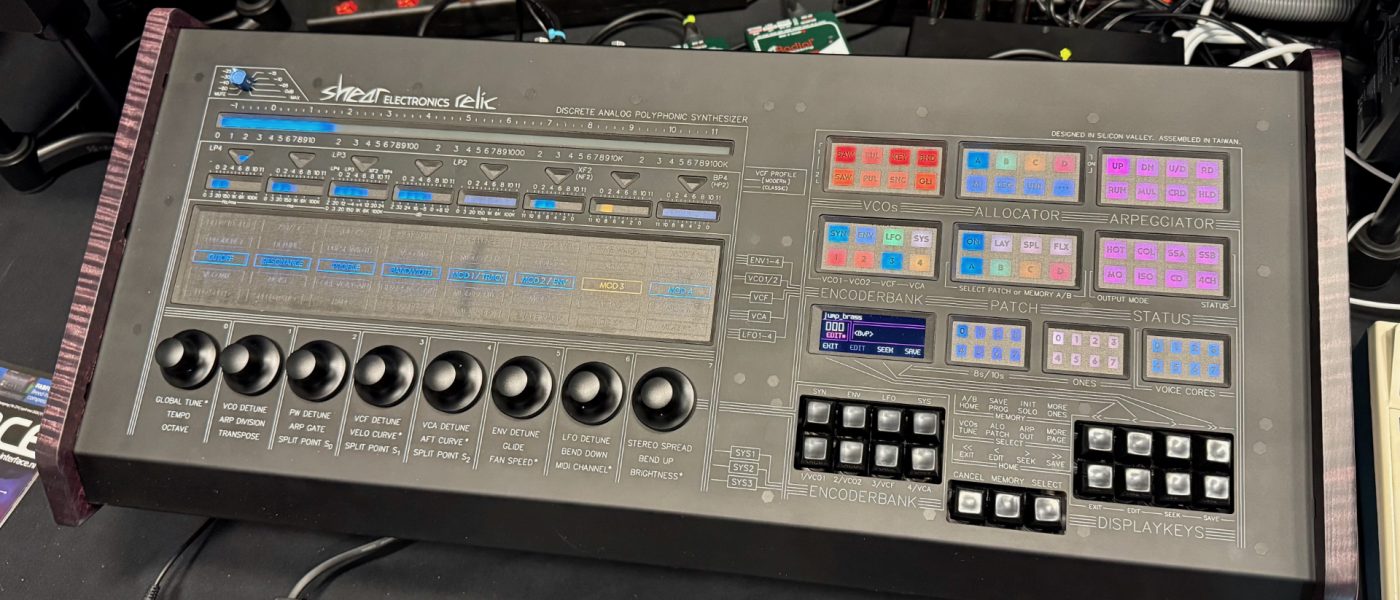
- Interface features eight hyperfine encoders, a high-resolution light fader mainbar, and eight light fader minibars—no screen, just glowing bars and touch-sensitive knobs.
- Each voice includes two analog oscillators, a continuously morphing multimode filter, four DAHDSR envelopes, and four LFOs; entire synth can be calibrated in under two minutes.
Reading time: 4 min
Want more synth news before your next coffee break? Join the Noxal newsletter — no spam, just gear worth knowing about.

The Long Road to Production

Let’s be honest: when Jacob Brashears first showed the Relic at NAMM 2017, I was still young enough to believe that “soon” meant six months. He was 18, I was nursing a hangover from too many free bar snacks, and the synth world was a simpler place—no Behringer OB-X clone, no Oberheim reissues, just a kid with a soldering iron and a dream. Fast-forward nine years, and the Relic has survived pandemic delays, prototype revisions, and the kind of skepticism that only a $14,000 price tag can attract.
At Superbooth 2026, the news finally landed: production is live in Taiwan, shipping starts very soon, and pre-orders are open. The development happened in Silicon Valley, where Jacob presumably subsisted on a diet of capacitors and coffee, but the actual manufacturing is overseas. According to the developer, both analog and digital sections required “significant effort” to harmonize—a polite way of saying that making a discrete OB-X clone with modern modulation flexibility is a nightmare. The reward? The entire synth can be calibrated in under two minutes. I’d like to see my barista do that with a La Marzocco.
What Makes the Relic Tick
At its core, the Relic is an 8-voice, fully independent analog synthesizer with a discrete signal path and a tightly coupled digital modulation system. Each voice gets two analog oscillators, a continuously morphing multimode filter (SEM-style morphing plus a “normal” mode), four DAHDSR envelopes, and four LFOs. That’s already more modulation than the original OB-X ever dreamed of, and it’s wrapped in a bi-timbral architecture that has since been upgraded to 4-zone multitimbral operation.
Yes, you read that right: the Relic now supports 4-zone multitimbrality with a 4-zone voice allocator and 512 programs, each containing four patches. That’s 2,048 patch slots if you’re counting, and I have no idea what you’d do with them all. But the point isn’t quantity—it’s the ability to layer four distinct sounds across the keyboard, each with its own voice allocation. For studio rats who live in a world of endless overdubs, this is a game-changer. For live performers, it’s a logistical challenge that will separate the brave from the merely well-funded.
The filter section deserves special attention. Jacob has implemented two filter topologies: one that delivers classic state-variable filtering with SEM morphing capabilities, and a “normal” mode that presumably leans into the OB-X’s iconic sound. The details are still a bit vague—Jacob described the filter structure as “very deep”—but early demos suggest a synth that can go from creamy Oberheim pads to snarling, aggressive leads without breaking a sweat.
The Interface: No Screens, Just Light
Here’s where the Relic gets weird, and I mean that as a compliment. The front panel is a futuristic landscape of light bars, touch-sensitive rotary encoders, and hyperfine knobs. There is no LCD screen. None. Zero. In an era where every synth seems to have a menu system deeper than the Mariana Trench, Jacob has opted for a purely visual interface: each modulation layer (envelope 1, envelope 2, etc.) glows in a different color, and touching a knob reveals its current value without moving it.
The centerpiece is a high-resolution light fader mainbar flanked by eight light fader minibars and eight hyperfine encoders. It looks like something from the bridge of a starship—or, as Jacob himself described the original 2017 prototype, “Star Trek.” The 2026 version is even larger, but it retains the same philosophy: you interact with the synth through light, touch, and immediate physical feedback. No menus, no submenus, no “press shift and hold for three seconds to enter utility mode.” It’s a radical choice, and I suspect it will either delight or infuriate, depending on your tolerance for learning curves.
The downside? There are no sound demos of the final production unit yet. Jacob pointed to the NAMM 2017 demos as reference, but that’s like showing your wedding photos to prove you’re still married a decade later. We at Noxal are reserving judgment until we hear the finished product, but the concept alone is enough to make us curious—and maybe a little thirsty for a coffee while we wait.
Market Context and Who Should Care
The OB-X clone market has gotten crowded. Behringer’s UB-X is looming, Oberheim is doing its own thing, and here comes Shear Electronics with a €14,000 box that takes up half a studio desk. Who is this for? The answer is: collectors, serious studio owners, and anyone who believes that authenticity requires discrete components and a Taiwanese production line. The Relic isn’t a mass-market instrument; it’s a labor of love for people who want the real thing but can’t find (or afford) a vintage OB-X in good condition.
At €14,000, it’s competing with high-end modular systems, flagship polysynths from Udo and Sequential, and, you know, used cars. But here’s the thing: the Relic offers something none of those do—a genuine discrete analog clone of a legendary synth with modern multitimbral flexibility and an interface that eschews screens entirely. If you’re the kind of person who buys a synth based on its circuit topology rather than its presets, you’re the target audience. If you’re looking for a bargain, I’d suggest looking elsewhere—perhaps at a decent espresso machine and a copy of Arturia’s OB-Xa V.
Frequently Asked Questions
When will the Shear Electronics Relic ship?
According to Jacob Brashears, production is underway in Taiwan and shipping will start “very soon.” No exact date has been given, but pre-orders are open now. Given the nine-year development cycle, “soon” probably means within the next few months—but we’ve learned not to hold our breath.
Can I still get on the waiting list?
Yes. Email relic@shearelectronics.com to put your name down. Shear Electronics warns that demand will be high and supply is limited, so act fast if you’re serious. The price is €14,000, so I’d also recommend checking your bank account first.
Is the Relic an exact clone of the Oberheim OB-X?
Not exactly. It’s an authentic discrete analog clone in terms of sound and architecture, but it adds modern features like four LFOs, four DAHDSR envelopes, 4-zone multitimbrality, and a completely unique light-bar interface. Purists may bristle at the upgrades, but Jacob describes it as a “super authentic clone in terms of concept and sound” with modern functionality.
I’m off to calibrate my coffee machine in under two minutes—it’s harder than you’d think. If you need me, I’ll be staring at a light bar and pretending I know what I’m doing.