
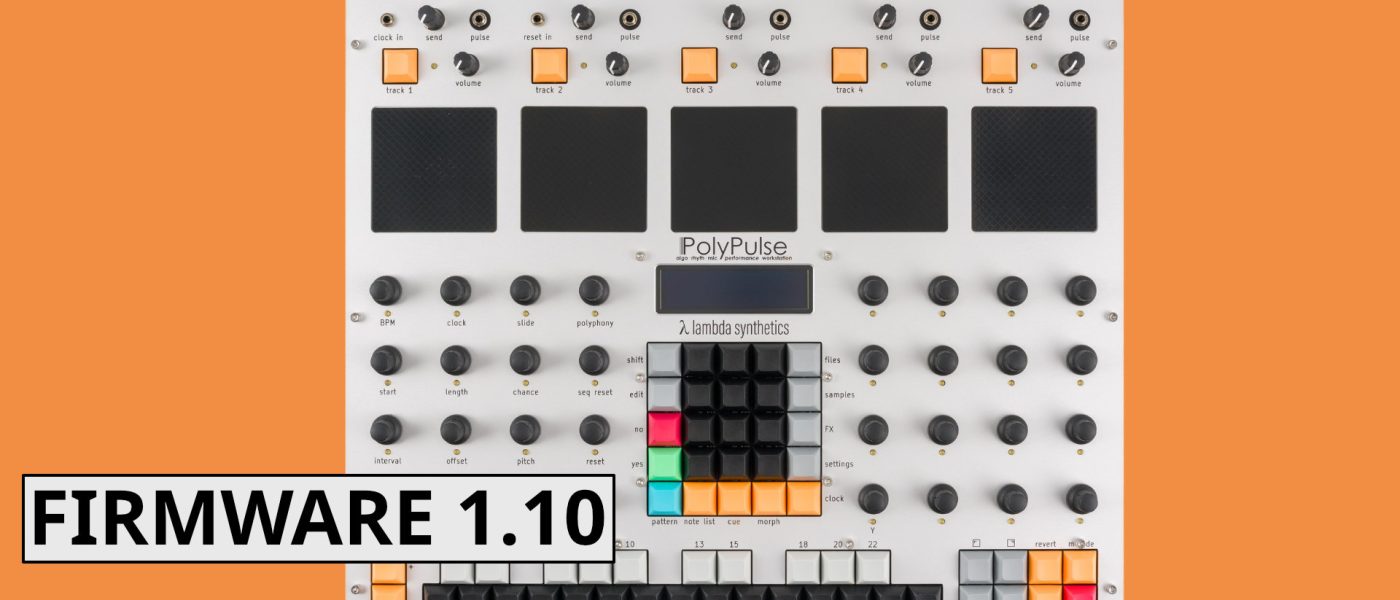
TL;DR: Lambda Synthetics’ PolyPulse algorithmic groovebox gets a substantial free firmware 1.10 update, adding wavetable synthesis, full modulation of the sequencer’s parameters, automatic sample trimming, and a browser mirroring feature for its tiny display. The update also bundles 35 presets, 71 wavetables, and 42 samples from sound designer Koarse and developer Ward Slager, all available for free — even for non-PolyPulse users.
- Wavetable synthesis now joins the existing subtractive, FM, additive, resonator, quad engine, and granular engines, with two wavetable oscillators per voice plus FM, multimode filters, and sample/noise blending.
- The algorithmic sequencer can now be modulated by LFOs, envelopes, and note chance — meaning you can automate generative patterns with generative patterns, which is exactly as gloriously recursive as it sounds.
- Resampling gains automatic start/stop, ending the tedious manual trimming that made sampling feel like a chore.
- Display mirroring to a browser on any device solves the problem of the PolyPulse’s notoriously small screen, a quality-of-life improvement that should have been a day-one feature.
- All new content — 71 wavetables, 42 samples, 35 presets — is free to download, even if you don’t own the hardware, which is either generous or a clever way to tempt you into that €1999 purchase.
Reading time: 4 min
Want more synth news before your next coffee break? Join the Noxal newsletter — no spam, just gear worth knowing about.

What Is the PolyPulse, and Why Should You Care?

Let’s be honest: the PolyPulse has always been the weird kid in the groovebox class. At Superbooth 2023, Lambda Synthetics unveiled a machine that looks like it was excavated from a Cold War bunker — all industrial metal, oversized buttons, and a display that makes you squint like you’re reading ancient runes. It’s not pretty. It’s not friendly. And at €1999, it’s certainly not cheap. But underneath that tank-like exterior sits one of the most genuinely innovative algorithmic grooveboxes we’ve seen in years.
The core concept is five tracks, each of which can host a different synthesis engine: subtractive virtual analog, FM, additive, resonator, quad engine, or granular. Each track has up to eight voices of polyphony. You can layer samples on top, route effects per track or per voice, and even configure spatial audio with up to eight speakers. The algorithmic sequencer is the real star — it generates patterns based on rules and probabilities rather than fixed step sequences, making every session feel like a conversation with a slightly unhinged robot.
We at Noxal were initially skeptical. Another groovebox? Another Kickstarter? But after spending time with the architecture — and watching the developer Ward Slager’s commitment to free updates — we started to see the vision. Firmware 1.10 is the latest chapter in that vision, and it’s a big one.
Firmware 1.10: The Wavetable Synthesis Engine
The headline feature is, without question, wavetable synthesis. Lambda Synthetics had already released a browser-based wavetable designer a few months back, and we wondered — as you do — why they’d build a tool for a feature that didn’t exist yet. Now we know. Firmware 1.10 grafts a full wavetable oscillator onto the subtractive engine, allowing you to combine two wavetable oscillators with FM, multimode filters, and a noise or sample player per voice.
That’s already a lot. But the real fun begins when you dig into the quad engine. This is a track type that combines four different synths or samplers on a single track, and now you can assign wavetable voices to each of those four slots. In practice, this means you can build a kit where a wavetable bassline, a wavetable pad, a wavetable lead, and a sample-based percussion all run on one track, each with its own algorithmic sequence. Or you can trigger four wavetables simultaneously, each with a different pitch and position modulation pattern.
Here’s where it gets properly interesting: the PolyPulse’s touchpad can morph both the pitch and the position of each wavetable. That’s not just a gimmick — it gives you real-time, tactile control over timbre in a way that knob-twiddling can’t replicate. Combined with the modulation matrix (LFOs, envelopes, random sources), you can create wavetable sweeps that evolve over bars, not just steps. It’s the kind of feature that makes you want to cancel your evening plans and just… morph.
Modulating the Sequencer and Other Quality-of-Life Updates
If wavetable synthesis is the main course, the sequencer modulation update is the secret sauce. Previously, the algorithmic sequencer was a powerful but relatively static beast — you could set rules and probabilities, but you couldn’t modulate those rules themselves. Firmware 1.10 changes that by allowing LFOs, envelopes, and note chance values to modulate any parameter of the sequencer. This means your generative patterns can now generate themselves recursively, producing sequences that feel alive and unpredictable without veering into chaos.
We at Noxal are particularly fond of the note chance modulation. Imagine a sequence where the probability of a note hitting increases as an envelope rises, then drops off again. That’s not just a rhythm — it’s a narrative. It’s the kind of feature that rewards deep exploration and makes the PolyPulse feel less like a tool and more like a collaborator.
Elsewhere in the update, the resampling engine now includes automatic start/stop, which means you no longer have to manually trim the beginning and end of a recorded sample. This is one of those small changes that makes a huge difference in workflow — we’ve wasted more time trimming samples than we care to admit. And for anyone who’s stared at the PolyPulse’s tiny display (it’s about the size of a matchbox, if matchboxes were unreadable), the new browser mirroring feature is a godsend. You can now mirror the screen to a computer, tablet, or smartphone via a browser. No app, no cables, just a URL. It’s simple, it’s elegant, and it makes the PolyPulse infinitely more usable in a studio setting.
Market Context and Who This Is For
Let’s address the elephant in the room: the price. At €1999, the PolyPulse is competing with the likes of the Elektron Analog Rytm MKII, the Erica Synths LXR-02, and the more recent Squarp Hapax sequencer. Those are established players with loyal fanbases. The PolyPulse, by contrast, is a niche product from a small Dutch team — it had only 34 Kickstarter backers, and YouTube demos are few and far between.
But here’s the thing: the PolyPulse isn’t trying to be a mainstream hit. It’s a tool for explorers, for people who find joy in algorithmic chaos, for those who want a groovebox that doesn’t just play patterns but writes them. The wavetable addition makes it even more versatile, and the free firmware update model is a breath of fresh air in an industry that often treats feature updates as paid DLC. If you’re the kind of musician who spends more time patching than playing, who loves the idea of a sequencer that can surprise you, and who doesn’t mind a machine that looks like it was designed by a Soviet engineer who moonlighted as a industrial designer — the PolyPulse might just be your dream box.
We’re not going to pretend it’s for everyone. It’s not. But for those who get it, firmware 1.10 makes a compelling case that the PolyPulse is one of the most forward-thinking grooveboxes on the market right now. And at least you can finally read the screen.
Frequently Asked Questions
Can I import my own wavetables into the PolyPulse?
Yes. The firmware 1.10 update allows you to load custom wavetables via the browser-based wavetable designer Lambda Synthetics released earlier. You can also create your own wavetables from scratch using that tool, then transfer them to the hardware. The feature supports standard wavetable formats, so you’re not locked into a proprietary ecosystem.
Does the PolyPulse still require manual sample trimming after recording?
Not anymore. Firmware 1.10 introduces automatic start/stop for resampling, which trims silence at the beginning and end of a recorded sample. This was a common pain point in earlier firmware, and the fix is genuinely useful for anyone who samples regularly. The manual trim function is still available if you want finer control.
Is the PolyPulse firmware 1.10 update free, and how do I get it?
Yes, it’s completely free. You can download it from the Lambda Synthetics website. The update also includes 71 wavetables, 42 samples, and 35 presets — all free. Even if you don’t own a PolyPulse, you can download the samples and wavetables for use in other software or hardware, which is a nice touch.
We at Noxal will be spending the weekend with a large pot of coffee and the PolyPulse’s new wavetable engine, trying to convince ourselves that recursion isn’t just for mathematicians. Wish us luck — and maybe bring a towel.