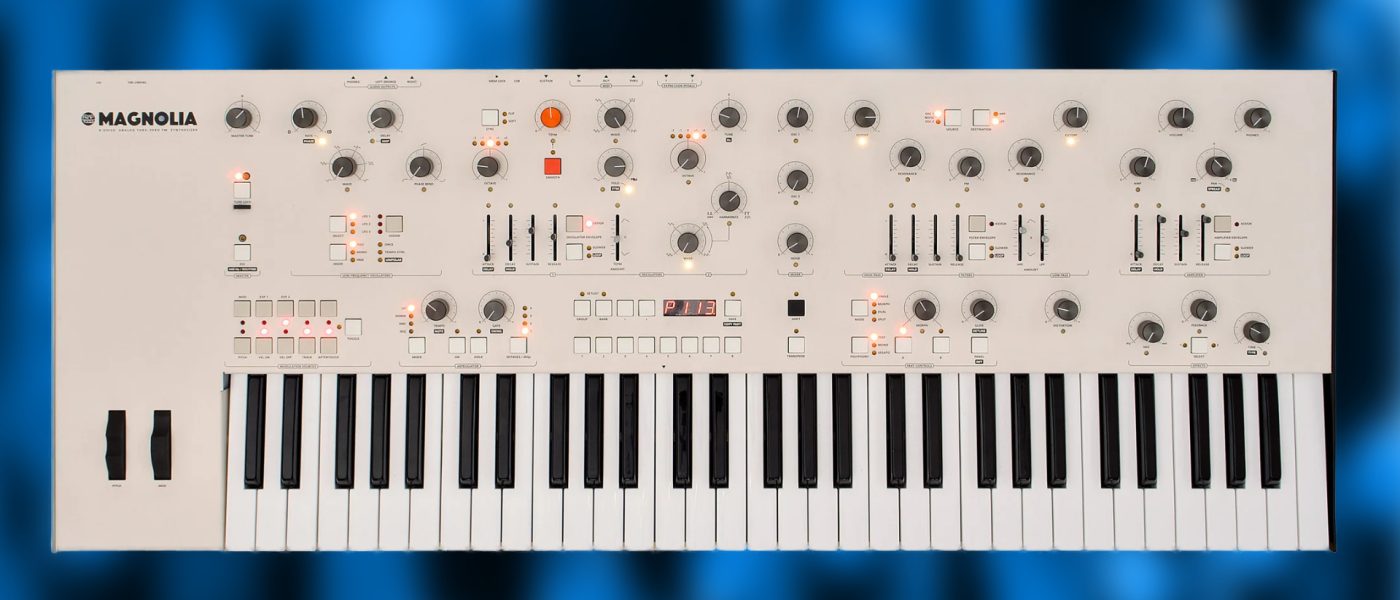
TL;DR: Frap Tools has released firmware 1.10 for their Magnolia, an 8-voice analog through-zero FM synthesizer that’s now shipping to retailers. The update adds 200 memory slots, full MIDI implementation over USB and CC, customizable aftertouch curves, and adjustable LED brightness — all for free. If you’ve been waiting for a West Coast polysynth that actually sounds like a modular in a keyboard, your patience is paying off.
- Firmware 1.10 adds 200 new memory slots (400 total), full MIDI over USB and CC in/out for every parameter, and 11 aftertouch curve degrees.
- Magnolia is an 8-voice analog through-zero FM polysynth with West Coast architecture — wavefolding, waveshaping, and TZFM — a first for a keyboard synth.
- Priced at $4829 / 4199€ / £3685, it’s now shipping to retailers worldwide.
- A computer utility and librarian are under development, according to Frap Tools.
- Bugs fixed include keyboard parameter retention after using the Static Display and incorrect MIDI note playback.
Reading time: 4 min
Want more synth news before your next coffee break? Join the Noxal newsletter — no spam, just gear worth knowing about.
What Is Magnolia?

Let’s get this straight: Frap Tools is not your average synth company. They’ve spent a decade building some of the most thoughtfully designed Eurorack modules on the market — think Brenso complex oscillator, Cunsa quad filter, and that time they helped design the Nonlinear Labs C15’s wooden enclosure. So when they announced their first keyboard synth at Superbooth 2025, the modular community collectively raised an eyebrow. And then they heard it.
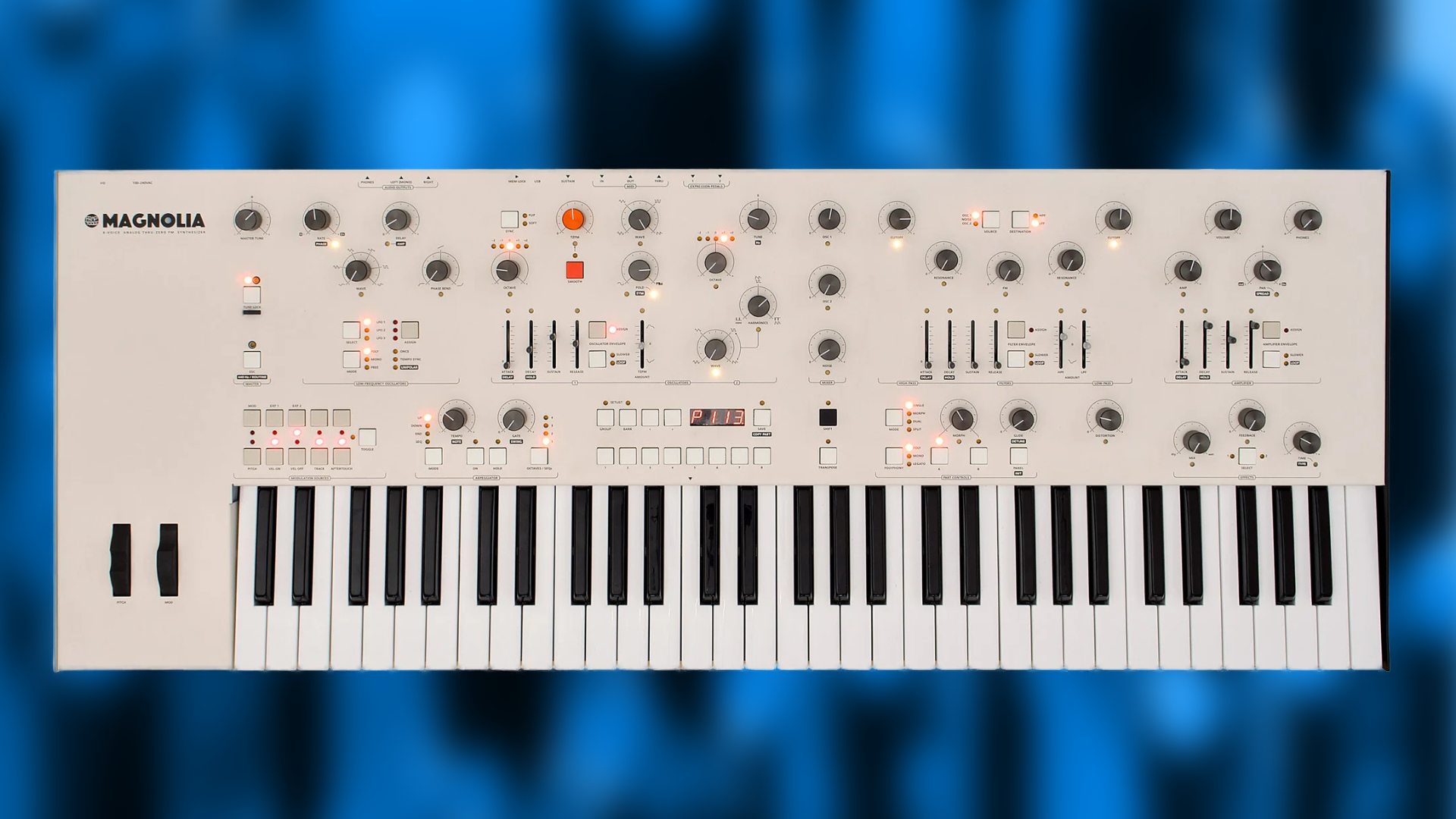
Magnolia is an 8-voice analog through-zero FM polyphonic synthesizer. That’s a mouthful, but here’s the short version: it takes the wild, unpredictable glory of West Coast synthesis — wavefolding, waveshaping, through-zero FM — and stuffs it into a keyboard form factor with 61 keys. No menus, no screen-based hell. Just knobs, sliders, and a whole lot of analog circuitry. The prototype we heard at Superbooth 2025 sounded “bellissima,” as the Italians say. Complex, fine, fat. It’s not a DX-7 clone. It’s not trying to be.
The architecture is built around two oscillators per voice, with TZFM (through-zero frequency modulation) that’s been ripped straight from their Brenso module. There’s cutoff, resonance, an ADSR envelope with hold and delay, and a button that lets you switch between single, morph, dual, and split filter routing. Polyphonic, mono, legato — it’s all there. And yes, it does classic subtractive synthesis too, but that’s like saying a Ferrari can go to the grocery store.
Firmware 1.10: The Good Stuff
Frap Tools has been shipping Magnolia since early 2025, but they’re not the type to abandon a product after release. Firmware 1.10, available now for free, is a substantial update that addresses some of the early adopter feedback and adds features that make the synth more playable and integrated into a studio setup.
First, memory. The original 200 slots were decent, but if you’re like me and you save every patch that sounds vaguely interesting at 3 AM, you’ll appreciate the bump to 400 slots. That’s double the storage for your own FM experiments — because let’s be honest, the factory presets are just the starting point.
Second, MIDI. Full implementation over USB and MIDI CC in/out for every parameter. That means you can automate the hell out of this thing from your DAW or controller. The aftertouch curve is now customizable with 11 degrees of hardness or softness — finally, you can dial in exactly how much pressure triggers that filter sweep without accidentally summoning a banshee. And yes, you can adjust the LED brightness (red, white, orange, and the static value display) between high, low, or custom user settings. Because nothing ruins a dimly lit studio vibe like blinding orange LEDs.
Bugs fixed include a nasty one where the keyboard wouldn’t retain a parameter value after using the Static Display, and another where incoming MIDI notes played incorrectly. Both are now squashed. A computer utility and librarian are in the works, per Frap Tools, which suggests they’re thinking about patch management beyond the front panel.
West Coast FM: Why It Matters
We’ve seen a lot of FM synths recently. ASM’s Leviasynth at NAMM 2025 uses the classic DX-7-style operator matrix — four operators, algorithms, the whole nine yards. That’s fine, but it’s a well-trodden path. Magnolia takes a different route: West Coast FM. Instead of clean, metallic sine waves, you get wavefolding, waveshaping, and through-zero modulation that introduces harmonic complexity and instability. It’s the sound of analog oscillators fighting each other, in a good way.
Analog through-zero FM has been a staple of Eurorack for years — think Make Noise’s DPO or Intellijel’s Rubicon 2. But nobody has put it in a keyboard polysynth before. That’s what makes Magnolia genuinely innovative. It’s not just another polyphonic analog synth with a few extra features; it’s a fundamentally different approach to sound design that rewards experimentation. You can get bell tones, yes, but also growls, swells, and sounds that seem to breathe. The demos we’ve heard from Superbooth and Buchla & Friends 2026 are staggering — complex, fine, but also fat, as one Italian attendee put it.
For context, Frap Tools’ Brenso complex oscillator is legendary in modular circles for its stability and sonic range. Magnolia effectively puts four of those into a keyboard, plus a quad analog filter and a comprehensive modulation matrix. It’s a serious instrument for serious sound designers.
Shipping, Pricing, and Who’s This For
Magnolia is now shipping to retailers, with first units expected to arrive next week. You can pre-order from Schneidersladen, Perfect Circuit, and other dealers for $4829 / 4199€ / £3685. Yes, that’s a lot. But this isn’t a mass-market synth. It’s a boutique instrument aimed at professionals, collectors, and anyone who’s ever looked at a Eurorack case and thought, “I want that sound, but I don’t want to spend two years patching it.”
Who is this for? If you’re a producer who needs a unique analog voice that can’t be replicated in software, Magnolia is a strong candidate. If you’re a modular enthusiast who wants a keyboard controller that doesn’t feel like a compromise, this might be your endgame. And if you’re someone who appreciates Italian design — the wooden enclosure, the thoughtful layout, the attention to detail — you’ll feel right at home. It’s not cheap, but neither is a good espresso machine. Both are worth the investment if you care about quality.
For the rest of us, we’ll wait for the used market in five years. But for now, Magnolia is a landmark: the first analog through-zero FM polysynth that actually delivers on its promise.
Frequently Asked Questions
How much does the Frap Tools Magnolia cost?
The Magnolia is priced at $4829 / 4199€ / £3685. It’s available for pre-order from retailers like Schneidersladen and Perfect Circuit, with units shipping now.
Does firmware 1.10 add new features, or is it just bug fixes?
Both. Firmware 1.10 adds 200 memory slots (400 total), full MIDI over USB and CC in/out for every parameter, customizable aftertouch with 11 curve degrees, and adjustable LED brightness. It also fixes bugs related to keyboard parameter retention and MIDI note playback, with a computer utility and librarian in development.
What makes Magnolia different from other FM synths like the ASM Leviasynth?
Magnolia uses West Coast synthesis — analog through-zero FM, wavefolding, and waveshaping — instead of the classic DX-7 operator matrix. This gives it a more organic, complex, and unstable character, closer to Eurorack modules than traditional FM synths. It’s an 8-voice polyphonic analog synth with a keyboard, something no other company has done before.
We’re now off to brew another pot of coffee and stare at the Magnolia’s orange LEDs, wondering if we can justify the price by selling a kidney. Probably not, but a synth this good makes you consider it.