TL;DR: Melbourne Instruments has released a major firmware update for NINA, transforming its hybrid digital/analog engine with a macro oscillator mode based on Mutable Instruments Braids, complete with all 45 synthesis models. The update is free for existing owners and dramatically expands NINA’s sound design capabilities beyond its analog VCOs and wavetable oscillators.
- New macro oscillator mode includes all 45 Braids synthesis models — from virtual analog and 2-operator FM to physical modeling, granular, and vowel synthesis.
- Unlike the original Eurorack module, NINA lets you play these algorithms polyphonically with up to 12 voices across four multitimbral parts.
- The update also works with NINA’s existing analog VCOs and digital wavetables, plus its unique preset morphing feature.
- This follows a previous major update that added a 4-track polyphonic sequencer and 64 noise types.
- Available now as a free download from Melbourne Instruments’ website.
Reading time: 4 min
Want more synth news before your next coffee break? Join the Noxal newsletter — no spam, just gear worth knowing about.

The Big News: Braids Goes Polyphonic
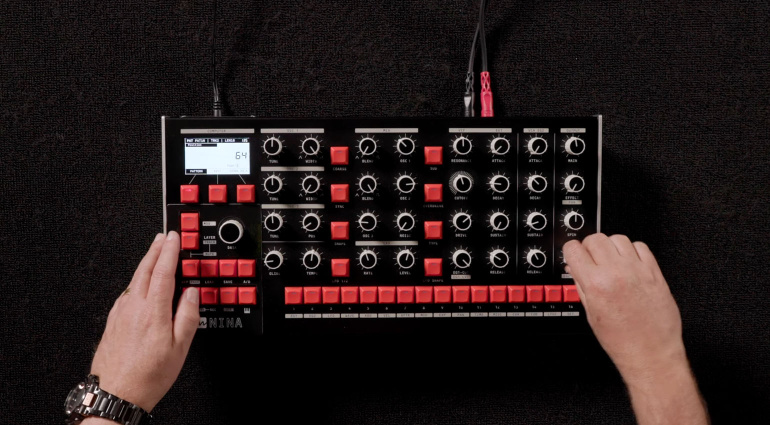
Let’s be honest: when Mutable Instruments closed its doors in 2022, the modular world mourned. But Émilie Gillet’s legacy — particularly the Braids macro oscillator — has proven remarkably resilient. Open-source firmware clones, reinterpretations, and now this: a full implementation inside a hybrid polysynth with motorized knobs.
Melbourne Instruments has dropped a firmware update that effectively turns NINA into a Braids-on-steroids. All 45 synthesis models are present: virtual analog, 2-operator FM, wavetables, granular, physical modeling, vowel and formant synthesis, and a dozen more esoteric algorithms. The Timbre and Color parameters map to model-specific controls, just like the original module. But here’s the kicker — NINA runs these algorithms with up to 12 voices of polyphony across four multitimbral parts. The original Braids was monophonic. This is like strapping a jet engine to a bicycle.
I’ll admit, when I first saw the announcement, I assumed it would be a stripped-down port. It’s not. This is the full Braids experience, now with polyphony, motorized recall, and the ability to layer it with NINA’s own analog VCOs and digital wavetables. The preset morphing function — which physically moves the knobs between two saved states — works with the macro oscillator too. That’s not just a feature; it’s a performance tool.
What Makes NINA Different
NINA is, at its core, a 12-voice analog hybrid synth with variable-shape triangle oscillators, a 4-pole transistor ladder filter, and digital wavetable oscillators with sampling. It’s got stereo effects, a deep modulation matrix, and quad digitally controlled amplifiers. But the headline act has always been those motorized knobs.
When Melbourne Instruments first showed NINA at NAMM 2022, the response was split. Some saw the motorized knobs as a gimmick waiting to fail — expensive, prone to breaking, and potentially leaving you with a very expensive paperweight. Others saw the future of patch recall and morphing. The company claims these are “long-lasting zero wear encoders with the feel and precision of analog pots.” I haven’t tested one long-term, but the concept is undeniably compelling: physical knobs that move to match saved parameters, letting you morph between patches in real time.
This update builds on that foundation. The previous major firmware added a 4-track polyphonic sequencer with 64 steps per track, polymetric capabilities, per-step parameter locking, and live automation recording. Plus 64 new noise types including percussion hits, digital textures, and metallic sounds. With the new macro oscillator, NINA is becoming less a fixed instrument and more a platform — one that rewards owners who keep coming back.
The Braids Legacy and Why It Matters
Braids was never just a VCO. It was a complete sound design toolkit in 14HP. The 45 algorithms ranged from the predictable (sawtooth, pulse) to the deranged (particle noise, chaotic waveforms). Its popularity spawned countless clones and inspired a generation of firmware-centric modules. But it was always monophonic, always limited to a single voice.
Melbourne Instruments has taken that DNA and injected polyphony. You can now play chords with Braids’ granular engine. Layer a formant pad with analog oscillators. Run four different Braids algorithms across four multitimbral parts. The morphing function lets you automate the transition between two entirely different Braids patches, with the knobs physically moving to reflect the change. It’s the kind of feature that makes you rethink what a polysynth can be.
For sound designers, this is a goldmine. The combination of Braids’ algorithmic variety with NINA’s analog filter, effects, and modulation matrix means you can build sounds that would take a full Eurorack system to replicate. And because the knobs are motorized, you can save and recall those complex patches without memorizing a single menu page.
Market Context and Who This Is For
NINA originally launched at $3,500 US for the first run of 500 units. That’s firmly in “prosumer flagship” territory — competing with the likes of the Sequential Prophet-5, Moog One, and UDO Super 6. But with each firmware update, Melbourne Instruments is adding features that differentiate it from the pack. The motorized knobs are unique. The Braids integration is unique. The combination of analog and digital is increasingly common, but the execution here is unusually thoughtful.
Who should buy this? Anyone who wants a polysynth that can do both classic analog and experimental digital without compromise. If you’re a sound designer working in film, TV, or game audio, the Braids algorithms alone justify the price. If you’re a live performer who wants to morph between patches physically, nothing else on the market does what NINA does. And if you’re a collector who just wants to own a synth that keeps getting better with age — well, this one’s for you.
That said, $3,500 is not impulse-buy territory. If you’re happy with a Hydrasynth or a Rev2, you’re not missing out on essential tools. But if you want a synth that feels like it’s still being invented, NINA is worth the stretch.
Frequently Asked Questions
Does the Braids macro oscillator replace NINA’s existing oscillators?
No. The macro oscillator is an additional mode that can be used alongside NINA’s analog VCOs and digital wavetable oscillators. You can layer them or use them independently across the four multitimbral parts.
Is the update free for existing NINA owners?
Yes, the firmware update is free and available for download from the Melbourne Instruments website. It includes both the new macro oscillator mode and all previously released features like the polyphonic sequencer and noise types.
Does the Braids mode support preset morphing?
Yes. The motorized knob morphing function works with the macro oscillator, allowing you to save and transition between two different Braids patches with physical knob movement.
Now if you’ll excuse me, I need to go re-learn all 45 Braids algorithms while my coffee goes cold — again. Some sacrifices are worth making.