
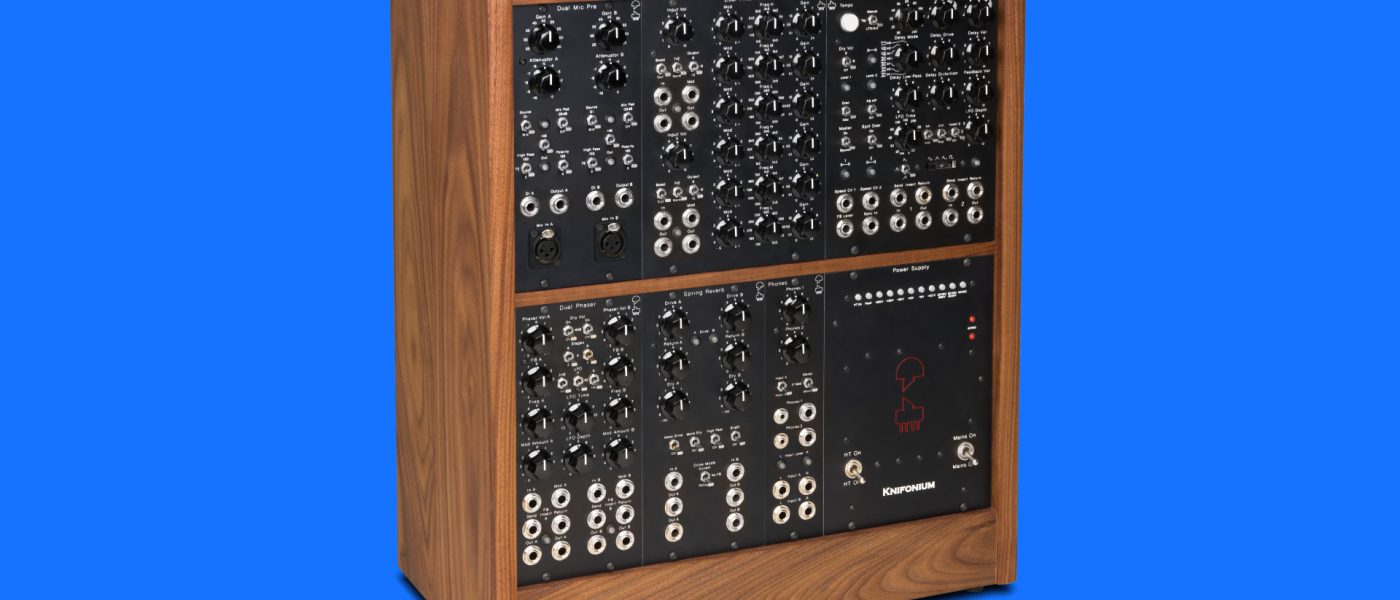
TL;DR: Knif Audio has announced the Knifonium Modular FX, a full 5U effects system for Superbooth 2026. It packs a tube mic preamp, phaser, filter bank, BBD delay, spring reverb, and modulation modules — all built with transformers, inductors, and enough glowing glass to warm your studio. No price or release date yet, but expect it to cost more than your rent.
- Seven modules in total: dual tube mic preamp, dual filter bank, BBD delay, dual phaser, stereo spring reverb, sample & hold/envelope follower, and output interface.
- Uses NOS tubes, Lundahl input transformers, and mu metal-shielded reverb tanks for low noise and high headroom.
- BBD delay includes tube distortion stages in the feedback loop, variable anti-alias filters, and a built-in LFO.
- Phaser module offers six-stage phase shifting with 12 opto isolators and per-channel frequency/modulation controls.
- Power supply delivers +/-18V, +6.3V, +12.6V, 6.3VAC, -120V, +120V, and +250V — not a module you plug into a Eurorack case.
Reading time: 4 min
Want more synth news before your next coffee break? Join the Noxal newsletter — no spam, just gear worth knowing about.

What Is the Knifonium Modular FX?

Let’s get one thing straight: this is not a toy for weekend warriors with a spare Eurorack rail. The Knif Audio Knifonium Modular FX is a full-size 5U effects system — and by “full-size” I mean you’ll need a dedicated studio desk, a forklift, and possibly a small power station to run it. Announced for Superbooth 2026, this is the latest obsession from Jonte Knif, the same mad genius behind the epic Knifonium Synthesizer and the recently standalone BBD delay unit that made us all re-evaluate our life choices at NAMM.
The system is the result of “years of development,” according to Knif Audio, and it shows. Every module uses tubes, transformers, and inductors as primary sonic weapons. Discrete transistors, FETs, and IC op-amps are used only where tubes would cause a meltdown — physically or financially. The result is a modular effects rig that looks like it was designed by a tube amp wizard who also moonlights as a nuclear engineer.
No sound demos yet, which is both frustrating and typical for this level of boutique gear. But based on the BBD delay we heard at NAMM, the sonic potential here is enormous. The visual design is clean, elegant, and unmistakably 5U — think Moog System 55 meets a high-end mastering console.
The Modules: A Deep Dive
The system comprises seven modules, and each one is a statement of intent. First up: a dual-channel tube mic preamp with Lundahl input transformers and NOS tubes. This alone would justify the price for anyone who’s ever heard what a good transformer-coupled preamp does to a source signal. It’s not just a utility — it’s a front-end that colours your sound with warmth, depth, and that slightly unfair advantage that tube gear provides.
Then we have the dual filter bank. This is not your average ladder filter. Knif Audio describes it as a “saturated inductor-modulated filter bank with tube amps.” Each filter stage has its own modulation, frequency, and gain control, plus a boost option. If you’ve ever wanted to dial in filter sweeps that sound like they’re powered by a small orchestra of vacuum tubes, this is your module.
The BBD delay module is the showstopper. It’s a bucket-brigade delay with multiple modes and — crucially — tube distortion stages in the delay loop. Variable anti-alias filters ensure maximum frequency response across the entire delay time range. And yes, it has its own LFO with time and depth controls. This is the kind of delay that makes digital emulations feel like they’re apologising for existing.
Let’s not overlook the dual-channel phaser: six tubes, 12 opto isolators, and six-stage phase-shifter networks per channel. Each channel gets its own volume, feedback, frequency, and modulation controls. Channel B offers a 0-, 90-, or 180-degree phase shift option. This is not a subtle modulation effect — it’s a weapon. The stereo spring reverb uses mu metal-shielded reverb tanks for extremely low hum and noise, with two driver modes (constant current and constant voltage). Naturally, it also has tube amplification. Because why wouldn’t it?
Rounding out the system: a sample & hold + envelope follower module, a stereo phones/interface module, and a power supply that delivers +/-18V, +6.3V, +12.6V, 6.3VAC, -120V, +120V, and +250V. That power supply alone could probably jump-start a vintage car. It’s modular, it’s massive, and it’s magnificent.
Why 5U in 2026?
Good question. In a world where Eurorack dominates every modular conversation and every synth meetup, 5U has become something of a niche within a niche. A few manufacturers still fly the flag — Moon Modular, Synth-Werk, STG — but the format is rarely the first choice for new builders. So why would Knif Audio invest years into a 5U effects system?
The answer, I think, is sound quality and space. 5U modules offer far more room for tube circuitry, transformers, and massive inductors than Eurorack ever could. You can’t fit a Lundahl transformer into a 3U module without breaking something. You can’t run high-voltage tubes in a cramped case without thermal issues. The 5U format allows Knif Audio to build without compromise — and that’s precisely what they’ve done.
There’s also a certain stubborn romanticism to it. The Knifonium Modular FX is a middle finger to the “smaller, cheaper, faster” ethos of modern gear. It’s expensive, large, and unapologetically focused on sound quality over convenience. For the right person, that’s exactly the point.
Who Is This For (and What’s the Catch)?
This system is for recording studios, serious collectors, and anyone who already owns a Knifonium Synthesizer and wants to complete the set. It’s also for tube enthusiasts who believe that no amount of DSP can replicate the behaviour of a real tube in a real circuit. If you’re the kind of person who spends more on a single microphone preamp than most people spend on a car, this is your dream modular effects rack.
The catch? Price and availability are TBA, but “anything but cheap” is the official descriptor. Expect the full system to cost well into five figures. There’s also the issue of space — you’ll need a proper 5U case or cabinet, and the power supply alone is a beast. And of course, no sound demos yet. That’s a leap of faith, but Knif Audio’s track record suggests the payoff will be worth it.
If you’re a Eurorack user looking for a cheap delay module, look elsewhere. If you want the most over-engineered, tube-saturated, transformer-coupled effects system money can buy — start saving now.
Frequently Asked Questions
Will the Knifonium Modular FX work in a standard Eurorack case?
No. This is a 5U system with a completely different power supply specification (+/-18V, +6.3V, +12.6V, 6.3VAC, -120V, +120V, +250V). You cannot plug these modules into a Eurorack case without severe damage to both the modules and your power supply.
Can I buy individual modules, or is it only available as a full system?
Knif Audio has not yet confirmed individual module pricing or availability. Given the integrated nature of the power supply and the system-level design, it’s likely they will be sold as a complete set or at least require the specific power supply module to operate.
When will sound demos be available?
No official date yet. Knif Audio will present the system at Superbooth 2026 (Bungalowdorf, booth B056). Expect demos to surface around or shortly after the event. Based on the BBD delay’s performance at NAMM, the wait should be worth it.
We at Noxal will be at Superbooth 2026, coffee in hand, trying not to drool on the Knifonium Modular FX while pretending we can afford it. If you see us, say hi — just don’t ask for a loan.