TL;DR: Chase Bliss has announced the Big Time, a large-format stereo delay pedal in their Automatone series, co-developed with Electronic Audio Experiments. It channels the gritty, lo-fi character of ’80s rackmount delays like the PCM 70 and SDD-3000, packing a stereo preamp, limiter, four delay modes, and up to 3.2 minutes of looping into a fader-covered beast. At €1,099, it’s their most expensive pedal to date — and we have opinions about that.
- Collaboration between Chase Bliss and Electronic Audio Experiments (of Prismatic Wall fame) for a rack-inspired delay pedal.
- Four delay modes — Mod, Short, Long, Loop — with up to 3.2 minutes of stereo looping memory.
- Analog-style preamp with saturation, a stereo limiter in the feedback path, and six faders with a secondary SHIFT layer for deep tweaking.
- Two stereo I/O pairs, balanced and unbalanced, plus 5-pin MIDI In/Thru with 127 presets (10 directly accessible).
- Price: €1,099 ($~1,200 USD), available via pre-order now, shipping expected June 2026.
Reading time: 4 min
Want more synth news before your next coffee break? Join the Noxal newsletter — no spam, just gear worth knowing about.

What Is the Chase Bliss Big Time?
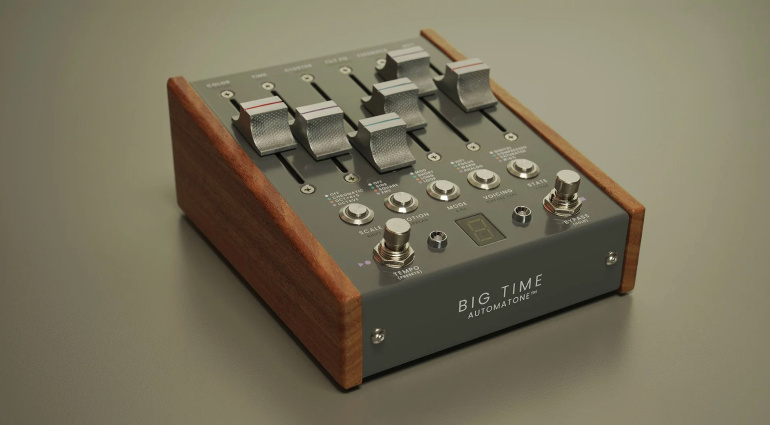
Let’s be honest: when Chase Bliss teased “big things” last week, we at Noxal assumed it was a new coffee mug. Instead, we got the Big Time — a monstrously large, stereo, digital-to-analog delay pedal that slots into their Automatone series. If you’ve seen the Preamp Mk II or CXM 1978, you know the form factor: a chunky metal enclosure with six motorized faders, five buttons, and two footswitches. It’s less a pedalboard staple and more a desktop monument.
What makes this one different is the collaboration. Chase Bliss brought in John Snyder of Electronic Audio Experiments (EAE), the mad scientists behind the Prismatic Wall — a physical modeling resonance pedal that sounds like a cathedral collapsing in slow motion. Together, they’ve aimed the Big Time squarely at the sound of ’80s rackmount delays. Think Yamaha SPX90, Lexicon PCM 70, Roland SDD-3000. Those boxes with low sample rates, questionable converters, and that unmistakable “digital vintage” vibe that modern producers pay a fortune to emulate.
I’ll confess: I’ve spent more time than I’d like to admit trying to recreate that sound with plugins. The Big Time promises to do it with hardware, in stereo, with a preamp and limiter built in. That’s either brilliant or overkill. Probably both.
The Sound of Vintage Digital
The core philosophy here is “less is more,” which is ironic given the pedal’s size. The signal path starts with a stereo preamp — a clean input stage that can be driven into saturation via the Level fader. Then comes a stereo limiter in the feedback path, with three levels of overdrive character. This is key: those old rack delays didn’t just repeat your signal; they ate it, compressing and distorting in ways that became part of the texture.
The actual delay engine offers four modes: Mod (chorus/flange), Short (slapback to about 300ms), Long (up to several seconds), and Loop (up to 3.2 minutes of stereo looping). That covers everything from subtle doubling to ambient wash to full-on loop-based composition. The low sample rate and limited bit depth are deliberately “imperfect,” giving repeats a grainy, smeared quality that modern pristine delays can’t touch.
We at Noxal have a soft spot for this aesthetic. The Keeley RK2000, released earlier this year, goes after similar territory, but the Big Time’s preamp and limiter give it an edge for synth players who want the delay to feel like part of the instrument, not an afterthought.
Controls and Features
The front panel is a fader lover’s dream. Six sliders control: Level (preamp saturation), Color (tone shaping), Time (delay time), Cluster (glitch/extra repeats), Tilt EQ (filtering), Feedback (echo decay), and Wet (mix). That’s seven parameters on six faders — one must be dual-purpose, but it’s not specified. Under the hood, the SHIFT button reveals a second layer: modulation speed and depth, spread, filter type, and more. Five buttons below the faders let you tweak delay character (Scale, modulation curve, filter type, limiter character).
Connectivity is serious: two stereo inputs and two stereo outputs, all capable of balanced or unbalanced signals. That means you can run a synth in stereo, or chain it with other gear without signal loss. MIDI In and Thru via 5-pin DIN give you 10 front-panel presets and 127 via MIDI program change. For a synth studio, this is a dream — the Big Time can be the central delay hub, recalled via a DAW or hardware sequencer.
One detail that made me snort my coffee: the Automatone faders are motorized. They move to their saved positions when you recall a preset. It’s a party trick, sure, but it’s also deeply satisfying to watch.
Market Context and Value
Let’s talk money. €1,099. That’s about $1,200 USD. For a pedal. I know, I know — we’re in an era where boutique delays cost as much as a used car. The Strymon TimeLine is $449. The Eventide H9 Max is $599. The Keeley RK2000 is $899. The Big Time is in a different league entirely, competing with rack units like the Eventide H9000 or a used Lexicon PCM 81.
Chase Bliss’s Automatone series has always been premium — the Preamp Mk II is $899, the CXM 1978 was $1,099 at launch. So the price isn’t a surprise, but it does raise the question: who spends this much on a delay pedal? The answer: synth enthusiasts with a taste for vintage digital character, studio owners who want a centerpiece, and collectors who treat gear as art. The pre-order window is open now, with first shipments in June 2026. Yes, 2026. That’s a long wait for a pedal that costs more than a month’s rent in some cities.
We at Noxal are torn. On one hand, the sound is genuinely unique and the build quality is impeccable. On the other, this is an investment, not an impulse buy. If you have the budget and the patience, it’s likely worth it. If you’re on a tighter budget, the RK2000 or a used Eventide might scratch the same itch for less.
Who Is It For?
The Big Time is for the person who already has a Strymon, an Eventide, and three Chase Bliss pedals — and still feels something missing. It’s for the synth player who wants a delay that sounds like it was pulled from a 1984 studio session, with all the grit and warmth that implies. It’s for the live performer who needs instant recall of complex settings via MIDI, or the studio rat who wants a single box to handle slapback, ambience, and looping without menu-diving.
It is not for the casual player or the budget-conscious. At this price, you’re buying into a philosophy: that the imperfections of old digital gear are worth preserving and celebrating. If that resonates, the Big Time will feel like a revelation. If not, there are cheaper ways to get echoes.
Personally, I’d love to try it with a Juno-60 and a cheap reverb tank. But I’ll need to sell a kidney first. Or at least stop buying coffee for a year.
Frequently Asked Questions
How does the Big Time compare to the Keeley RK2000?
Both target ’80s rack delay sound, but the Big Time offers a stereo preamp with saturation, a limiter, and 3.2 minutes of looping, while the RK2000 focuses on dual delay engines and more traditional controls. The Big Time is larger, more expensive, and more integrated for synth setups. The RK2000 is more pedalboard-friendly and costs less.
Can I use the Big Time with a guitar, or is it only for synths?
It works with both. The balanced/unbalanced I/O and stereo preamp make it ideal for synths, but guitarists can use it too — just be aware of the size and price. The preamp can be driven for overdrive, which guitarists might enjoy, but the intended market seems to be synth and studio users.
Is the Big Time worth €1,099?
That depends on your needs and budget. If you value the unique sound of vintage digital delays and want a premium, all-in-one solution with MIDI control, preamp, and looping, it’s a strong contender. If you’re happy with plugins or lower-cost pedals, it’s hard to justify. We at Noxal recommend trying one if possible — sound is subjective, and this is an expensive gamble.
I’m off to brew another cup and stare longingly at my bank account. The Big Time may be the ultimate delay, but my wallet just whispered “not today, old friend.”