
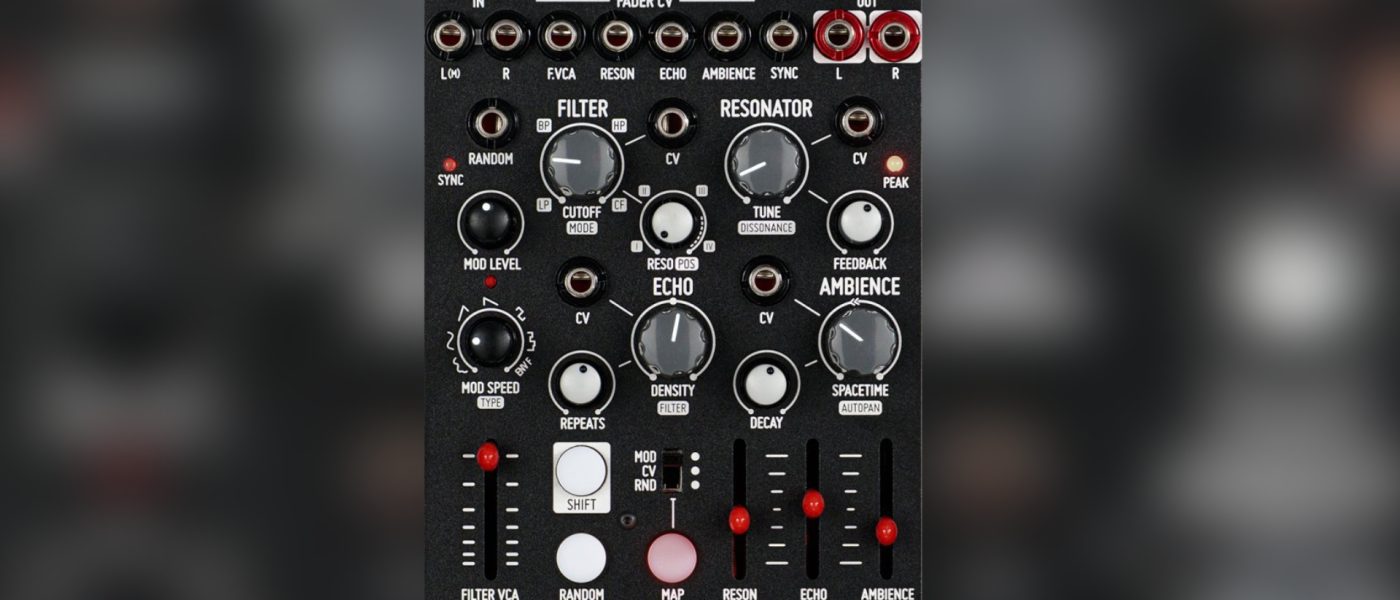
TL;DR: Befaco has stripped the multi-FX engine from its Oneiroi drone synth and squeezed it into a standalone 18HP Eurorack module called IROI. It packs a filter, resonator, echo, reverb, and modulation into a single unit where all four effects run simultaneously — no algorithm switching required. Expect big, evolving soundscapes from any input, with CV control over nearly everything.
- IROI is a dedicated stereo multi-FX module derived from Befaco’s Oneiroi, omitting the oscillators and looper to focus solely on the effects chain.
- Four simultaneous effects: multimode filter (LP/BP/HP/comb), 3-band resonator, 2-tap echo, and a lush reverb — all with independent dry/wet faders.
- Modulation includes a morphable LFO and envelope follower, plus a randomizer with undo/redo for controlled chaos.
- Powered by OWL mk3 hardware with 24-bit/48 kHz stereo audio and 32-bit internal processing.
- Full CV control over faders and parameters, plus external sync input.
Reading time: 4 min
Want more synth news before your next coffee break? Join the Noxal newsletter — no spam, just gear worth knowing about.

What Is Befaco IROI?
We at Noxal have a soft spot for modules that do one thing and do it well — especially when that thing is “turn everything into a droning, atmospheric mess.” The Befaco IROI is exactly that, but in a tidy 18HP package that won’t devour your entire case. Announced for Superbooth 2026, IROI is essentially the multi-FX heart of Befaco’s Oneiroi experimental synth voice, divorced from its wavetable oscillator, supersaw oscillator, and looper. The marriage is still happy; the kids just moved out.
What you get is a stereo effects processor that takes two mono inputs (left and right) and runs them through a signal chain that feels like a well-curated pedalboard in module form. The OWL mk3 brain handles 24-bit/48 kHz audio with 32-bit internal processing, so the digital bits are crisp. IROI is not trying to be a Swiss Army knife of 50 algorithms you’ll never use — it’s a focused tool for creating big, evolving soundscapes from any external signal. Think Endorphin.es Ghost, but with a more interesting configuration — and we don’t say that lightly.
The Effects Chain: A Grand Tour
Let’s walk through the effects, because this is where IROI earns its keep. First up: a multimode filter with low-pass, band-pass, high-pass, and comb filtering modes. The filter is integrated into a VCA that can be freely positioned anywhere along the effects chain. That’s a clever touch — you can filter before the resonator for a smoother tone, or after the echo for rhythmic grit. It’s the kind of flexibility that makes you wonder why more modules don’t do this.
Next is a 3-band resonator with controls for tune and dissonance (feedback). This is where the organic, metallic quality sneaks in — think ringing glass bottles or a struck piece of corrugated metal, depending on how you dial it. Then comes a 2-tap echo with time and density controls. It’s not a ping-pong delay, but two taps give enough space to add depth without overwhelming the signal. Finally, there’s a lush ambiance generator — a reverb — with macro controls for space time (size) and decay. All four effects have dedicated dry/wet faders, so you can mix them independently. No more diving into menus to balance a reverb tail against a filter sweep.
This simultaneous operation is the killer feature. Most multi-FX modules let you use one algorithm at a time; IROI lets you stack all four, plus modulation. It’s like having four separate modules working in concert, but without the cable spaghetti and power drain. For anyone who’s ever wanted to turn a simple sequence into a cathedral of sound, this is your jam.
Modulation, Randomization, and CV Control
Modulation is where things get properly interesting. IROI includes a freely mappable LFO with multiple morphable waveform shapes — think sine, triangle, saw, square, and everything in between — plus an envelope follower mode. You can route modulation to almost any parameter, which means you can create slow, breathing swells or frantic, stuttering bursts without patching in an external modulator.
But the real party trick is the randomizer. It offers four different targets, three levels of intensity, and — crucially — an undo/redo function. If you’ve ever hit “randomize all” on a synth and immediately regretted it, you’ll appreciate this. It’s a safety net for happy accidents. The randomizer can be triggered manually or via CV, making it a powerful tool for live improvisation or generative patches.
CV control extends to all faders and most parameters, plus there’s an external sync input. This means you can sequence the effects like a sound designer’s dream: automate the filter cutoff, modulate the reverb decay, or sync the echo to your master clock. IROI is not just a set-and-forget processor; it wants to be played.
Market Context and Who It’s For
Multi-FX modules are a crowded field. The Endorphin.es Ghost is the obvious comparison, but IROI’s simultaneous effects chain and independent dry/wet faders give it a different flavor. There’s also the Qu-Bit Electronix Prism and the Make Noise Mimeophon, but those are more specialized. IROI is a generalist with a focus on atmosphere — it’s the module you reach for when you want to add space, movement, and texture to any sound source.
Who is this for? If you’re a Eurorack user who loves drones, ambient, or experimental music, IROI is a no-brainer. It’s also a fantastic tool for processing external gear — think feeding a MicroFreak, a guitar, or even a field recording into it and watching it bloom. The 18HP size is reasonable, and the hands-on control layout means you won’t be menu-diving mid-performance. We at Noxal are eagerly awaiting the first demos, because the proof is in the pudding — or in this case, the reverb tail.
Frequently Asked Questions
What is the difference between Befaco IROI and Oneiroi?
IROI is the multi-FX section of the Oneiroi removed and placed in its own module. The Oneiroi includes a wavetable oscillator, supersaw oscillator, and looper; IROI strips those away and focuses solely on the effects chain (filter, resonator, echo, reverb) plus modulation and randomization. If you only need the effects, IROI saves space and cost.
Can I use all four effects at the same time?
Yes. Unlike many multi-FX modules that only let you use one algorithm at a time, IROI’s filter, resonator, echo, and reverb can all run simultaneously. Each effect has its own dry/wet fader, so you can blend them independently.
Does IROI support CV control?
Yes. Most parameters, including all faders, can be controlled via CV. There’s also an external sync input for clocking the echo and LFO. The randomizer can be triggered via CV as well, making it a flexible tool for generative patches.
I’m already imagining feeding a single sawtooth into IROI and letting the randomizer do its thing while I sip a cold brew and pretend I’m in a Berlin club at 4 AM. The module isn’t out yet, but the anticipation is half the fun — the other half is waiting for the demos.